

Choosing between AWS IoT and Azure IoT depends heavily on your existing software ecosystem and business model. AWS IoT stands out with its highly customizable services, flexible pay-as-you-go pricing, and deep integration with developer tools. Meanwhile, Azure IoT shines for enterprises already using Microsoft services, offering superb out-of-the-box device management and robust hybrid cloud solutions.
Imagine you are building a smart factory. You have thousands of sensors tracking temperature, speed, and machine vibration. Every single second, these tiny devices send crucial data points. But where does all this data go? How do you make sense of it in real time? This is where Internet of Things (IoT) cloud platforms come into play. They act as the central brain of your smart network, turning raw data into smart, actionable business decisions.
Choosing the right platform is one of the most critical decisions your development team will make. Two technology giants dominate this space: Amazon Web Services and Microsoft Azure. If you are trying to decide between them, you are in the right place. We will look at their tools, costs, and features side by side. Our goal is to help you figure out the winner in the matchup of AWS IoT vs Azure IoT: Which Is Better? for your unique business goals.
In this comprehensive guide, we will break down how each platform handles device connection, edge computing, pricing, and security. By the end, you will know exactly which cloud matches your team’s programming skills and your company’s long-term budget.
Key Takeaways
- Ecosystem Alignment: AWS IoT works seamlessly with Amazon Web Services, while Azure IoT is the natural choice for enterprises committed to Microsoft tools.
- Device Management: Azure IoT Hub provides highly structured, ready-to-use tools like Azure IoT Central for rapid deployment.
- Edge Computing: Both clouds offer top-tier edge solutions, utilizing AWS IoT Greengrass and Azure IoT Edge respectively.
- Pricing Models: AWS relies on a granular, message-based pricing system, whereas Azure uses more predictable, tiered hub units.
- Security Standards: Both platforms feature enterprise-grade security with advanced encryption and robust device authentication mechanisms.
📑 Table of Contents
Understanding the Basics: AWS IoT and Azure IoT
Before we dive into the deep technical details, let us look at the big picture. Both platforms offer a rich suite of services designed to connect, manage, and secure physical devices. They both aim to help you build highly scalable applications, but they approach the market with slightly different philosophies.
What is AWS IoT?
AWS IoT is Amazon’s suite of cloud services for smart devices. It launched early and grew incredibly fast. Today, it offers deep integrations with the massive AWS library. If you already use Amazon services like Lambda or S3, AWS IoT feels like a natural extension. It is highly modular, meaning you can pick and choose the exact services you need for your device fleet.
What is Azure IoT?
Azure IoT is Microsoft’s answer to smart device management. Microsoft designed this suite to fit seamlessly into the corporate enterprise world. It works beautifully with Windows systems, Office tools, and Azure’s analytical software. Azure focuses heavily on pre-built solutions. This makes it easier for teams to get up and running without building every single component from scratch.
Device Management and Connectivity
To run a successful network, you must be able to onboard and monitor your hardware easily. This is where we compare AWS IoT Core and Azure IoT Hub. Both serve as the gateway to the cloud, but they handle things differently. For a deeper look, check out this enterprise architect’s perspective on scalability to see how they stack up under heavy, real-world data loads.
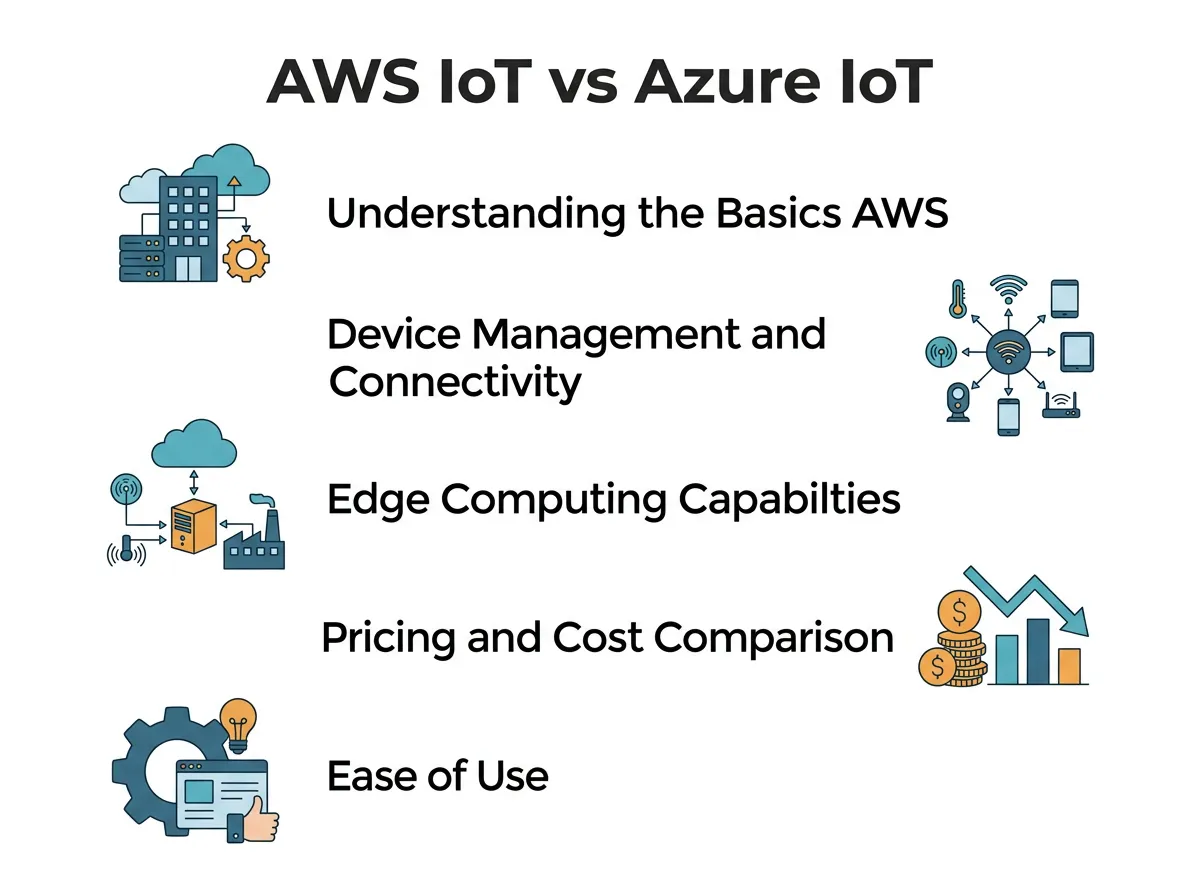
AWS IoT vs Azure IoT: Which Is Better? — key points at a glance
AWS IoT Core and Device Registry
AWS IoT Core uses a registry to keep track of all your connected things. It supports popular industry protocols like MQTT, HTTPS, and LoRaWAN. AWS makes it easy to create “Device Shadows.” A Device Shadow is a virtual version of your device. It stores the device’s state even when it is offline. When the device reconnects, the system syncs the data automatically. This is incredibly useful for remote sensors with shaky internet connections.
Azure IoT Hub and Device Provisioning
Azure IoT Hub offers stellar device management tools. Its Device Provisioning Service (DPS) is a standout feature. It allows you to register millions of devices automatically without human touch. Azure also uses “Device Twins,” which are very similar to AWS Device Shadows. However, Azure goes a step further by offering Azure IoT Central. This is a fully managed Software-as-a-Service (SaaS) portal that lets you manage devices with visual dashboards, requiring almost no coding.
Edge Computing Capabilities
Sometimes, sending every piece of data to the cloud is too slow or too expensive. That is why we use edge computing. Edge computing lets your devices process data locally. This is vital for self-driving cars, smart medical devices, or offshore oil rigs where milliseconds matter.
AWS IoT Greengrass
AWS IoT Greengrass brings cloud capabilities directly to local devices. It lets your local hardware run AWS Lambda functions, predict data trends using machine learning, and sync with the cloud when needed. Greengrass is highly customizable. You can write your own code in Python, Node.js, or C++ and deploy it easily to your edge devices.
Azure IoT Edge
Azure IoT Edge takes a different approach. It uses Docker containers to deploy services to the edge. This means you can pack your custom code, database systems, or artificial intelligence models into neat containers. You then deploy them directly to your hardware. This container-based system makes it very easy to move applications between the cloud and the edge without rewriting any code.
Pricing and Cost Comparison
Cost is often the deciding factor for many businesses. When analyzing AWS IoT vs Azure IoT, the pricing structures can look very different on your monthly bill. For a real-world scenario, you can read this detailed breakdown of what 10,000 devices actually cost on both platforms to understand the long-term financial commitment.
AWS Pay-As-You-Go Model
AWS IoT Core uses a granular, pay-as-you-go pricing model. You are charged based on the exact number of messages sent, the minutes your devices connect, and the registry actions you perform. This model is highly precise. If your devices send very little data, your bill will be tiny. However, if your devices chat constantly, your costs can spike unexpectedly. It requires careful monitoring to avoid bill shock.
Azure Tiered Hub Units
Azure IoT Hub uses a tiered subscription model based on “IoT Hub Units.” You purchase a specific tier (such as B1, S1, or S2) based on the daily message limit you expect to need. For example, a basic unit might allow 400,000 messages per day. This structure makes budgeting very simple. You know exactly what you will pay each month. However, if you exceed your daily limit, your messages might get blocked or delayed unless you upgrade to a larger tier.
Ease of Use and Developer Support
How easy are these platforms to use? If your team has to spend months in training, you lose time and money. Both cloud giants offer a broad range of cloud provider IoT products, but their workflows suit different developer styles.
The Developer Experience on AWS
AWS is a developer’s playground. It gives you raw, powerful blocks of services. You have complete control over how you build your system. However, this freedom comes with a steep learning curve. The AWS Console can feel overwhelming for beginners. You will need experienced cloud engineers to configure permissions, roles, and networking rules correctly.
The Developer Experience on Azure
Azure focuses heavily on developer comfort and quick setup. If your team already knows C#, Visual Studio, and Windows, they will feel right at home. Azure IoT Central is perfect for fast prototyping. It provides ready-made templates for industries like retail, energy, and healthcare. You can get a working proof-of-concept running in hours rather than weeks.
Security and Compliance
Security is not optional when it comes to physical devices. A hacked smart lock or medical monitor can have severe real-world consequences. Fortunately, both Amazon and Microsoft take security very seriously. They protect your data from the physical device all the way to the cloud database.
AWS secures its system using Identity and Access Management (IAM) roles, X.509 certificates, and custom authorizers. You can set very strict policies for each individual device. Azure utilizes a similar approach with its Device Provisioning Service and support for X.509 certificates. Azure also integrates with Microsoft Defender for IoT. This service continuously scans your network for strange behavior or security threats. Both platforms meet strict global compliance standards, making them safe for healthcare, finance, and industrial applications.
Which Is Better for Your Business?
Now we return to the big question: AWS IoT vs Azure IoT: Which Is Better? The answer depends entirely on your current setup and future business goals.
AWS IoT is the better choice if you want maximum flexibility, already use other AWS services, and have a team of skilled cloud developers. It lets you customize every single layer of your architecture.
Azure IoT is the better choice if you want to launch quickly, need predictable monthly pricing, or are already heavily invested in the Microsoft ecosystem. Its out-of-the-box templates and managed services save valuable time.
Whichever path you choose, both platforms provide the reliable, secure, and powerful foundation you need to bring your hardware to life. Start with a small pilot project on both clouds to see which interface feels right for your team.
Frequently Asked Questions
Is AWS IoT cheaper than Azure IoT?
It depends on how your devices communicate. AWS uses a pay-as-you-go model that is cheaper for devices with low message frequency, while Azure uses tiered pricing which is more predictable and cost-effective for high-volume, constant messaging.
Can I use Azure IoT with Linux devices?
Yes, absolutely. While Azure is a Microsoft product, Azure IoT Edge and Azure IoT SDKs fully support Linux, Windows, and various real-time operating systems (RTOS).
What is the difference between AWS Device Shadows and Azure Device Twins?
They serve the same basic purpose of keeping a virtual record of a device’s state. AWS Device Shadows sync the actual and desired state of a device, while Azure Device Twins use a slightly different JSON document structure to track properties and configurations.
Do I need coding experience to use these platforms?
AWS IoT requires comfortable coding knowledge to set up rules and services. Azure IoT offers Azure IoT Central, which is a low-code/no-code SaaS platform that allows you to manage devices using a visual web interface.
Which platform is better for machine learning at the edge?
Both are excellent, but they use different delivery methods. AWS Greengrass lets you run local Lambda functions and machine learning models, while Azure IoT Edge deploys models inside Docker containers, making container management slightly cleaner.
Can I migrate from AWS IoT to Azure IoT later?
Yes, you can migrate, but it requires significant effort. Since both platforms use different SDKs, registry formats, and APIs, you will need to rewrite your device firmware and update your cloud integration code.
