


For long-distance wired communication in IoT, RS-485 and Industrial Ethernet with fiber optics are the absolute best solutions. RS-485 excels in noise-heavy industrial areas over distances up to 4,000 feet, while fiber optic Ethernet offers unmatched speed for data-heavy systems. Choosing the right setup depends on your specific bandwidth needs, environmental noise, and installation budget.
Imagine walking into a massive solar farm or a noisy factory floor. Thousands of smart sensors are tracking temperature, voltage, and movement. Wireless signals seem like an easy, modern choice for this setup. But thick concrete walls, heavy metal machines, and constant electrical hums can block those wireless signals instantly. When your systems must work without a single drop in connection, cables are still your best friend.
But what happens when your smart devices are miles apart? Standard cables like USB or basic HDMI simply will not work over long distances. To keep your network running smoothly, you must find a way to bridge these huge gaps. While many engineers look at connecting sensors through long-range wireless IoT, physical cables remain the ultimate choice for absolute stability. So, what is the best solution for long-distance wired communication in IoT?
In this guide, we will look at the most reliable wired technologies available today. We will break down how they work, where they shine, and how to choose the perfect one for your unique setup.
Key Takeaways
- RS-485 Is the Budget King: It supports long distances up to 1,200 meters and handles electrical noise incredibly well using simple twisted-pair cables.
- Fiber Optics Offer Maximum Speed: For high-bandwidth tasks over several miles, fiber optic cables deliver unmatched speed without electromagnetic interference.
- Industrial Ethernet Is Highly Scalable: When combined with repeaters or fiber media converters, Ethernet easily connects complex, data-heavy modern networks.
- Noise Immunity Matters: Always select shielded cables and proper grounding to protect your signals from industrial machines and power lines.
- Hybrid Systems Work Best: Combining a strong wired backbone with short-range wireless nodes often yields the most reliable overall IoT framework.
📑 Table of Contents
The Power of RS-485 in Challenging Environments
If you ask an industrial engineer about reliable wiring, they will likely mention RS-485 right away. This standard has been around for decades, and it is still one of the most reliable options for smart networks. It is cheap, tough, and can run up to 4,000 feet (1,200 meters) without needing a signal booster.
Why Differential Signaling Matters
RS-485 uses a clever trick called differential signaling to fight off electrical noise. Instead of sending a signal down a single wire, it sends the same signal down two different wires. One wire carries a positive voltage, and the other carries a negative voltage. When electrical noise hits the cable, it affects both wires equally. The receiving device only looks at the difference between the two wires, which completely cancels out the noise. This makes it perfect for busy factories filled with heavy motors and power lines.
Distances and Speeds You Can Expect
With RS-485, you get a direct trade-off between speed and distance. If you need to send data over the full 4,000 feet, your speed will top out at around 100 kilobits per second (kbps). This is plenty of speed for reading simple sensor data, like temperature or pressure. If you shorten the cable to 40 feet, you can reach speeds up to 10 megabits per second (Mbps). This flexibility makes it a staple for smart buildings and grid monitoring.
Ethernet and Fiber Optics for High-Bandwidth Needs
Sometimes, simple sensor data is not enough. If your IoT devices need to send high-definition video, audio, or real-time control commands, RS-485 will be too slow. This is where Ethernet steps in as a heavy hitter, especially when you are deciding on which network is suitable for IoT wireless or wired systems.
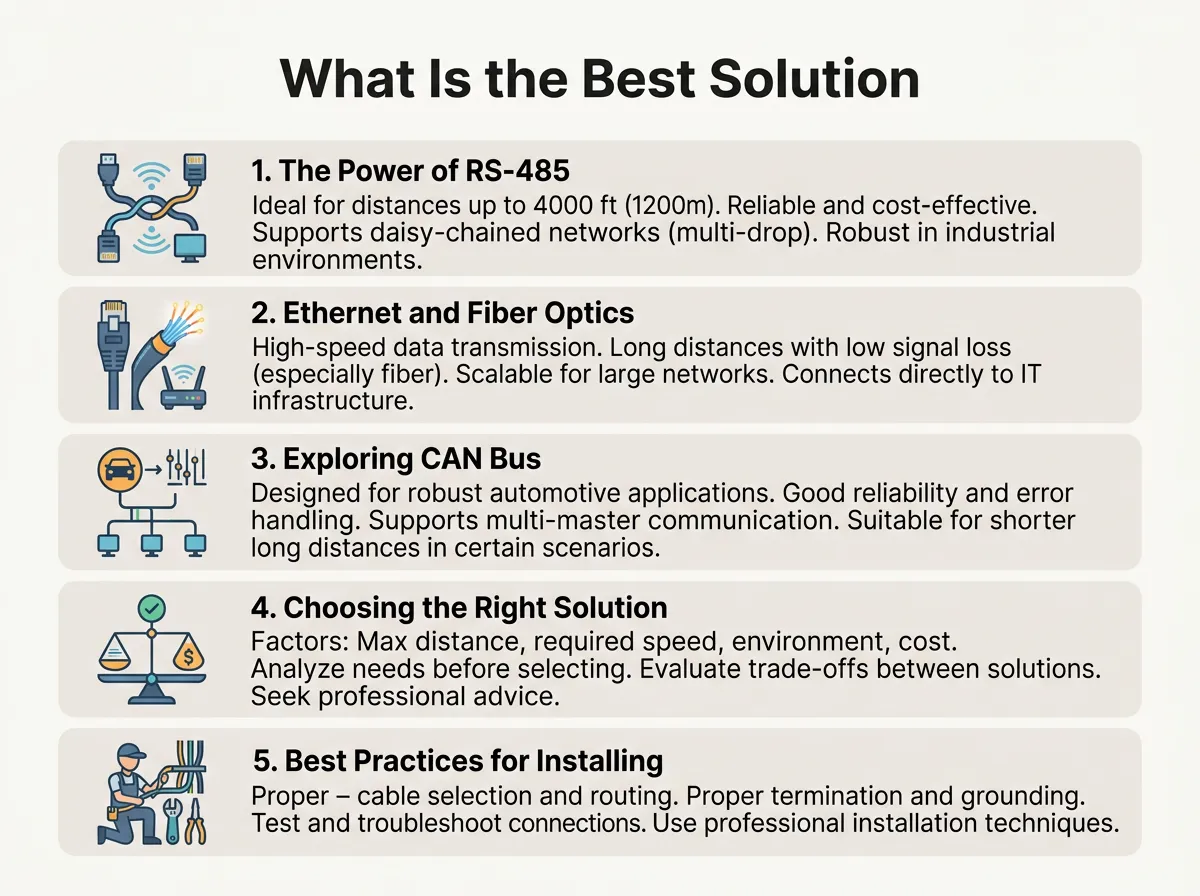
What Is the Best Solution for Long-Distance Wired Communication in IoT? — key points at a glance
When Standard Ethernet Falls Short
Standard copper Ethernet cables (like Cat5e or Cat6) are great for homes and offices. However, they have a strict physical limit of 328 feet (100 meters). If you try to run them any farther, the signal fades away, and your data gets lost. To solve this over long distances, you either need to install active network switches every 100 meters, or you need to upgrade your cabling material.
Fiber Optics for Ultimate Range and Speed
When you need to cross miles instead of feet, fiber optic cables are the gold standard. Fiber optics use light pulses instead of electrical currents to carry data. This means they are completely immune to electromagnetic noise. Single-mode fiber cables can easily carry gigabit speeds over distances of 25 miles (40 kilometers) without any signal loss. This makes fiber optics the clear winner when asking: What Is the Best Solution for Long-Distance Wired Communication in IoT for high-speed data?
Exploring CAN Bus and Fieldbus Options
Aside from RS-485 and Ethernet, there are other specialized wired protocols designed for tough environments. These systems are highly structured and work beautifully when you have many devices talking on the same wire.
CAN Bus for Robust Data Sharing
Originally designed for cars, the Controller Area Network (CAN) bus is now highly popular in industrial IoT. It allows multiple microcontrollers to talk to each other without a central computer. CAN bus can cover distances up to 1,000 meters at lower speeds. Its main benefit is its extreme reliability and built-in error handling. If a collision occurs on the wire, the system automatically prioritizes the most important message.
Modbus and Profibus Systems
If you want to know which software protocols run on top of your physical wires, you should look at the protocols used for long-distance communication in IoT. Modbus is highly popular because it works smoothly over RS-485. It lets one master device read data from hundreds of slave sensors along a single line. Profibus is another robust option that is widely used in European manufacturing plants for high-speed factory automation.
Choosing the Right Solution for Your Project
Every IoT project has its own unique challenges. To find the right fit, you must weigh your technical needs against your budget limits. When deciding what is the best solution for long-distance wired communication in IoT for your project, keep these key factors in mind.
Bandwidth vs. Distance
First, look at how much data your sensors actually send. Do they only send a tiny text file once an hour? If so, a simple RS-485 network is perfect. Do you have security cameras or live vibration monitors? You will need the high bandwidth of fiber optic Ethernet. Remember, as a general rule, the farther the signal travels, the harder it is to maintain high speeds over copper wires.
Noise, Heat, and Physical Barriers
Next, study your environment. If your cables must run alongside high-voltage power lines or heavy welding gear, copper cables can act like antennas for noise. In these high-interference zones, fiber optics are worth every penny because they use light instead of electricity. Also, make sure to buy cables rated for outdoor use, extreme heat, or moisture if you plan to bury them underground.
Best Practices for Installing Long-Distance Wired IoT
Even the best cable will fail if it is installed poorly. Following a few simple guidelines can save you hours of troubleshooting down the road. It ensures your long-distance wired communication in IoT works perfectly from day one.
Proper Shielding and Grounding
Always use Shielded Twisted Pair (STP) cables instead of Unshielded Twisted Pair (UTP) when working with copper over long runs. The metal shield blocks outside electrical noise from reaching the copper wires inside. Additionally, make sure to ground your cables at only one end. Grounding both ends can create a ground loop, which actually introduces more noise into your system.
Daisy-Chaining vs. Star Topologies
How you connect your devices matters. RS-485 works best when you daisy-chain devices together in a straight line, one after another. Ethernet, on the other hand, relies on a star topology, where every device plugs into a central switch. Daisy-chaining saves on cable costs but can be harder to troubleshoot if a single device in the middle fails. Star topologies require more cable but keep the rest of your network online if one device drops off.
Conclusion
When it comes to building a rock-solid, long-range network, there is no single option that fits every project. If you need a cheap, reliable, and noise-tolerant system for simple sensors, RS-485 is incredibly tough to beat. However, if your project demands lightning-fast speeds and high-definition data over several miles, investing in fiber optic Ethernet is your smartest move.
By carefully checking your bandwidth needs, environmental noise, and physical layout, you can easily answer: What Is the Best Solution for Long-Distance Wired Communication in IoT? With the right cables in place, your smart network will stay connected, safe, and lightning-fast for years to come.
Frequently Asked Questions
What is the maximum distance for RS-485 communication?
RS-485 can reliably transmit data up to 4,000 feet (1,200 meters) without a signal repeater. However, as the distance increases, the maximum data transfer rate drops to around 100 kbps.
Can I use standard Ethernet cables for long-distance IoT?
Standard copper Ethernet cables are limited to a maximum length of 328 feet (100 meters). For longer distances, you will need to use fiber optic cables or install active network switches to boost the signal.
Why are fiber optic cables immune to electrical noise?
Fiber optic cables use light pulses instead of electrical currents to send data through glass fibers. Because there is no electrical current, magnetic fields and high-voltage power lines cannot interfere with the signal.
What is the difference between RS-485 and CAN Bus?
RS-485 is a physical layer standard that is great for simple master-slave setups over long distances. CAN Bus is a complete protocol that allows multiple devices to talk at once with built-in error handling, making it ideal for automotive and complex industrial use.
How does differential signaling help reduce cable noise?
Differential signaling sends the same signal over two different wires with opposite polarities. Since external electrical noise affects both wires equally, the receiver can easily subtract the noise by looking only at the difference between the two signals.
Is wired communication safer than wireless for IoT?
Yes, wired connections are generally much safer than wireless options. Physical cables are much harder for hackers to intercept or jam from a distance, making them ideal for secure industrial setups.
