


Choosing the right platform depends entirely on your specific project goals. ThingsBoard is the top choice for enterprise data visualization, while Home Assistant is the gold standard for smart home automation. Ultimately, the best open-source IoT platform balances ease of use, robust security, and active community support.
Imagine you want to build a smart device. Maybe you want to track the moisture level in your garden soil. Or perhaps you want to control your living room lights automatically. You buy a small sensor and a tiny computer like a Raspberry Pi. You connect them together. But then you hit a wall. How do you actually view the data? How do you send commands to your device? This is where an internet of things (IoT) platform comes into play. It acts as the brain of your entire smart system.
The search for the right tool can feel overwhelming. There are dozens of choices available today. Many developers ask: What Is the Best Open-Source IoT Platform? In this guide, we will break down the top choices. We will look at their features, their pros, and their cons. By the end, you will know exactly which platform fits your project.
We will explore everything from simple home setups to massive industrial networks. You will learn about key features to look for. We will also share practical tips to make your first project a success. Let us dive in and explore the exciting world of open-source IoT.
Key Takeaways
- ThingsBoard leads in data visualization: It is the best choice for complex dashboards and enterprise-level scale.
- Home Assistant dominates smart homes: It offers unmatched local control and supports thousands of smart home devices.
- OpenRemote is built for smart cities: It excels at asset management, geographic tracking, and large public systems.
- Thinger.io offers lightweight performance: It is perfect for fast setups on small microcontrollers like Arduino and ESP32.
- Open-source saves money and protects privacy: Hosting your own platform keeps your sensitive data safe and avoids monthly fees.
📑 Table of Contents
Why Choose an Open-Source IoT Platform?
Before we look at the specific options, let us discuss why open-source is so popular. When you build smart systems, you want freedom. Open-source software gives you that freedom. You do not have to worry about sudden price hikes or restrictive rules. You can run the software on your own computer, a local server, or a cloud provider of your choice.
Complete Control and Privacy
When you use a closed, proprietary platform, your data lives on someone else’s servers. With an open-source tool, you keep your data safe under your own roof. You decide who can see your information. This is very important for private homes and security-minded businesses alike.
No Vendor Lock-in
What happens if a cloud company goes out of business? Your smart devices could stop working overnight. Open-source tools prevent this issue completely. You own the code and the setup. You can keep using your system forever, even without an active internet connection.
Big Cost Savings
Many commercial IoT clouds charge you for every single message your devices send. If you have many sensors, this can get expensive very fast. Open-source platforms are free to download. You only pay for the hardware or hosting you choose to use. This makes them highly cost-effective.
The Top Contenders: What Is the Best Open-Source IoT Platform?
Now, let us answer the big question. What Is the Best Open-Source IoT Platform for your needs? There is no single answer for everyone. The right choice depends on your specific goals. Here are the leading platforms you should consider today.
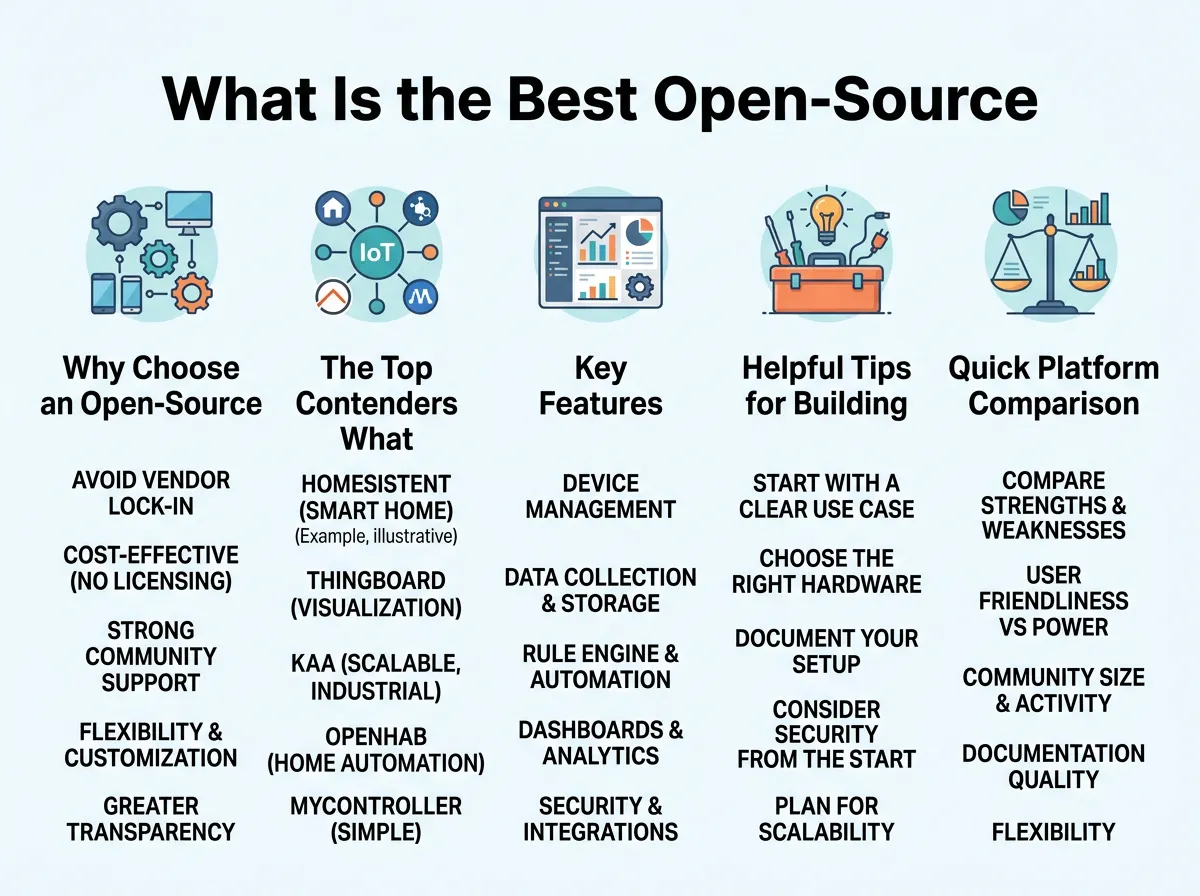
What Is the Best Open-Source IoT Platform? — key points at a glance
ThingsBoard: Best for Enterprise Data and Analytics
If you need beautiful dashboards and heavy data analysis, look no further than ThingsBoard. It is a highly popular option for good reason. It lets you collect, analyze, and show data from your devices in real-time. You can build custom dashboards with drag-and-drop widgets without writing complex code. It supports top communication protocols like MQTT, CoAP, and HTTP. If you want to check out the source code directly, you can browse the official ThingsBoard GitHub repository for more technical details.
ThingsBoard is great for big projects. It can scale to millions of connected devices easily. However, it can be a bit hard to learn at first. The setup process requires some basic technical knowledge of databases and servers. But once you get it running, it is incredibly powerful and reliable.
Home Assistant: Best for Local Smart Homes
Are you building a smart home? If so, Home Assistant is the absolute best choice. It focuses entirely on local control and user privacy. It supports thousands of smart devices out of the box. You can connect smart lights, switches, media players, and temperature sensors with ease.
Home Assistant has a massive and friendly community. They release updates and new features every single month. It is very easy to install on a simple Raspberry Pi. The user interface is clean, modern, and highly customizable. If your goal is home automation, this is the platform to choose.
OpenRemote: Best for Asset Management and Smart Cities
For smart cities, geographic tracking, and large-scale industrial projects, OpenRemote is a fantastic option. It helps you connect different systems into a single dashboard. It has an excellent rule engine for automating complex tasks. You can track moving vehicles on a map, manage smart energy grids, or control city streetlights. It is a bit too complex for a simple home project, but it shines bright in professional settings.
Thinger.io: Best for Quick and Lightweight Setups
If you want a lightweight solution, consider Thinger.io. It is extremely fast and very easy to set up. It works wonderfully with small microcontrollers like the ESP8266, ESP32, or Arduino. You can deploy your own instance in just a few minutes. It is perfect for hobbyists and students who want to get a project up and running quickly without complex server management.
Key Features of a Great IoT Platform
When you are choosing the best open-source IoT platform for development, you must check a few important features. Do not just pick the most popular option on the list. Think about what your devices actually need to do.
Support for MQTT and Other Protocols
Your platform must speak the same language as your devices. Look for tools that support MQTT. MQTT is the standard protocol for smart devices because it uses very little power and data. HTTP is also useful for simple web requests, while CoAP is great for constrained devices with limited memory.
Visual Rule Engines
Data is only useful if you can act on it. A good platform has a strong rule engine. For example, if a moisture sensor detects dry soil, the platform should turn on your garden water pump. Look for visual rule builders. They make setting up these smart automations much easier for beginners.
Easy User Management
Will other people use your system? You might need different levels of access. For instance, you want your family to control the living room lights, but you do not want them to change the main system settings. Look for platforms that offer robust, role-based access control.
Helpful Tips for Building Your First System
Starting your first IoT project can feel a bit scary. Here are a few practical tips to help you succeed from day one.
- Start with a single device: Do not try to connect your entire house or office at once. Start with one simple temperature sensor and get it working first.
- Use standard hardware: Buy popular microcontrollers like the ESP32. They are cheap, reliable, and have thousands of free guides available online.
- Keep security in mind: Even on a private home network, change all default passwords immediately. Use secure protocols like HTTPS and MQTTS whenever possible.
- Backup your configuration: If you run your server on a Raspberry Pi, back up your files regularly. SD cards can wear out and fail over time.
Quick Platform Comparison
To help you decide, let us quickly compare our top choices. If you want high-end charts, deep analytics, and business-focused features, ThingsBoard is the clear winner. For smart homes, Home Assistant has no true rival. If you want a lightweight and fast tool for microcontrollers, Thinger.io is your best bet. Finally, for smart cities and asset tracking, OpenRemote is the strongest tool.
Take some time to think about your ultimate goals. You can always try more than one tool. Since they are open-source, they are free to download and test. This makes it easy and fun to find your perfect match.
Conclusion
Finding the final answer to “What Is the Best Open-Source IoT Platform?” depends entirely on your specific project. If you are building an enterprise application with heavy data needs, go with ThingsBoard. If you are automating your home, Home Assistant is the ultimate tool. For simple hobby projects, Thinger.io will save you time and effort.
The best part of the open-source world is the freedom to experiment. Download a platform today, connect a simple sensor, and start building your smart future!
Frequently Asked Questions
What is an open-source IoT platform?
An open-source IoT platform is software that helps you connect, manage, and analyze smart devices. Because the source code is public, you can download, modify, and host it on your own servers for free.
Can I host an open-source IoT platform at home?
Yes, you can easily host platforms like Home Assistant or ThingsBoard at home. Many hobbyists run these platforms on a cheap Raspberry Pi or an old computer.
Is ThingsBoard free to use?
Yes, ThingsBoard offers a Community Edition that is completely open-source and free to use. They also offer a paid Professional Edition with extra enterprise features.
Which platform is best for smart homes?
Home Assistant is widely considered the best open-source platform for smart homes. It supports thousands of devices and focuses heavily on local privacy and control.
Do I need to know how to code to use these platforms?
Not necessarily. While some coding knowledge helps for advanced setups, platforms like Home Assistant and ThingsBoard offer visual dashboards and drag-and-drop tools for beginners.
What is the most popular IoT communication protocol?
MQTT is the most popular protocol for IoT communication. It is lightweight, uses very little power, and is supported by almost every open-source IoT platform.
