


The most reliable IoT eSIM is one that offers multi-network failover, eUICC compliance, and robust global coverage through top-tier providers like FloLive, Onomondo, or Pelion. To ensure maximum uptime, look for an eSIM that automatically switches to the strongest local carrier without physical swapping. Ultimately, true reliability depends on your specific geographic footprint and the remote provisioning capabilities of your connectivity management platform.
Imagine deploying hundreds of smart sensors across a busy city or a remote forest. Suddenly, one of your devices goes dark. You realize the local carrier just dropped its signal. Now, your device is stuck offline, unable to send critical data. This is a costly nightmare for any business that relies on connected hardware.
In the world of connected devices, keeping your hardware online is everything. This is where modern SIM technology comes into play. Many fleet managers and developers ask themselves: what is the most reliable IoT eSIM for my specific business needs? The answer is not always a single brand, but rather a set of features that keep your devices connected anywhere in the world.
In this guide, we will break down what makes an eSIM reliable. We will look at top providers, compare critical features, and help you choose the best fit for your projects. Let us dive in and explore the options together.
Key Takeaways
- Multi-Network Redundancy: A reliable IoT eSIM must support automatic failover to alternative local carriers when a signal drops.
- eUICC Compliance: Ensure your eSIM uses eUICC technology to allow over-the-air (OTA) updates and profile swaps without physical access.
- Carrier Agnostic: The best eSIM providers do not lock you into a single mobile network operator, giving you maximum flexibility.
- Global Coverage: Look for solutions that comply with permanent roaming laws in strict regions like Brazil and Turkey.
- Centralized Management: A robust connectivity management platform is crucial for monitoring data usage and troubleshooting devices remotely.
📑 Table of Contents
What Makes an eSIM Reliable?
To find the most reliable IoT eSIM, we first need to understand what reliability actually means in the IoT space. It is not just about having a strong signal in one city. It is about how the SIM behaves when things go wrong. A truly reliable eSIM keeps your devices connected through changing network landscapes, carrier outages, and geographic moves.
Network Redundancy and Auto-Switching
The core feature of a reliable IoT eSIM is network redundancy. Traditional SIM cards tie you to one specific carrier. If that carrier has an outage, your device dies. A high-quality eSIM holds multiple carrier profiles. If the primary network fades, the eSIM automatically switches to the next strongest network. This process happens in seconds without any human intervention. This auto-switching capability keeps your data flowing smoothly.
True eUICC Capability
You cannot talk about eSIM reliability without mentioning eUICC. This stands for Embedded Universal Integrated Circuit Card. It is the software technology that allows you to change carrier profiles over the air. Understanding the eUICC SIM technology benefits is key to future-proofing your business. With eUICC, you do not need to physically swap plastic cards when you change network providers. You simply send a digital update to the device, saving you thousands of dollars in maintenance costs.
The Core Benefits of a Reliable IoT eSIM
Switching to a modern eSIM solution offers major advantages over legacy plastic SIM cards. Let us look at why businesses are making the switch for their smart device deployments.
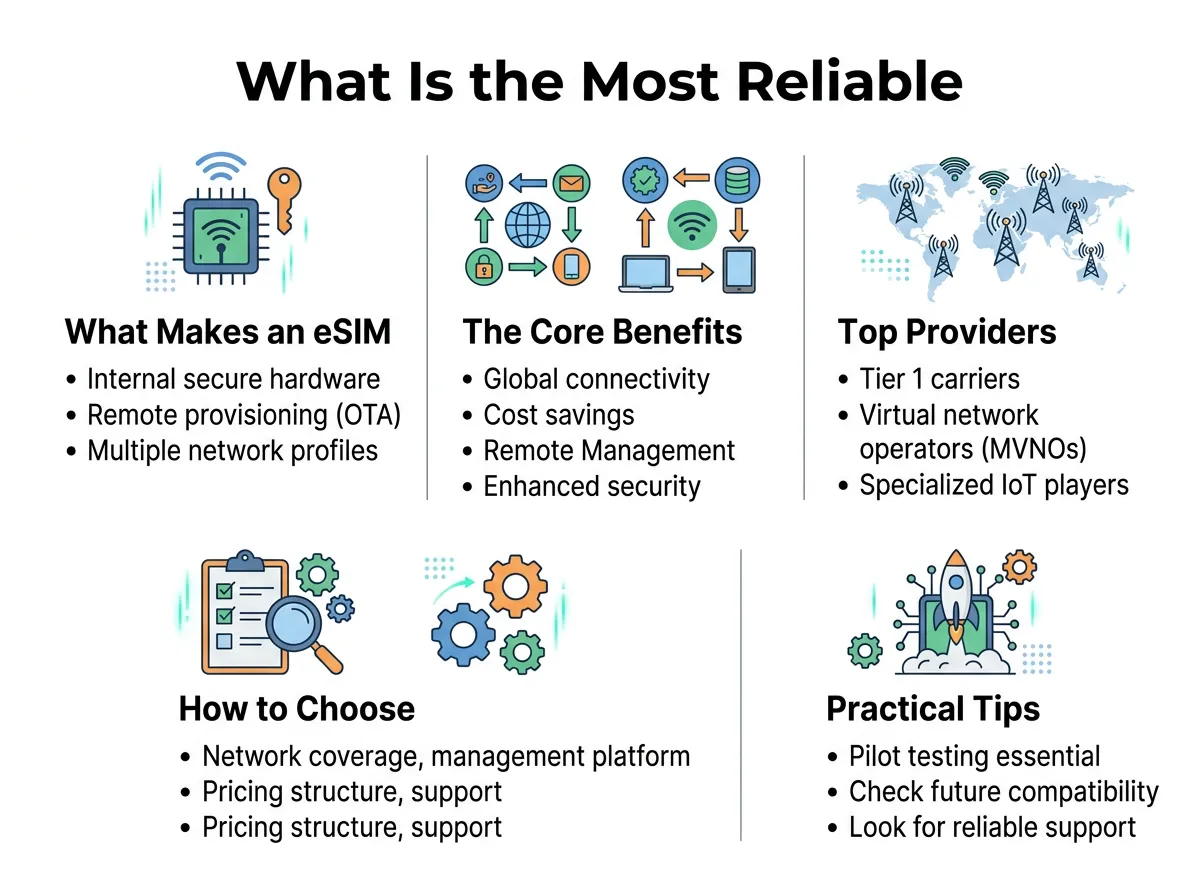
What Is the Most Reliable IoT eSIM? — key points at a glance
Lower Total Cost of Ownership
Sending a technician into the field to replace a physical SIM card is expensive. If you have devices deployed across the globe, it is almost impossible. A reliable IoT eSIM removes this logistical headache entirely. You manage everything from a single digital screen. By streamlining your updates, you lower your long-term operational costs significantly.
Enhanced Security and Provisioning
Security is a massive concern for any connected fleet. Modern eSIMs offer secure, encrypted channels for updating profiles. This prevents unauthorized users from tampering with your connection. Industry experts often highlight the eSIM role in provisioning and security as a primary driver for enterprise adoption. It protects your data from the chip level all the way to the cloud.
Top Providers in the IoT eSIM Space
Several providers offer top-tier eSIM solutions. Each has unique strengths depending on your scale and geographic focus. Let us examine some of the most reliable options available today.
Onomondo
Onomondo is famous for its unique virtualized core network. Instead of relying on traditional roaming agreements, Onomondo connects directly to local networks worldwide. This approach bypasses many common roaming issues. It gives you faster connection speeds and lower latency. Their platform is highly praised among businesses looking for connectivity providers for large fleets because of its deep network control.
FloLive
FloLive offers a highly localized global network. They solve the issue of permanent roaming restrictions by using a local IMSI library. This means your devices appear as local devices to networks in different countries. If you deploy devices in countries with strict cellular laws, FloLive is an incredibly reliable choice.
Pelion
Pelion provides a highly secure and scalable connectivity platform. They focus on making device management as simple as possible. Their partnership with global carriers ensures that you get excellent coverage wherever you deploy. Reviewing list of the top-rated IoT eSIM providers often places Pelion near the top for enterprise-grade security and support.
Things Mobile
For smaller deployments or startups, Things Mobile offers a highly accessible entry point. They provide flexible pay-as-you-go pricing models. While they might lack some of the advanced enterprise features of Onomondo or Pelion, their network coverage is vast and dependable for growing projects.
How to Choose the Best eSIM for Your Needs
Finding the most reliable IoT eSIM requires looking closely at your specific business goals. No two IoT projects are exactly alike. Here is how you can evaluate your options.
Analyze Your Geographic Footprint
Where will your devices live? If they stay in one country, you might only need a simple multi-carrier SIM. But if your hardware travels across international borders, you need an eSIM with robust global agreements. Check if the provider has local partnerships in your target regions to avoid high roaming fees.
Evaluate the Management Software
A reliable network is nothing without a good management platform. Your team needs to monitor data usage, activate new devices, and troubleshoot connection issues in real-time. Look for a platform with an intuitive user interface and a powerful API. This allows you to integrate connectivity data directly into your own software tools.
Consider Power Consumption
Many IoT devices run on batteries and must last for years. Your eSIM should support low-power cellular standards like LTE-M and NB-IoT. These technologies allow your devices to send data using very little power, extending the lifetime of your hardware in the field.
Practical Tips for a Successful eSIM Deployment
Before you purchase thousands of eSIMs, keep these practical tips in mind to ensure a smooth rollout:
- Run a Pilot Test: Always test a small batch of eSIMs in your target environment. This helps you identify any coverage dead zones or hardware compatibility issues before a full launch.
- Understand Local Regulations: Some countries, like Brazil and India, have strict rules regarding permanent roaming. Choose a provider that can offer local profiles in those regions.
- Monitor Latency: If your devices require real-time data transmission, test the connection latency. Virtualized core networks often provide much lower latency than traditional roaming.
Conclusion
In the search for the most reliable IoT eSIM, there is no one-size-fits-all answer. However, the most dependable options always combine eUICC technology, automatic network failover, and a powerful management platform. By choosing a carrier-agnostic provider like Onomondo, FloLive, or Pelion, you can build a resilient IoT network that keeps your business running smoothly for years to come. Take the time to analyze your coverage needs, test your hardware, and select a partner that can grow with your business.
Frequently Asked Questions
What is an IoT eSIM?
An IoT eSIM is an embedded SIM card that allows devices to connect to cellular networks without using a physical plastic card. It supports over-the-air updates, enabling businesses to change network carriers remotely. This technology is essential for managing large-scale global device deployments efficiently.
How does automatic network failover work on an eSIM?
Automatic network failover occurs when the eSIM detects a weak signal from the primary carrier. It quickly searches its stored profiles and switches to an alternative local network with a stronger signal. This process keeps the device online without requiring any manual physical card changes.
Can I use an IoT eSIM anywhere in the world?
Yes, most high-quality IoT eSIMs support global roaming across hundreds of countries. However, you must check local regulations, as some nations like Brazil have strict permanent roaming laws. Reliable providers offer localized carrier profiles to bypass these regional restrictions legally.
What is the difference between eSIM and eUICC?
eSIM refers to the physical hardware chip embedded directly into the device’s circuit board. eUICC is the software technology running on that chip that allows remote carrier provisioning and multiple profiles. Together, they enable seamless over-the-air cellular network updates.
Are IoT eSIMs secure?
Yes, IoT eSIMs are highly secure because they are soldered directly onto the device hardware, making them tamper-proof. Additionally, remote profile provisioning uses advanced encryption standards to protect data. This prevents unauthorized access and secures your connection from the chip to the cloud.
How does an eSIM save business operational costs?
An eSIM saves money by eliminating the need for manual SIM card swaps when changing network providers. Businesses can update carrier profiles remotely over the air, which reduces truck rolls and maintenance visits. It also helps avoid expensive roaming charges by allowing local carrier profiles to be loaded dynamically.
