


The best SIM card for IoT devices is a multi-network roaming eSIM or M2M SIM that offers global coverage, flexible data plans, and centralized management. Unlike consumer SIMs, top IoT SIMs seamlessly switch between different carrier networks to prevent downtime. Choosing the right provider depends on your deployment scale, security needs, and geographic reach.
Imagine this scenario. You just launched a fleet of smart cargo trackers. They work perfectly in your office. But the moment they cross the state line, they go completely dark. Your dashboard shows zero data. You lose track of valuable shipments. Your customer is calling, and you have no answers. What went wrong?
In most cases, the culprit is a poor cellular connection. Many people think they can just pop a standard phone SIM into their smart devices. Sadly, this is a recipe for a massive headache. To make your smart devices work reliably, you need the right hardware. So, what is the best SIM card for IoT devices?
In this guide, we will break down the complex world of IoT cellular connectivity. We will look at how these cards differ from your phone’s SIM. We will explore the key features you must check. Finally, we will share practical tips to help you choose the perfect partner for your hardware. Let’s dive in!
Key Takeaways
- Multi-network roaming is essential: IoT devices need SIMs that switch carriers automatically to maintain a constant connection.
- Industrial-grade SIMs last longer: They withstand extreme temperatures and vibration better than standard plastic consumer SIMs.
- eSIMs offer ultimate flexibility: They allow you to change carriers remotely without physically swapping plastic cards.
- Platform management saves time: Look for vendors providing a central platform to monitor data usage and manage SIM status.
- Security features protect data: Top-tier IoT SIMs offer private APNs and VPN support to keep your device traffic safe.
- Plan scaling matters: Choose a provider that lets you pool data across your fleet to avoid expensive overage fees.
📑 Table of Contents
Understanding IoT SIMs vs. Consumer SIMs
To find the right fit, you must first understand what makes an IoT SIM different from a normal one. They might look identical on the outside. However, they act very differently on the inside.
The Core Differences
Your personal smartphone uses a consumer SIM. This card is built for high data usage like streaming videos and browsing social media. It connects to one specific carrier network. If you lose signal from that carrier, your phone goes offline. In contrast, an IoT SIM is built for machine-to-machine (M2M) communication. These devices often send tiny bits of data at set times. They need to connect to whatever network is strongest at that moment.
Why Consumer SIMs Fail in IoT
Using a consumer card in a commercial device is risky. First, carriers often block consumer cards if they detect automated M2M traffic. Second, consumer cards lack global roaming flexibility. Third, standard plastic cards melt or crack in extreme conditions. If your device sits in a hot engine bay or a freezing field, a standard SIM will fail quickly.
Key Features to Look For
When shopping for cellular options, you cannot just look at the lowest price. You must evaluate the technical features that ensure your devices stay online. Let’s look at the most vital features.
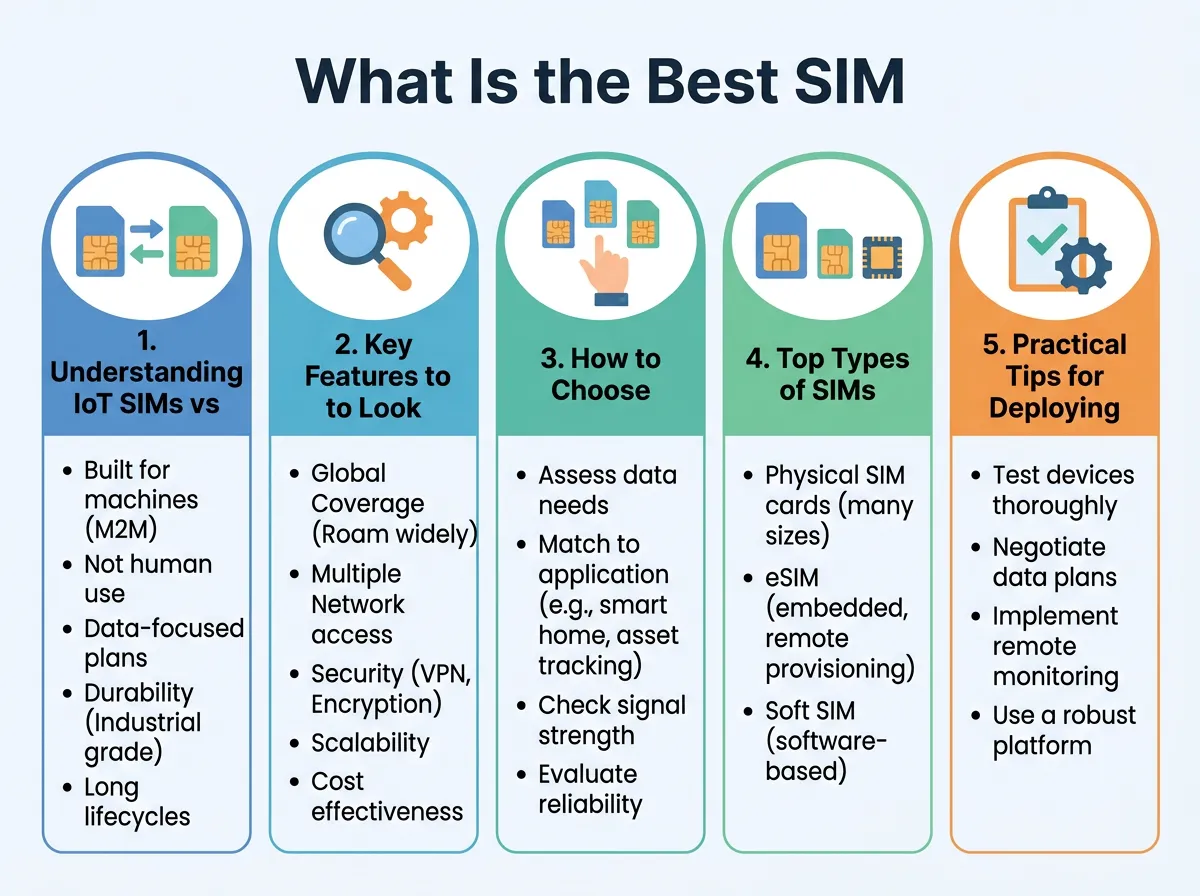
What Is the Best SIM Card for IoT Devices? — key points at a glance
Multi-Network Roaming
Your devices will move. Even if they stay in one place, local cell towers can fail. A great IoT SIM does not lock you into one network. Instead, it offers multi-network roaming. If Carrier A has a weak signal, the SIM automatically switches to Carrier B or C. This keeps your uptime close to 100%. To find the right partner, it helps to read about multi-network connectivity solutions that offer this safety net.
Form Factors: Standard, Industrial, and eSIM
SIM cards come in various physical styles. The standard plastic triple-cut SIM is fine for indoor, climate-controlled devices. But what if your hardware faces extreme cold, vibration, or moisture? For harsh conditions, you need an industrial-grade SIM. These are made of tougher materials and can handle temperatures from -40°C to 105°C.
There is also the embedded SIM, or eSIM (also called eUICC). An eSIM is soldered directly onto your device’s circuit board during manufacturing. It is tiny, waterproof, and impossible to steal. Plus, you can change your cellular provider over the air without swapping plastic cards. Understanding the history and physical development of SIMs helps you appreciate how these tiny chips became so durable and flexible.
How to Choose the Right Vendor for Your Scale
Choosing a cellular partner is about more than just buying plastic chips. It is about choosing a long-term business partner that can scale with you.
Assessing Management Platforms
How will you manage your cards? If you have five devices, you can track them manually. But what if you have five thousand? You need a robust connectivity management platform (CMP). This software lets you activate, pause, and monitor cards from a single screen. You can set up alerts to warn you if a device uses too much data. This prevents surprise bills. When you begin your search, take time to learn how to select the right provider for your business model.
Data Pricing and Pooling
Traditional phone plans charge you a flat fee per line. This does not work for IoT. Some of your devices might use 10 Kilobytes a month, while others use 10 Megabytes. Look for vendors that offer “data pooling.” This means all your devices share a single pool of data. If one device goes over its limit, it uses the leftover data from a device that stayed under. This saves you money and keeps your monthly expenses predictable.
Top Types of SIMs for Different IoT Use Cases
The best card for you depends entirely on what your hardware does. Let’s look at three common scenarios.
Tracking and Logistics
Asset trackers travel across borders, through tunnels, and over oceans. For this use case, you need a global roaming SIM. It should support multiple cellular bands like LTE-M or NB-IoT. These bands use very little power and can penetrate deep walls and metal shipping containers.
Smart Agriculture and Remote Sensing
Soil sensors and weather stations are placed in remote rural areas. They must survive extreme heat, rain, and snow. For these situations, industrial-grade eSIMs are the gold standard. They are sealed inside the device, protecting them from dirt and moisture.
Smart Cities and Infrastructure
For smart streetlights, security cameras, or utility meters, you are looking at large-scale deployments. These setups often require private networks to protect public data. You need a SIM vendor that offers private APNs (Access Point Names) and VPN setups. If you are preparing a massive rollout, you should research deploying connected devices at scale to avoid common pitfalls.
Practical Tips for Deploying IoT SIMs
Before you order thousands of cards, keep these practical tips in mind:
- Test before you buy: Always ask your vendor for a trial kit. Test the cards in the exact locations where your devices will operate.
- Monitor your data limits: Set up automated alerts. A buggy firmware update can cause a device to reboot and download massive amounts of data, leading to a shocking bill.
- Plan for the future: If you plan to expand internationally, choose a vendor with global coverage from day one. Swapping SIM cards later is incredibly expensive.
- Secure your devices: Change default passwords and block unneeded ports. A SIM card connects your hardware to the wider internet, making security vital.
Finding the Ultimate Winner
So, what is the best SIM card for IoT devices? There is no single brand that fits every single project. Instead, the best card is one that aligns with your specific needs.
If you want maximum flexibility, go with an eUICC-compatible eSIM. If you operate in harsh outdoor settings, choose an industrial M2M card. If your business depends on continuous uptime, look for a multi-network roaming card backed by a clean management platform. Take your time to test your hardware, plan your data needs, and choose a vendor that can grow with you. With the right connection, your smart devices will stay online, keeping your business running smoothly.
Frequently Asked Questions
Can I use a regular phone SIM card in an IoT device?
While a regular phone SIM might work temporarily, it is not recommended for IoT devices. Consumer SIMs lock you to a single carrier network and lack the physical durability required for harsh environments. Additionally, mobile operators may block your service if they detect automated machine-to-machine traffic on a consumer plan.
What is the difference between an IoT SIM and an M2M SIM?
There is essentially no difference, as the terms are often used interchangeably. Both IoT and M2M SIMs are designed to connect smart machines and sensors to the internet, rather than connecting human users. They both feature specialized pricing plans, global roaming features, and robust management portals.
What is an eSIM in IoT?
An eSIM, or eUICC, is a programmable chip that is soldered directly onto an IoT device’s circuit board during manufacturing. It allows you to update carrier profiles remotely over the air without physically swapping out a plastic card. This makes it ideal for global deployments and devices that are hard to reach physically.
How does multi-network roaming work for IoT?
Multi-network roaming allows your IoT SIM card to automatically detect and connect to the strongest available cellular signal in its area. If the primary network experiences an outage or drops in signal strength, the SIM seamlessly switches to an alternative local network. This keeps your smart devices connected with minimal downtime.
Why is industrial-grade hardware important for IoT SIMs?
Standard plastic SIM cards can easily melt, warp, or crack when exposed to extreme environmental conditions. Industrial-grade SIMs are manufactured with tougher, corrosion-resistant materials designed to withstand extreme temperatures and heavy vibrations. They are essential for outdoor, industrial, or automotive use cases.
What is a data pool in IoT pricing?
A data pool allows all the SIM cards in your IoT fleet to share a single, collective allowance of data. For example, if you have 100 devices that each get 10MB, you have a total pool of 1,000MB. If some devices use more data and others use less, the overages are balanced out automatically to prevent extra fees.
