


AWS IoT is the clear winner for most businesses because it offers a fully managed, native suite of IoT tools like AWS IoT Core and Greengrass. Google Cloud retired its native IoT Core service in 2023, meaning you must now rely on third-party partners or build your own pipeline using Google’s raw data tools. If you want an all-in-one, ready-to-go IoT platform, AWS is the best choice, but Google Cloud remains excellent for analyzing IoT data once it is collected.
Imagine you are building a smart home product. Or maybe you are setting up thousands of sensors across a massive factory floor. You need these physical devices to talk to the digital cloud. They must send data, receive updates, and stay secure. To do this, you need a strong cloud platform to act as the backbone of your project.
For years, developers have looked at the two biggest giants in cloud computing to solve this problem. When comparing these two giants, the big question is: Google Cloud IoT vs AWS IoT: Which Is Better? The answer used to be a close battle. However, recent changes in the tech landscape have shifted the ground beneath our feet. Choosing the right platform now requires looking at how each company approaches the internet of things today.
In this guide, we will break down both platforms in plain English. We will look at how they connect devices, how they handle data, and how much they cost. By the end, you will know exactly which cloud provider fits your business needs.
Key Takeaways
- Native Support: AWS offers a complete, active, and fully managed suite of native IoT services.
- Google’s Shift: Google Cloud retired its native IoT Core service in 2023, shifting to a partner-led model.
- Device Management: AWS IoT Greengrass and AWS IoT Core make managing millions of physical devices simple.
- Data Analytics: Google Cloud excels at processing and analyzing IoT data through BigQuery and AI tools.
- Pricing Models: Both use pay-as-you-go pricing, but AWS offers more predictable costs for device connectivity.
- Integration: AWS integrates smoothly with its own ecosystem, while Google requires connecting external partner platforms.
📑 Table of Contents
The Current State of Cloud IoT
Before we look at features, we must address a massive change in the industry. The way these two companies handle IoT is now very different. This change will likely make your decision much easier from the start.
AWS IoT: The Native Giant
Amazon Web Services (AWS) has doubled down on its native IoT tools. They offer a complete, in-house suite of services. This means AWS builds, maintains, and supports every tool you need to run your devices. You do not need to leave the AWS ecosystem to connect a device, manage its security, or send its data to a database.
Google Cloud: The Partner-Driven Approach
Google Cloud took a very different path. In August 2023, Google officially retired its native “IoT Core” service. Many developers were shocked by this move. Today, Google does not offer a direct, native tool to register and manage your physical devices. Instead, Google relies on trusted third-party partners like ClearBlade, KORE Wireless, and Litmus. These partners handle the device management, and then they send the data directly into Google’s powerful analytics tools.
Device Management and Connectivity
How easy is it to get your devices online and keep them healthy? This is the core task of any IoT platform. Let us compare how both giants handle device connection and management.
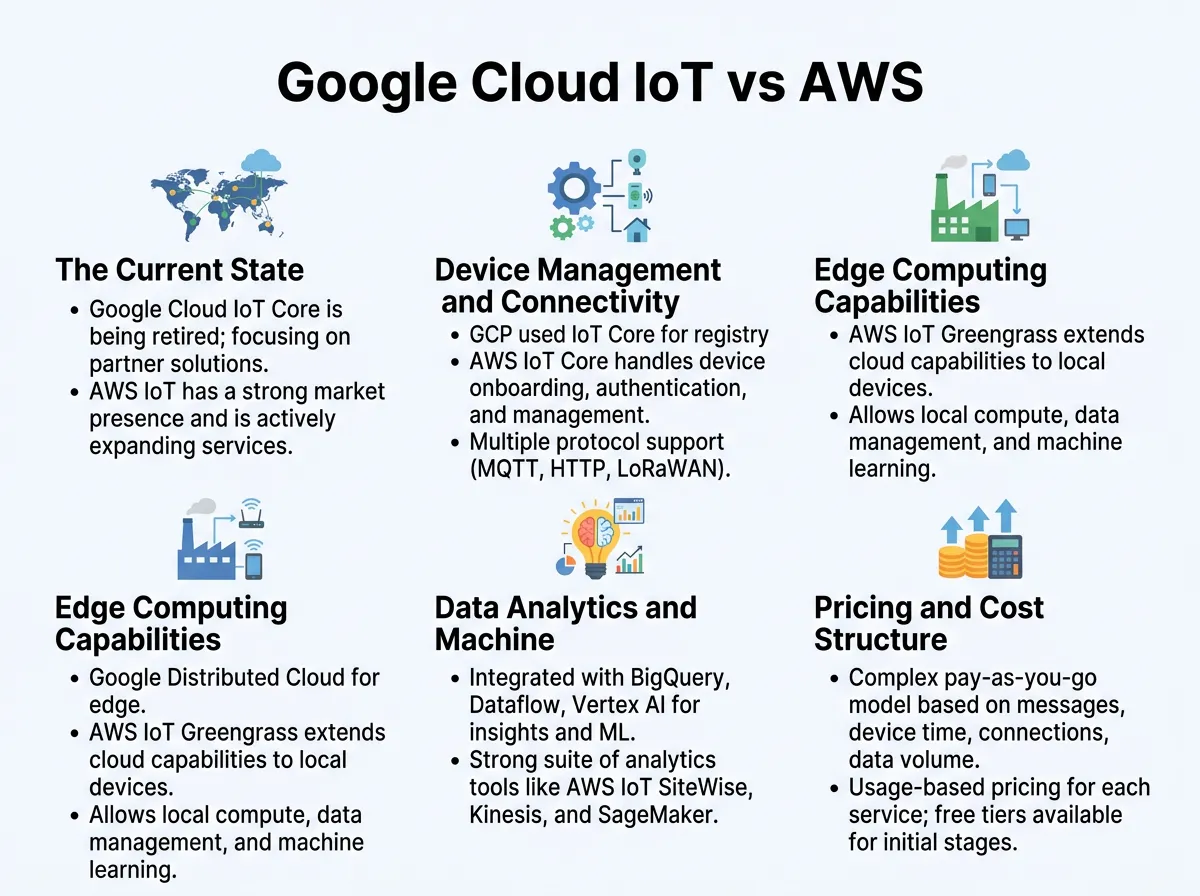
Google Cloud IoT vs AWS IoT: Which Is Better? — key points at a glance
How AWS Keeps Devices Online
AWS IoT Core is the heart of Amazon’s system. It lets you connect billions of devices without needing to manage any servers. It supports popular industry protocols like MQTT, HTTPS, and LoRaWAN. AWS also has a dedicated device registry. This registry acts as a digital inventory of every physical sensor you own. You can track device metadata, check connection status, and push security patches easily.
How Google Handles Devices Now
Since Google retired IoT Core, you cannot connect a device directly to a native Google IoT registry. Instead, you must use a partner platform. For example, if you use ClearBlade, you will register your devices in the ClearBlade console. ClearBlade then acts as the bridge. It packages your device data and streams it directly into Google Cloud Pub/Sub. While this extra step might sound annoying, Google’s partners have made this transition very smooth. It can actually save you time if you prefer using a specialized IoT interface.
Edge Computing Capabilities
Sometimes, your devices cannot wait for the cloud to respond. A self-driving delivery cart or a robotic arm needs to make decisions in milliseconds. This is where edge computing comes in. It lets your devices process data locally, right on the physical hardware.
AWS IoT Greengrass
AWS IoT Greengrass is an industry favorite for edge computing. It extends cloud capabilities to local devices. With Greengrass, your devices can run AWS Lambda functions, use machine learning models, and keep data sync’d even when they lose internet connection. It is highly mature, well-documented, and works on a huge variety of hardware.
Google Distributed Cloud and Edge AI
Google handles the edge through its Google Distributed Cloud and Edge AI tools. While they do not have a direct equivalent to Greengrass anymore, they offer incredible hardware integration. For example, Google’s Coral TPU chips allow you to run lightning-fast AI models directly on small devices. If your main goal is running smart computer vision at the edge, Google’s partner-backed hardware ecosystem is incredibly strong.
Data Analytics and Machine Learning
Collecting data is only half the battle. You also need to understand it. This is where the battle of Google Cloud IoT vs AWS IoT: Which Is Better? gets very interesting. This is Google’s home turf.
Google’s Data Analytics Superpowers
Google Cloud is famous for its data tools. Once your partner-led IoT network sends data into Google Cloud Pub/Sub, the magic begins. You can stream that data into BigQuery, which is arguably the best data warehouse on the planet. BigQuery lets you analyze petabytes of data in seconds using simple SQL. You can also feed this data into Vertex AI to build highly advanced machine learning models with very little effort. If your goal is deep data science, Google is hard to beat.
AWS Analytics Suite
AWS is certainly no slouch in this department. They offer AWS IoT Analytics, which is a fully managed service designed specifically to clean and enrich IoT data. For storing data, you can use Amazon S3 or Amazon Redshift. For machine learning, Amazon SageMaker is a powerful tool that helps you build and train models. While AWS tools are incredibly robust, they can sometimes feel more complex to set up and manage than Google’s streamlined data tools.
Pricing and Cost Structure
Both platforms use a pay-as-you-go pricing model. This means you only pay for what you use. However, the way they bill you is quite different.
Understanding AWS IoT Costs
AWS bills you based on the specific actions your devices take. You are charged for:
- The number of messages sent and received.
- The amount of time your devices stay connected.
- The number of rules triggered in the rules engine.
This model is highly predictable. If you know how often your devices send data, you can calculate your monthly bill with high accuracy.
Calculating Google Cloud IoT Expenses
Because Google relies on partners, your pricing will have two parts. First, you must pay the partner company (like ClearBlade) for device management and connection. Second, you pay Google Cloud for data ingestion (Pub/Sub), storage (BigQuery), and any machine learning tools you use. This two-part system can sometimes make budgeting a bit more complex, but it also gives you more flexibility to shop around for the best partner rates.
Making Your Decision
When asking yourself Google Cloud IoT vs AWS IoT: Which Is Better?, the right choice depends on your team’s skills and your project’s goals.
Choose AWS IoT If:
- You want an all-in-one, native solution managed by a single cloud provider.
- You need robust edge computing tools like Greengrass out of the box.
- Your team is already comfortable with the AWS ecosystem.
- You want a simple, single-vendor billing process.
Choose Google Cloud If:
- Your primary focus is advanced data analytics, artificial intelligence, and machine learning.
- You prefer using specialized, third-party software for device management.
- You already use BigQuery and Vertex AI for other parts of your business.
- You want to leverage Google’s world-class global network speed.
Conclusion
The debate between Google Cloud IoT vs AWS IoT: Which Is Better? used to be a feature-by-feature race. Today, it is a choice between two different philosophies. AWS offers a safe, powerful, and completely native home for your devices from start to finish. Google Cloud offers a highly flexible, partner-led model that connects your devices to the best data analysis tools in the world. Assess your team’s hardware experience and data needs today to make the right choice for your connected future.
Frequently Asked Questions
Did Google Cloud retire its IoT Core service?
Yes, Google officially retired its native IoT Core service in August 2023. Google now partners with third-party companies like ClearBlade and Litmus to handle device management and connectivity.
Is AWS IoT Core easy to use for beginners?
AWS IoT Core is highly powerful, but it has a steep learning curve. Beginners may find the interface complex, but AWS offers excellent documentation and pre-built templates to help you get started.
Can I still build an IoT project on Google Cloud?
Absolutely. You can use a Google partner platform to register and connect your physical devices, which then stream the data directly into Google’s native databases and analytics tools.
Which platform is better for edge computing?
AWS is generally better for edge computing because of AWS IoT Greengrass, a mature and native tool. Google relies on partner software and physical Coral TPU hardware to manage edge computing.
How does the pricing compare between AWS and Google Cloud IoT?
AWS charges you natively based on messages sent and connection time. Google Cloud requires you to pay a partner for device connections, plus standard Google fees for data storage and analysis.
Which cloud has better machine learning tools for IoT data?
Google Cloud is widely considered the leader in this area. Tools like BigQuery and Vertex AI make it incredibly easy to clean data, run queries, and build advanced AI models with your IoT data.
