

When comparing these two cloud giants, user reviews show that AWS IoT shines with its developer-friendly flexibility and deep integration into Amazon’s vast ecosystem. Meanwhile, Microsoft Azure IoT is highly praised for its enterprise-ready templates, stellar security tools, and seamless hybrid cloud setups. Ultimately, your choice depends on whether your team prefers the highly customizable building blocks of AWS or the structured, pre-built solutions of Azure.
Imagine you want to connect a million smart light bulbs to the internet. Or perhaps you want to track a fleet of delivery trucks across the globe. To do this, you need a safe and fast way for your devices to talk to the cloud. You need an Internet of Things (IoT) platform that can handle massive amounts of data without breaking a sweat.
This challenge brings most businesses to a major crossroads. They must choose between the two biggest names in the cloud space: Amazon Web Services (AWS) and Microsoft Azure. Both offer incredibly powerful IoT tools, but they approach the problem in very different ways.
In this guide, we will dive deep into the ultimate matchup. We will look at what real users say about usability, features, pricing, and support. By the end of this post, you will know exactly which platform fits your project best.
Key Takeaways
- Usability: Azure IoT is often rated higher for beginners due to its out-of-the-box templates, while AWS IoT offers ultimate flexibility for custom code.
- Security: Both platforms offer top-tier security, but Azure is highly praised for its enterprise-grade compliance and threat protection.
- Cost Structure: AWS IoT charges strictly by message count, which is great for small scales, whereas Azure IoT uses tiered pricing that can be more predictable for massive operations.
- Edge Computing: Both tools provide great edge features, with AWS Greengrass and Azure IoT Edge leading the market in offline device management.
- Ecosystem Fit: The best choice usually comes down to your existing tech stack; stick with what your team already knows.
📑 Table of Contents
The Core Landscape of Cloud IoT
Before we look at the reviews, let us look at the playing field. Both AWS and Azure have built massive systems to connect, manage, and secure smart devices. These platforms do not just collect data. They also help you analyze it, run machine learning models, and take action in real time.
According to reports on global IoT cloud market trends, these two providers dominate the enterprise space. AWS IoT Core is the foundation of Amazon’s IoT suite. It is built to be modular and highly scalable. Microsoft Azure IoT Hub is the heart of Azure’s suite. It focuses heavily on enterprise security and hybrid cloud setups.
While both platforms can achieve the same goals, their design philosophies are different. AWS feels like a box of high-quality building blocks. You can build anything you want, but you have to assemble it yourself. Azure feels more like a pre-assembled model kit. It is easier to get started, but it can be harder to customize in unique ways.
What Do Users Say About Ease of Use and Setup?
When you read through user feedback, usability is always a hot topic. How easy is it to connect your first device? How fast can your team build a working prototype?
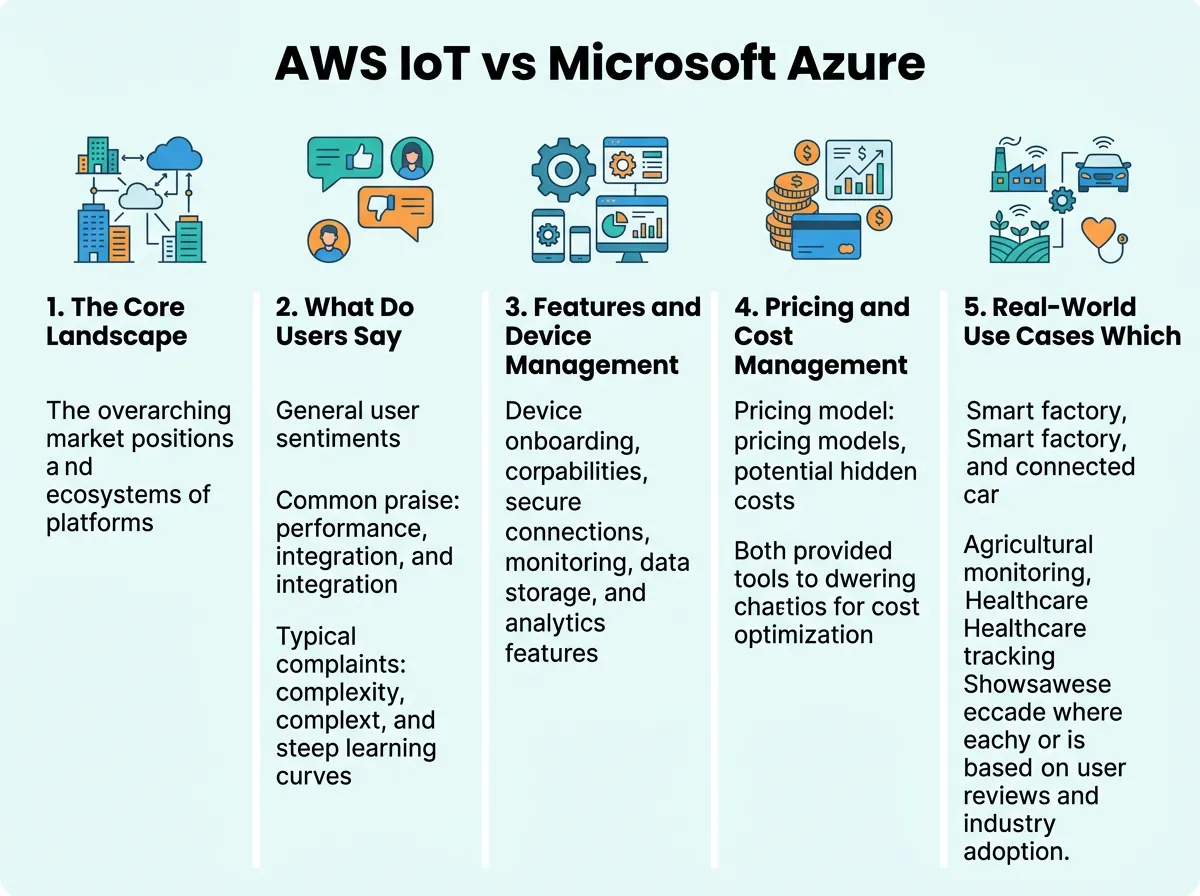
AWS IoT vs Microsoft Azure IoT: What Do Reviews Say? — key points at a glance
The AWS IoT Experience
Reviews for AWS IoT often highlight its deep developer focus. If your team loves writing code and configuring custom setups, AWS is a dream. The platform gives you fine-grained control over every single connection and data path.
However, many users note that the learning curve is quite steep. The console can feel cluttered, and finding the right settings takes time. If you are new to the AWS ecosystem, the setup process can feel overwhelming. You have to configure policies, certificates, and roles just to send your first message.
The Azure IoT Experience
Microsoft Azure takes a different route. Real-world user reviews on TrustRadius often praise Azure for its friendly onboarding. Azure offers a service called IoT Central. This is a fully managed software-as-a-service (SaaS) solution.
With IoT Central, you get pre-built templates and a clean dashboard. You can connect a device and see data flowing in minutes without writing a single line of backend code. For business analysts and non-developers, Azure is often the clear winner for quick proof-of-concept projects.
Features and Device Management
Both platforms offer a rich set of features to manage your smart devices. Let us look at how they compare in key areas.
Device Shadow vs. Device Twin
What happens when a smart device goes offline? Both platforms have a feature to solve this problem. AWS calls it the “Device Shadow.” Azure calls it the “Device Twin.”
These features create a digital replica of your physical device in the cloud. You can send commands to the digital twin while the device is offline. Once the physical device reconnects, it syncs with the cloud copy automatically. Reviews show that both systems work flawlessly, but Azure’s Device Twin is slightly easier to query using SQL-like syntax.
Edge Computing Capabilities
Sometimes, you need to process data right on the device rather than sending it to the cloud. This is called edge computing. AWS offers IoT Greengrass, while Azure offers IoT Edge. Both tools are highly rated by developers. They allow you to run local code, machine learning models, and database functions directly on your hardware.
Pricing and Cost Management
Pricing is where these two platforms differ the most. It is also the source of many complaints in user reviews. A bad architectural choice can lead to a surprise bill at the end of the month.
AWS IoT Core uses a pay-as-you-go model. You are charged based on the exact number of messages sent and received. This is fantastic for small projects or devices that only send data once an hour. However, if you have millions of devices sending messages every second, the costs can add up quickly. You must be very careful with how you design your data payloads.
Azure IoT Hub uses a tier-based model. You choose a tier based on the daily message volume you expect. This makes your monthly bill highly predictable, which enterprise finance departments love. However, if you slip over your daily limit, you might have to pay for the next tier up, even if you only exceeded the limit by a few messages.
Here is a quick tip: always calculate your expected message sizes and frequencies before committing to a platform. A tiny change in message frequency can double your monthly cloud costs.
Real-World Use Cases: Which One Wins Where?
To make the right choice, it helps to look at how other businesses make their decisions. Let us look at some common scenarios.
When to Choose AWS IoT
If your company already uses AWS for other services, staying in the family makes sense. AWS IoT integrates perfectly with AWS Lambda for serverless computing and Amazon S3 for cheap data storage. According to various architectural comparison guides, AWS is also the preferred choice for startups and highly agile teams. These teams value raw flexibility and the ability to customize every single API call.
When to Choose Azure IoT
Azure is the undisputed king of the corporate enterprise. If your company relies heavily on Windows, Office 365, or Active Directory, Azure IoT is a natural fit. It integrates beautifully with enterprise tools like Power BI for advanced data visualization. Azure is also highly favored by industries with strict compliance and security needs, such as healthcare and manufacturing.
Conclusion
So, AWS IoT vs Microsoft Azure IoT: What Do Reviews Say? The consensus is clear. There is no single “best” platform. Instead, there is a “best fit” for your specific team and project.
If you want ultimate control, love writing custom code, and already use Amazon services, AWS IoT is a fantastic choice. But if you want to get up and running quickly with pre-built templates, need predictable monthly billing, and work in an enterprise Microsoft environment, Azure IoT is likely your best bet.
The best way to decide is to run a small pilot project. Try connecting a few test devices to both platforms. Let your developers play with the consoles. You will quickly feel which platform matches your team’s workflow and style.
Frequently Asked Questions
Is AWS IoT cheaper than Azure IoT?
It depends on your message volume. AWS charges per message, which is cheaper for low-frequency devices, while Azure uses tiered pricing which is more cost-effective and predictable for high-volume enterprise projects.
Which platform is better for beginners?
Azure IoT is generally considered better for beginners because of Azure IoT Central. This tool offers pre-built templates and a simple web interface that requires no coding to get started.
Can I use both AWS and Azure for my IoT system?
Yes, some large enterprises use a multi-cloud strategy. However, this increases complexity and cost, so most businesses prefer to stick to one ecosystem to keep things simple.
What is the difference between AWS Greengrass and Azure IoT Edge?
Both tools allow you to run cloud functions locally on your devices. AWS Greengrass focuses on running Lambda functions and Docker containers, while Azure IoT Edge is highly praised for its seamless module management and deployment tools.
Do these platforms support open-source protocols?
Yes, both platforms fully support industry-standard protocols. These include MQTT, HTTPS, and AMQP, making them highly compatible with almost any modern hardware device.
Which platform has better security features?
Both platforms offer industry-leading, enterprise-grade security. AWS relies heavily on fine-grained IAM policies and certificates, while Azure is often praised for its built-in threat protection and deep integration with Active Directory.
