


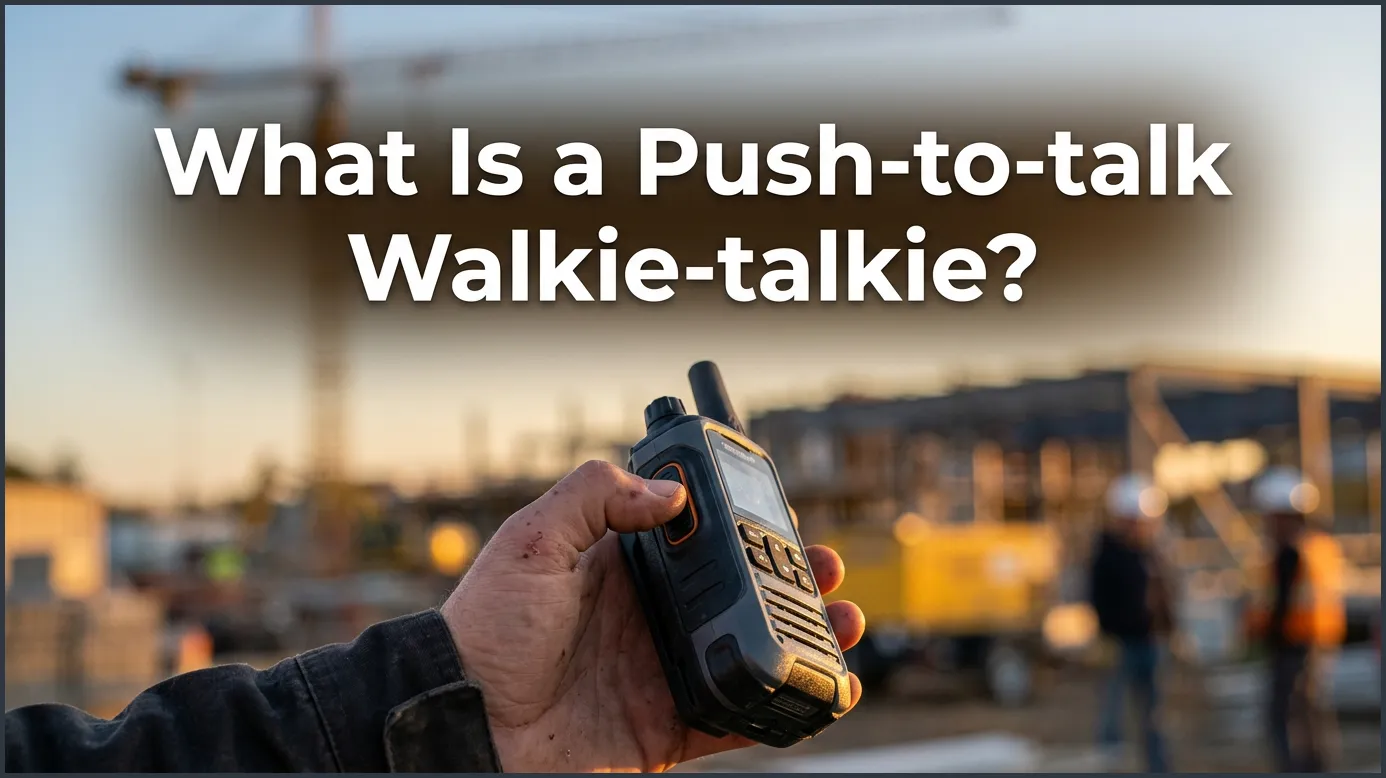
A push-to-talk walkie-talkie is a handheld, two-way radio that offers instant voice communication at the press of a single button. Operating on a half-duplex system, it allows one person to speak at a time while others on the same channel listen. These devices are highly valued for their speed, rugged durability, and reliable performance in environments where cell phones fail.
Imagine you are hiking up a steep, rocky trail deep in the mountains. The wind is howling, and the temperature is dropping fast. Suddenly, your hiking partner slips and twists their ankle. You pull out your smartphone, only to see the dreaded “No Service” message in the top corner. In moments like these, waiting for a call to connect can feel like an eternity—if it works at all. This is exactly where a reliable backup communication tool becomes a lifesaver.
For decades, adventurers, security teams, and construction workers have relied on a classic tool to stay in touch. This simple, rugged device keeps teams connected over long distances without relying on cellular towers. Today, we are going to dive deep into this technology. We will explore how it works, why it remains so popular, and how to choose the right model for your specific needs.
Whether you want to coordinate a crew on a noisy job site or keep your family safe on a camping trip, understanding this tool is essential. Let us take a closer look at what makes this device an enduring classic in the world of technology.
Key Takeaways
- Instant Communication: Connect with individuals or entire groups instantly without dialing or waiting for a connection.
- Half-Duplex Design: Only one user can speak at a time while others listen, keeping communication clear and organized.
- Industrial Durability: Built to withstand drops, dust, water, and extreme weather conditions.
- No Monthly Fees: Traditional radio models communicate directly over radio waves without requiring cellular data plans.
- Modern LTE Options: Push-to-Talk over Cellular (PoC) blends traditional convenience with nationwide mobile network range.
📑 Table of Contents
Understanding the Basics of a Push-to-Talk Walkie-Talkie
At its heart, a push-to-talk walkie-talkie is a portable, two-way radio transceiver. The term “push-to-talk” (often abbreviated as PTT) refers to the method of conversation. Unlike a phone call where both people can speak at the same time, this device uses a single button to switch between transmitting and receiving signals.
To learn more about the history and technical standards of this design, you can read about the evolution of push-to-talk technology on Wikipedia. This simple setup ensures that the user has complete control over when they are sending audio out into the world. It also keeps channels clear of background noise when no one is actively speaking.
The Magic of the Half-Duplex System
To understand how a push-to-talk walkie-talkie operates, we must look at how it shares information. Phones use a “full-duplex” system, which allows simultaneous two-way talking. Walkie-talkies use a “half-duplex” system. This means that communication only flows in one direction at a time on a shared frequency. When you press the side button, your radio turns into a transmitter. When you let go, it goes back to being a receiver.
Frequencies and Channels
These devices send signals through radio waves. To talk to someone, both devices must be tuned to the exact same frequency or channel. Most consumer radios come pre-programmed with standard channels. Professional models, however, can be programmed with custom, secure frequencies. This ensures that your private business conversations do not get interrupted by nearby users.
Key Features That Make These Devices Stand Out
Why do people still use a push-to-talk walkie-talkie when almost everyone carries a smartphone? The answer lies in the unique features designed for speed, safety, and harsh environments. Let us break down the main reasons these devices remain unbeatable in many industries.
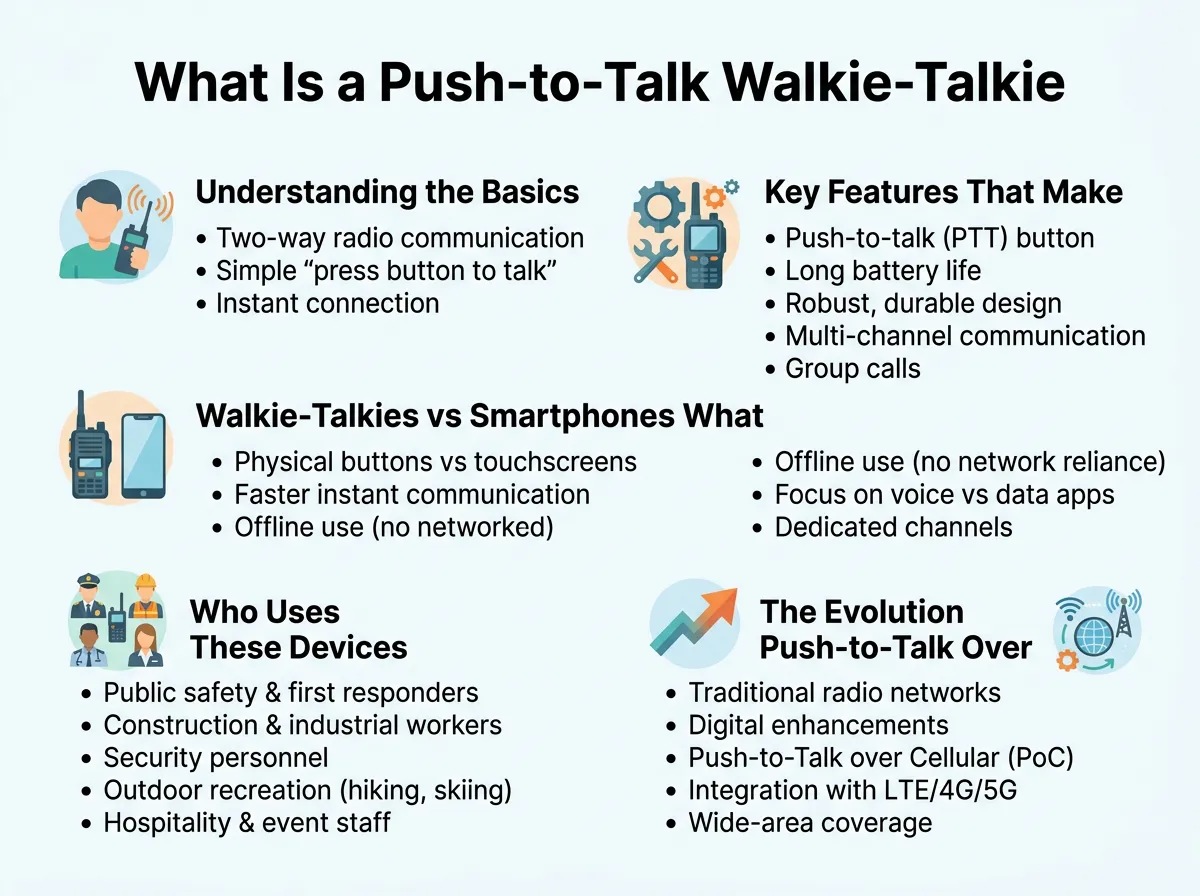
What Is a Push-to-Talk Walkie-Talkie? — key points at a glance
Instant, One-Touch Communication
With a smartphone, you have to unlock the screen, find your contact, place the call, and wait for them to answer. With a push-to-talk walkie-talkie, communication is instant. You press the button and speak. Your voice immediately plays out of the speaker of every radio tuned to your channel. This speed is vital during emergencies where every second counts.
Rugged and Durable Builds
Smartphones are delicate glass rectangles. Drop one on a concrete floor or into a puddle, and it is likely ruined. A quality push-to-talk walkie-talkie is built like a tank. They feature heavy-duty plastic casings, shock-absorption frames, and rubber seals. Many are fully waterproof and dustproof, meaning they can survive drops, rain, and mud without missing a beat.
Battery Life Built for Long Shifts
Because they do not have large touchscreens or run background apps, these radios are highly energy-efficient. A single charge can easily last through a 12-hour work shift or a full weekend camping trip. Many models also support swappable battery packs or AA batteries, allowing you to quickly restore power in the field.
Walkie-Talkies vs. Smartphones: What is the Difference?
It is easy to assume that mobile phones have made two-way radios obsolete. However, they serve very different purposes. Let us look at how they compare when put to the test in real-world scenarios.
For a detailed breakdown of how these technologies diverge, you can explore this community discussion on the difference between traditional radios and cellular PTT on Quora.
Why Call Connections Matter
When you place a phone call, your device must establish a connection through a complex network of cell towers. This process takes time and can fail if the network is busy. A push-to-talk walkie-talkie sends radio waves directly from one antenna to another. This peer-to-peer connection is direct, fast, and does not depend on any third-party infrastructure.
Network Reliability in Remote Areas
If you lose cell service in a valley or inside a concrete building, your phone becomes a paperweight. Traditional radios do not care about cell towers. As long as you are within physical range of the other radio, you can communicate. This makes them the gold standard for search and rescue teams, remote construction sites, and wilderness explorers.
Who Uses These Devices Today?
You might be surprised by how many different industries rely on a push-to-talk walkie-talkie every single day. They are not just for kids playing in the backyard or security guards at the mall.
Industrial and Construction Teams
On a loud construction site, coordination is key to keeping everyone safe. Crane operators, foremen, and safety inspectors use rugged radios to warn each other of hazards instantly. The physical buttons are easy to press even while wearing thick work gloves.
Emergency Responders and Security
Police officers, firefighters, and paramedics rely heavily on instant communication. During natural disasters, cell towers often fail due to power outages or high traffic. Emergency services use dedicated, secure radio networks to coordinate rescue efforts without interruption.
Outdoor Enthusiasts and Hikers
If you enjoy skiing, hiking, or off-roading, a push-to-talk walkie-talkie is a must-have safety tool. They allow groups to stay together even when spread out over a mountain or dense forest trail. Many consumer models also include built-in NOAA weather alerts to warn you of incoming storms.
The Evolution: Push-to-Talk Over Cellular (PoC)
As technology has advanced, the line between radios and phones has started to blur. Today, we have a hybrid technology known as Push-to-Talk over Cellular, or PoC.
To learn more about how this modern system functions, you can read about how push-to-talk technology works on the Motorola Solutions website. This modern approach offers some unique benefits for businesses with large service areas.
How LTE and Wi-Fi Change the Game
Instead of using radio waves, PoC devices use existing 4G LTE and 5G cellular networks. This gives you the instant, one-button communication of a walkie-talkie, but with unlimited range. You can press a button in New York and instantly speak to someone in Los Angeles with zero delay.
Turning Smartphones into Walkie-Talkies
You do not even need to buy new hardware to enjoy this technology. Many businesses use specialized apps to turn their employees’ existing smartphones into virtual transceivers. By installing a dedicated app, you can use a digital screen button to talk to your entire team instantly, combining phone utility with radio speed.
How to Choose the Right Push-to-Talk Walkie-Talkie
If you are ready to buy a push-to-talk walkie-talkie, the number of choices can feel overwhelming. To find the perfect model for your needs, keep these practical tips in mind.
- Identify Your Environment: If you plan to use the radios indoors or in areas with lots of obstacles, look for UHF (Ultra High Frequency) models. If you need them for wide-open outdoor spaces, VHF (Very High Frequency) models will offer better range.
- Check the IP Rating: Look for an Ingress Protection (IP) rating to see how waterproof the device is. An IP67 rating means the radio can survive being dropped into a shallow puddle of water.
- Consider the Range: Manufacturer range claims are often tested under perfect, flat conditions. Expect the actual range in wooded or urban areas to be significantly shorter than what is listed on the box.
- Look for Hands-Free Features: Many modern models support voice-activated transmission (VOX). This allows you to speak and transmit without physically pressing the button, which is perfect for driving or climbing.
Conclusion
The push-to-talk walkie-talkie is far from a relic of the past. It is a highly specialized, reliable, and evolving tool that keeps us connected when it matters most. From classic radio wave models to cutting-edge cellular hybrids, these devices offer unmatched speed, simplicity, and durability. Whether you are managing a busy warehouse, coordinating a security team, or exploring the great outdoors, having a dedicated physical button to talk keeps you safe and productive. The next time you plan an adventure or organize a big project, make sure you have one of these trusted devices by your side.
Frequently Asked Questions
What does push-to-talk mean on a walkie-talkie?
Push-to-talk (PTT) means you must hold down a physical button on the side of the device to transmit your voice. When you release the button, the device switches back to receiving mode, allowing you to hear others on the same channel.
Can a walkie-talkie connect to a cell phone?
Traditional radio walkie-talkies cannot connect directly to standard cell phones. However, modern Push-to-Talk over Cellular (PoC) systems and specific smartphone apps can bridge the gap, allowing phones and digital radios to communicate over cellular networks.
Do push-to-talk walkie-talkies require a monthly fee?
Standard consumer and business two-way radios communicate directly over free public radio waves and do not require monthly subscription fees. Only advanced cellular-based systems (PoC) require a recurring data plan to access cellular networks.
What is the typical range of a standard walkie-talkie?
In real-world conditions with trees, hills, or buildings, consumer walkie-talkies usually have a range of 1 to 3 miles. Under perfect, unobstructed line-of-sight conditions, some high-powered models can reach up to 30 miles.
What is the difference between UHF and VHF radios?
UHF (Ultra High Frequency) waves are shorter and better at penetrating wood, concrete, and steel, making them ideal for indoor or urban use. VHF (Very High Frequency) waves travel further in open spaces, making them best for outdoor marine, aviation, and open-field use.
Can multiple brands of walkie-talkies talk to each other?
Yes, as long as both radios are tuned to the exact same frequency channel and use the same privacy codes. Brand does not matter, but the underlying radio technology (such as FRS, GMRS, or PMR446) must match.
