

Choosing the right IoT platform depends on your business goals and current setup. AWS IoT offers great customization, Azure IoT shines with enterprise-level integrations, and Google Cloud works best for advanced data analytics. Matching their unique strengths to your project is the key to success.
Imagine walking into a modern factory. Hundreds of machines hum at once. Sensors track every move. They check temperatures, monitor speed, and predict failures before they happen. This is the power of the Internet of Things, or IoT. But how do these machines talk to each other? They need a smart cloud platform to connect them.
This brings us to a big question: AWS IoT vs Azure IoT vs Google IoT: Which Is Best? Choosing the right platform can feel overwhelming. There are many tools to look at, and each brand uses different names. In this post, we will break down the options in plain English. We will look at what each cloud giant does best so you can make the right choice.
By the end of this guide, you will know the strengths and weaknesses of each platform. You will see how they handle security, pricing, and device management. Let us jump in and look at the big picture.
Key Takeaways
- AWS IoT is the market leader: It offers the most diverse suite of tools and deep customization options.
- Azure IoT is built for enterprises: It provides seamless integration with existing Microsoft business systems.
- Google Cloud focuses on data: Though Google retired its IoT Core, its ecosystem excels at data analytics and machine learning.
- Security is strong across all three: Each platform uses top-tier encryption, but Azure Sphere offers unique hardware-level security.
- Edge computing is built-in for AWS and Azure: Both offer native edge tools, while Google relies on third-party partners.
📑 Table of Contents
The Big Three IoT Platforms at a Glance
Each of these cloud giants wants to run your smart devices. They offer tools to connect, manage, and secure your hardware. When comparing the top cloud platforms for IoT, you will find that each vendor takes a slightly different path. Some focus on deep customization. Others focus on ready-to-use business tools.
AWS is the oldest and largest cloud provider. Microsoft Azure is the favorite of many large businesses. Google Cloud is famous for its smart data tools. Let us look at how they work.
AWS IoT: The Customization Champion
Amazon Web Services, or AWS, is a pioneer in the cloud space. Their IoT suite is vast. It gives you complete control over your setup. If you can dream it, you can probably build it with AWS.
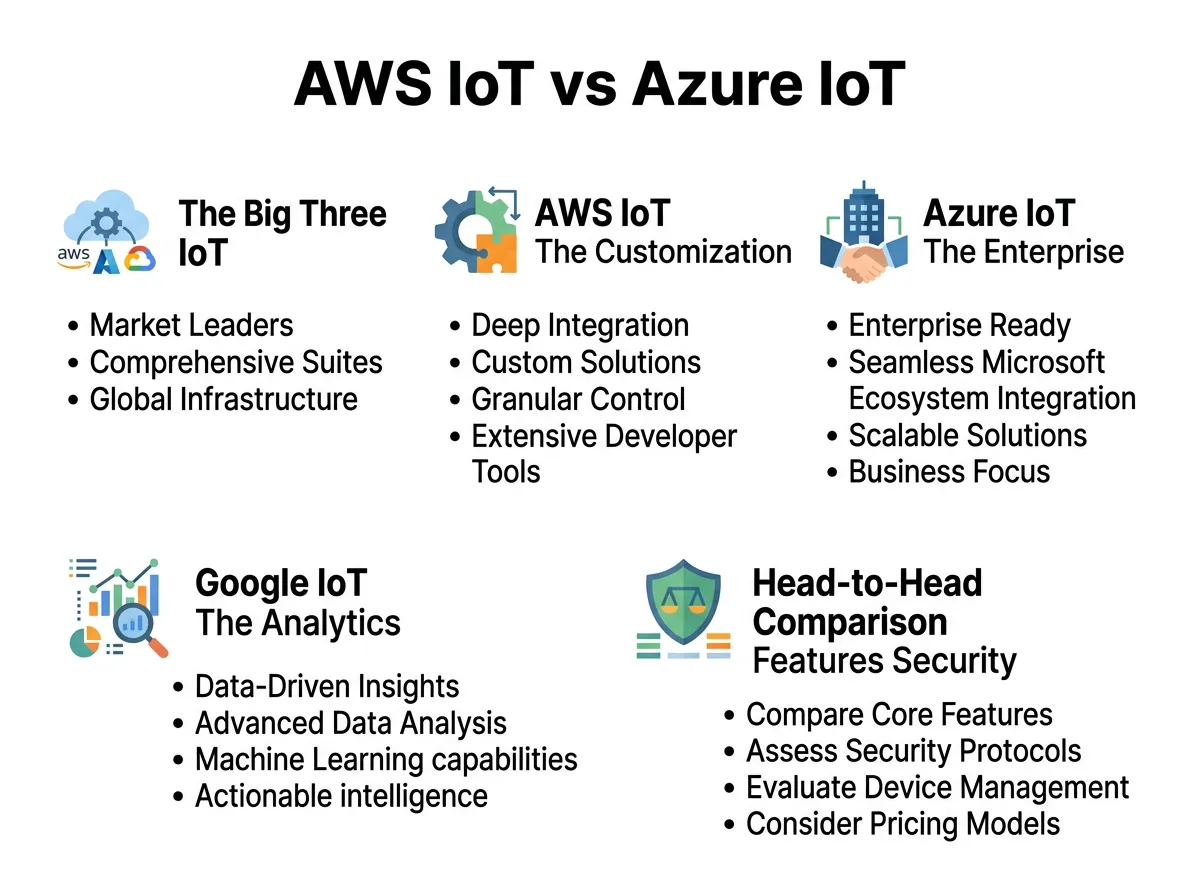
AWS IoT vs Azure IoT vs Google IoT: Which Is Best? — key points at a glance
Key Features of AWS IoT
AWS IoT Core is the main hub. It lets devices connect easily and securely. AWS IoT Device Defender keeps things safe by checking for security issues. For edge computing, AWS IoT Greengrass lets you run code on your local devices. This means your devices can work even without an active internet connection.
Pros and Cons of AWS IoT
AWS gives you endless options. You can build highly custom setups. The community is huge, so you can find answers to your questions quickly. However, AWS can be hard to learn. The learning curve is steep. You might feel lost in all the settings if you are new to the cloud.
Best Use Case for AWS
AWS is best for teams with skilled developers. It works well if you want a custom setup. It is also great if you already use AWS for your website or database.
Azure IoT: The Enterprise Specialist
Microsoft Azure is a powerful choice for businesses. It is built to work with tools you already use, like Windows and Microsoft 365. It focuses on making deployments fast and secure.
Key Features of Azure IoT
Azure IoT Hub is the core service. It manages two-way communication with your devices. Azure IoT Central is a great tool that offers ready-made templates. You can start a project without writing much code. Azure Sphere provides top-tier security for your chips and hardware.
Pros and Cons of Azure IoT
Azure is very easy to scale. Its pre-built templates save a lot of time. To understand the details of their services, look at how AWS and Azure IoT product differences impact device deployment. On the downside, Azure can feel rigid. If you want to customize every single detail, you might find it a bit restrictive.
Best Use Case for Azure
Azure is perfect for large companies. If your business already uses Microsoft tools, Azure is a natural fit. It is also ideal for quick setups using IoT Central.
Google IoT: The Analytics Powerhouse
Google Cloud has a different strategy. In 2023, Google retired its main IoT Core service. This changed the game for many users. However, Google did not leave the IoT space entirely.
Google’s New IoT Strategy
Instead of managing devices directly, Google now works with expert partners. Google focuses on what it does best: data. Once your partner system gathers the data, Google Cloud processes it. It uses tools like Pub/Sub and BigQuery to handle huge streams of information.
Pros and Cons of GCP for IoT
Google offers amazing tools for artificial intelligence and machine learning. Vertex AI helps you build smart models. The downside is that you need third-party tools to manage your physical devices now. This adds another step to your setup.
Best Use Case for Google
Google is best for projects that need deep data analysis. If you want your smart devices to learn and predict things, Google is the winner.
Head-to-Head Comparison: Features, Security, and Pricing
Now let us compare these platforms directly. This will help you answer: AWS IoT vs Azure IoT vs Google IoT: Which Is Best?
Device Management and Edge Computing
AWS Greengrass and Azure IoT Edge are both excellent. They let you run smart code on your local hardware. This saves bandwidth and cuts down on lag. Google relies on partners to do this. If you want a built-in edge solution, AWS and Azure are your best choices.
Security Protocols
Security is vital for smart devices. All three platforms use strong encryption. They support TLS and certificate-based security. Azure goes a step further with Azure Sphere. This is a complete security solution that includes hardware, OS, and cloud security.
Pricing Models
Pricing can be tricky. AWS and Google charge you based on the messages you send. If your devices talk constantly, costs can go up quickly. Azure offers tier-based pricing for IoT Hub. This can make your monthly bills more predictable.
For a broader look at how these providers stack up globally, check out a detailed AWS vs Azure vs Google Cloud comparison.
AWS IoT vs Azure IoT vs Google IoT: Which Is Best? Our Verdict
So, what is the final decision? There is no single winner. The best platform depends on your needs.
Choose AWS IoT If:
- You have strong developers who want complete control over their code.
- You need deep customization and native edge tools.
- You already use other AWS services.
Choose Azure IoT If:
- You run a large business and want fast, ready-to-use templates.
- Your company relies on Microsoft software.
- You want predictable, tier-based pricing.
Choose Google Cloud If:
- Your project relies on heavy data science.
- You want to use advanced machine learning and AI.
- You are happy to use partner tools for device management.
Conclusion
Choosing a cloud platform is a major step. It shapes how you build your smart network. Take time to test each platform. Most offer free trials to help you get started. By matching your goals with the right cloud power, your IoT project will succeed.
Frequently Asked Questions
Which IoT platform is easiest for beginners?
Azure IoT is generally the easiest for beginners. Its IoT Central tool offers ready-to-use templates that let you start without writing complex code. AWS has a steeper learning curve, while Google requires partner integrations.
Is Google Cloud IoT retired?
Yes, Google retired its IoT Core service in August 2023. However, Google Cloud still supports IoT projects by partnering with other companies for device management and using GCP for advanced data analytics.
Which platform is best for edge computing?
Both AWS and Azure are excellent for edge computing. AWS Greengrass and Azure IoT Edge allow you to run code locally on your devices, keeping them functional even without an internet connection.
How does pricing differ between AWS and Azure IoT?
AWS charges you based on the exact number of messages sent and received. Azure offers tier-based pricing for its IoT Hub, which can make monthly budgeting more predictable for businesses.
Can I use Google Cloud tools with AWS IoT?
Yes, you can build hybrid setups. You can use AWS IoT Core to manage and connect your physical devices, and then send the gathered data to Google Cloud for advanced machine learning and analysis.
Which platform has the best security?
All three platforms offer enterprise-grade security. However, Azure stands out with Azure Sphere, which provides integrated security across the hardware chip, the operating system, and the cloud service.
