

ThingsBoard is widely considered the best open-source IoT cloud platform due to its incredible visualization, security, and scalability. Other powerful alternatives like Mainflux and Kaa IoT offer excellent features for specialized microservices and enterprise needs. Choosing the right platform ultimately depends on your specific hardware requirements and coding expertise.
Imagine setting up a network of smart sensors around your home or factory. You watch them collect data on temperature, humidity, and movement. But then, you hit a massive wall. How do you gather all this data, visualize it on a clean dashboard, and control your devices remotely without paying a fortune to a third-party provider? This is where the magic of self-hosted cloud software comes into play.
In this article, we will dive deep into the world of connected devices. We will compare the top contenders to help you figure out what is the best open-source IoT cloud platform for your unique needs. Whether you are a hobbyist building a smart garden or an engineer launching an industrial project, we have got you covered.
Key Takeaways
- ThingsBoard is the visual leader: It offers the most intuitive drag-and-drop dashboard creator for beginners and pros.
- Mainflux excels in architecture: Its Go-based microservices setup makes it highly scalable and stable for complex systems.
- Kaa IoT is built for enterprise: It is highly mature, modular, and capable of handling millions of devices.
- Open source prevents vendor lock-in: Hosting your own platform keeps your data secure and avoids unexpected subscription fees.
- Docker makes installation simple: Most modern IoT platforms can be launched quickly using Docker containers.
📑 Table of Contents
Why Choose an Open-Source IoT Cloud Platform?
Using open-source tools gives you complete control over your data. With proprietary systems, you often face unexpected monthly fees and sudden feature changes. Open-source alternatives let you host everything on your own local servers or private clouds. This independence is a game-changer for data privacy and long-term stability.
Total Customization and Control
When you build on an open-source framework, you can tweak the code to fit your exact requirements. You do not have to wait for a vendor to release an update. If you need a specific dashboard widget or a unique database connector, you can build it yourself or ask the community for help.
Avoiding Vendor Lock-In
Vendor lock-in is a massive risk in the modern tech world. If a cloud provider raises their prices or shuts down, your entire network of smart devices could go dark. By choosing the best open-source IoT cloud platform, you ensure that you own your entire tech stack from top to bottom. If you want to explore more options, you can browse a directory of open-source IoT tools to see the sheer variety of software available today.
The Leading Contenders in the IoT Space
Let us look closely at the top projects making waves in the community. Each of these options has distinct strengths and weaknesses.
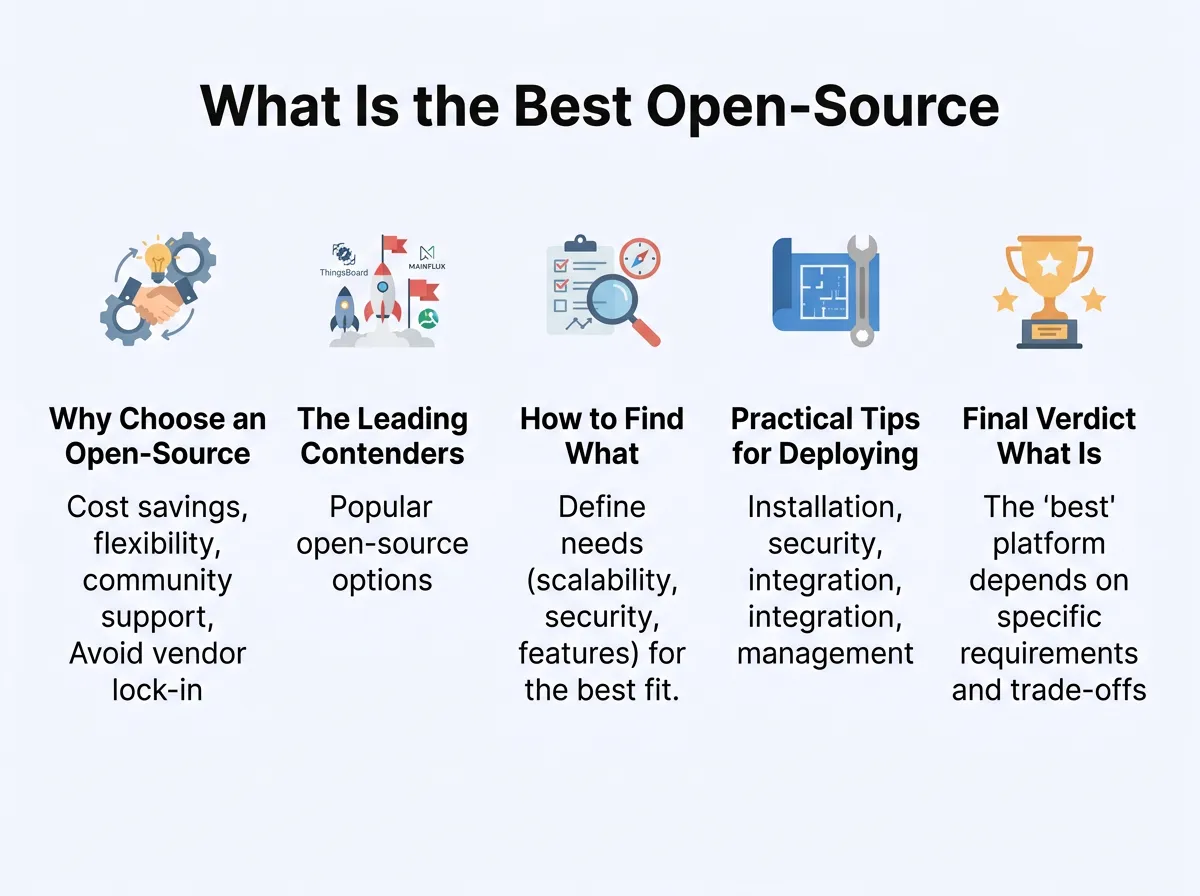
What Is the Best Open-Source IoT Cloud Platform? — key points at a glance
ThingsBoard: The Visual Champion
ThingsBoard is widely celebrated as the best open-source IoT cloud platform for creators who love beautiful, ready-to-use dashboards. It offers an incredible user interface that lets you drag and drop widgets to visualize your sensor data in real-time.
ThingsBoard supports popular protocols like MQTT, CoAP, and HTTP. It handles device provisioning, telemetry data collection, and visualization with ease. If you want to set up an impressive dashboard within minutes of booting your system, ThingsBoard is hard to beat. You can learn more about how it stacks up against proprietary tools by reading about the leading options in the IoT market.
Mainflux: The Microservices Powerhouse
If you are building a highly complex, scalable system, Mainflux might be your ideal choice. Written in Go, Mainflux is built from the ground up on a microservices architecture. This means each component runs independently, making the system incredibly resilient and easy to scale.
Mainflux works wonderfully with container tools like Docker and Kubernetes. It supports secure device connections and offers a robust set of APIs. While its visual interface is not as flashy as ThingsBoard right out of the box, its internal architecture is top-tier for developers who love clean, modular code.
Kaa IoT: The Enterprise Veteran
Kaa is one of the oldest and most mature open-source IoT platforms. It provides a rich set of features for device management, data analytics, and configuration management. Kaa is highly versatile and can handle millions of connected devices without breaking a sweat.
The platform uses a modular design, allowing you to plug in only the components you actually need. While the latest versions of Kaa have leaned more toward enterprise commercial licenses, their open-source roots and community editions remain highly capable for serious builders.
How to Find What Is the Best Open-Source IoT Cloud Platform for You
There is no single perfect platform for everyone. The right choice depends on your technical background and what you want to achieve. Let us look at a few practical ways to narrow down your choices.
Check Your Hardware Compatibility
Before committing to a software stack, ensure it plays nicely with your physical devices. Do you use ESP32 microcontrollers, Raspberry Pis, or industrial PLCs? Some platforms offer native SDKs for specific hardware, which can save you dozens of hours of troubleshooting. For a closer look at how different networks and platforms integrate, check out these IoT platform documentation guides.
Evaluate the Learning Curve
If you are a beginner, look for a platform with an active community and plenty of tutorials. ThingsBoard has a massive library of YouTube guides and forums. Mainflux, on the other hand, requires a solid grasp of Docker and microservices, which might feel overwhelming if you are just starting out.
Practical Tips for Deploying Your IoT Platform
Once you select your platform, the real fun begins. Here are some quick, practical tips to ensure a smooth setup:
- Use Docker: Almost all modern open-source IoT platforms offer Docker Compose files. Using Docker makes installation and updates incredibly simple. It also keeps your host operating system clean.
- Secure Your Broker: If you use MQTT, never leave your broker open to the public internet without a password. Always implement SSL/TLS encryption for your device connections to prevent data leaks.
- Plan Your Database: IoT projects generate massive amounts of time-series data. Choose a platform that supports databases built for this task, like InfluxDB or TimescaleDB, so your system does not slow down over time.
Final Verdict: What Is the Best Open-Source IoT Cloud Platform?
If we have to crown a single winner, ThingsBoard takes the trophy for most users. Its combination of a gorgeous user interface, active community support, and robust protocol handling makes it the best open-source IoT cloud platform for beginners and professionals alike.
However, do not ignore the power of Mainflux if you love microservices, or Kaa if you need an enterprise-grade framework. The beauty of open-source software is that you can test all of them for free. Spin up a Docker container tonight, connect a single sensor, and see which system feels right for you!
Frequently Asked Questions
Is ThingsBoard completely free to use?
Yes, ThingsBoard offers a fully functional open-source Community Edition that is free to use. They also offer professional and cloud-hosted paid editions if you need advanced enterprise features.
Can I host an IoT platform on a Raspberry Pi?
Absolutely! Lightweight platforms like ThingsBoard and Mainflux run smoothly on a Raspberry Pi. This setup is perfect for home automation setups and small-scale testing projects.
What protocol is best for open-source IoT cloud platforms?
MQTT is widely considered the best protocol for IoT because of its low bandwidth usage and reliable message delivery. Most open-source platforms support MQTT, HTTP, and CoAP out of the box.
Do open-source IoT platforms support secure connections?
Yes, most top open-source platforms support industry-standard security measures like SSL/TLS encryption. You can also configure secure device tokens and user authentication to protect your entire network.
What database should I use for storing IoT data?
Time-series databases like InfluxDB, TimescaleDB, or Cassandra are best for IoT data because they handle continuous data streams efficiently. Many open-source IoT platforms support these databases natively.
Can I build commercial products using open-source IoT platforms?
Yes, most open-source IoT platforms are released under permissive licenses like Apache 2.0 or MIT, which allow commercial use. However, always review the specific license of the platform you choose before launching a product.
