


Choosing the right foundation for your connected devices is a critical decision that impacts long-term costs, scalability, and development time. While cloud giants like AWS and Azure offer highly secure, ready-to-scale managed services, a custom backend provides ultimate flexibility and control without vendor lock-in. Understanding how these paths compare will help you select the most efficient architecture for your unique IoT ecosystem.
Imagine you are building a smart system. Maybe it is a fleet of delivery trucks tracking temperature, or smart home devices saving energy. The hardware is ready, but now you face a giant mountain to climb: how do you manage all the incoming data? Every sensor sends messages every second. You must process, store, and secure this data without breaking the bank or crashing your servers.
This brings us to a major architectural decision. How Do IoT Platform Architectures Compare: AWS vs Azure vs a Custom Backend? Choosing the wrong path can lead to massive bills, security holes, or development dead ends. It is not just about choosing a brand; it is about choosing how your entire business scales.
In this article, we will break down these three popular paths. We will look at how they manage devices, route messages, and scale. By the end, you will have a clear map to guide your development team toward the right choice.
Key Takeaways
- AWS Ecosystem Integration: AWS IoT Core integrates seamlessly with Amazon’s deep suite of serverless tools and databases.
- Enterprise-Grade Azure: Azure IoT Hub excels in enterprise environments, offering robust hybrid cloud integration and advanced edge computing.
- Custom Freedom: A custom backend offers complete control and eliminates recurring message-based subscription fees.
- Scalability Overhead: Cloud giants handle massive traffic spikes automatically, whereas a custom backend requires manual infrastructure scaling.
- Time-to-Market: Using pre-built cloud microservices drastically reduces development time compared to coding broker logic from scratch.
- Shared Security: Security is heavily managed by AWS and Azure, while a custom backend places 100% of the security burden on your development team.
📑 Table of Contents
- Understanding the Core Architectural Needs of IoT
- Inside the Amazon Ecosystem: AWS IoT Core
- The Enterprise Heavyweight: Azure IoT Hub
- Going Your Own Way: The Custom Backend Approach
- Head-to-Head Comparison: Scalability, Security, and Costs
- How Do IoT Platform Architectures Compare: AWS vs Azure vs a Custom Backend?
- Conclusion
Understanding the Core Architectural Needs of IoT
Before we look at the platforms, we must understand what an IoT backend actually does. It is not like a standard web app backend. An IoT backend must handle thousands of constant, tiny data packets sent at irregular intervals.
Device Management and Provisioning
You cannot manually log into every smart light bulb to set it up. An IoT platform must onboard devices automatically. This process is called provisioning. The system must verify that each device is authentic and safe before letting it connect to your network.
Message Routing
Once online, devices send messages constantly. The backend needs a message broker to sort these messages. Most systems use a protocol called MQTT because it is lightweight and saves battery power. The broker must take these messages and send them to the right database or application instantly.
Data Storage and Analytics
Some data needs to be saved forever for compliance or reports. Other data is only useful for a few seconds. Your architecture needs to split this data. It should send quick data to real-time dashboards and heavy, cold data to long-term storage systems.
Inside the Amazon Ecosystem: AWS IoT Core
Amazon Web Services (AWS) is a cloud titan. AWS IoT Core is their specialized service for connected devices. It acts as the secure front door for all your physical hardware.
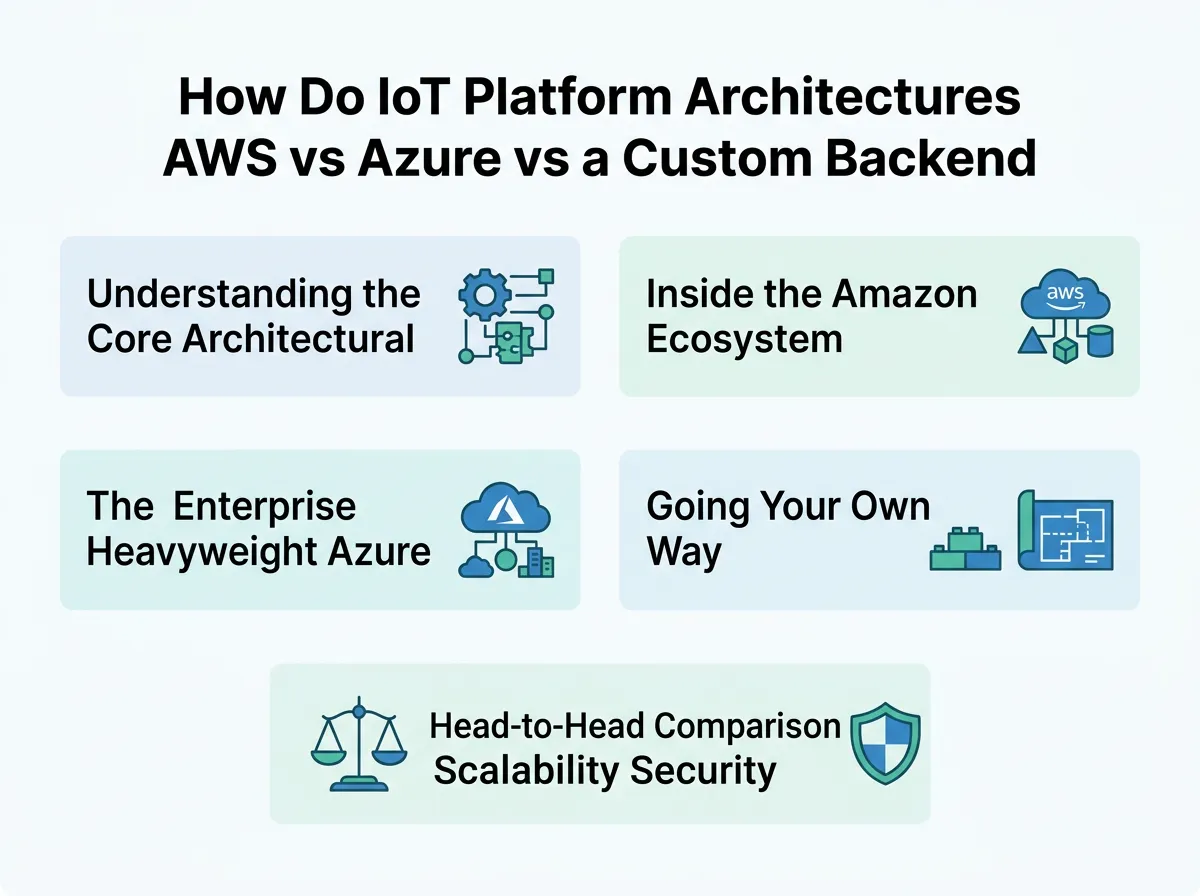
How Do IoT Platform Architectures Compare: AWS vs Azure vs a Custom Backend? — key points at a glance
Key Components of AWS IoT
At the center of AWS IoT is the message broker. It supports MQTT, WebSockets, and HTTPS. AWS also uses a feature called the Device Shadow. This is a virtual copy of your physical device stored in the cloud. If a device loses its internet connection, your mobile app can still read the last known state from the shadow. When the device comes back online, AWS syncs the state automatically.
The Pros and Cons of AWS
The biggest benefit of AWS is its vast ecosystem. You can send your IoT data directly into AWS Lambda for serverless computing. You can also send it to Amazon DynamoDB for fast database storage. To understand how these features match up against competition, you can look at a direct feature comparison between cloud leaders.
On the downside, AWS is highly complex. The settings can be overwhelming. Setting up secure connections requires a deep understanding of AWS policies, which can easily slow down a small, inexperienced team.
The Enterprise Heavyweight: Azure IoT Hub
Microsoft Azure is the preferred choice for many corporate giants. It is designed to work seamlessly with existing enterprise software and Windows systems.
Key Components of Azure IoT
Azure IoT Hub is Microsoft’s core gateway. It allows for reliable two-way communication between your devices and the cloud. Azure uses “Device Twins” which work just like AWS Device Shadows to keep track of device states.
A standout feature of this ecosystem is Azure IoT Edge. This lets you run cloud analytics and machine learning models directly on your physical hardware. This is perfect for remote areas with poor internet connections, like oil rigs or cargo ships.
The Pros and Cons of Azure
Azure excels in hybrid setups. If your company runs its own local servers but still wants to use the cloud, Azure connects them easily. The security tools are also highly integrated, making compliance simple for regulated industries.
However, Azure can feel overly complex for simple projects. The user interface can be difficult to navigate, and the pricing structure requires careful planning. Despite this, the rapid growth of IoT cloud platforms proves that many organizations find Azure well worth the investment.
Going Your Own Way: The Custom Backend Approach
What if you do not want to use Amazon or Microsoft? Some teams decide to build their own backend from scratch using open-source tools.
How a Custom Backend Works
To build a custom backend, you must assemble the pieces yourself. Instead of paying for a cloud broker, you might install an open-source broker like Mosquitto or EMQX on your own virtual private servers. For databases, you might use InfluxDB for time-series data and PostgreSQL for user accounts. You write the control panel and device registry yourself, often using backend languages like Node.js, Go, or Python.
The Pros and Cons of Custom Architecture
The biggest advantage is freedom. You have complete control over your code, data, and security. There are no surprise cloud bills at the end of the month. You only pay for raw server space, not for every message sent.
But the development cost is huge. You have to build features from scratch that AWS and Azure give you out of the box. This includes writing your own security protocols and setting up database backups. When choosing a cloud backend for IoT projects, you must ask yourself if your team has the time and skill to manage this infrastructure long-term.
Head-to-Head Comparison: Scalability, Security, and Costs
Now, let us put these three choices side-by-side to see how they truly perform in the real world.
Scalability
AWS and Azure win hands-down here. They are designed to scale instantly. If your business goes viral and you add 50,000 devices in one day, the cloud handles it without a stutter. With a custom backend, you must build your own auto-scaling systems. If your servers get overloaded, your devices will disconnect, and you could lose crucial data.
Security
Security is a massive risk in IoT. AWS and Azure use strict security standards. They require unique security certificates for every single device and handle the validation process. A custom backend requires your team to manage these certificates. If you make a mistake in your security code, hackers could access your entire network.
Cost Structure
With AWS and Azure, you pay for what you use. This is great for small startups with only a few devices. But as your fleet grows and sends millions of messages, those micro-transactions add up to huge monthly bills. A custom backend has a flat monthly cost for servers, which is much cheaper at scale. However, you must factor in the cost of hiring engineers to maintain those servers.
How Do IoT Platform Architectures Compare: AWS vs Azure vs a Custom Backend?
To make your final decision, look closely at your resources, timeline, and goals.
Choose AWS If:
- You want to get to market quickly.
- Your developers are already familiar with the Amazon Web Services ecosystem.
- You want to use serverless tools to analyze your data.
Choose Azure If:
- You work in an enterprise environment that already uses Microsoft products.
- You need strong hybrid cloud features to connect local servers.
- You plan to process heavy data on the edge of your network.
Choose a Custom Backend If:
- You have a highly unique project with custom communication protocols.
- You have a skilled team of DevOps engineers ready to maintain servers.
- You want to avoid ongoing monthly cloud fees and vendor lock-in.
Conclusion
There is no single winner in the debate between AWS, Azure, and a custom backend. Cloud platforms give you speed, security, and easy scaling at the cost of higher monthly bills and vendor lock-in. A custom backend gives you total control and lower server costs, but requires immense effort to build, protect, and scale.
Take a close look at your team’s skills and your long-term budget. The right choice is the one that lets you focus on building a great product for your users, rather than constantly fighting your backend infrastructure.
Frequently Asked Questions
Which platform is cheaper for a small number of devices?
AWS and Azure are usually cheaper for small projects because they offer free tiers and pay-as-you-go pricing. A custom backend requires you to pay for virtual servers immediately, even if you only have one device connected. As your device count grows, however, cloud message costs can overtake flat server fees.
Can I switch from a cloud platform to a custom backend later?
Yes, but it is highly difficult. You would need to rewrite your device firmware to point to a new broker and re-engineer your entire data pipeline. It is best to choose an architecture you can stick with for at least the first few years of your product’s lifecycle.
Do AWS and Azure support the same communication protocols?
Yes, both platforms support the most common IoT protocols, including MQTT, HTTP, and WebSockets. They also support secure variations of these protocols to ensure all device data is encrypted during transit.
What is a device shadow or device twin?
A device shadow (AWS) or device twin (Azure) is a JSON document stored in the cloud that holds state information for your device. This allows your applications to read and write device data even if the physical device is currently offline. Once the physical device reconnects, it automatically synchronizes with the cloud copy.
Is a custom backend more secure than cloud platforms?
Generally, no. AWS and Azure have massive teams of security experts and meet strict global compliance standards. While a custom backend can be secure, it relies entirely on your own developers to correctly configure firewalls, manage certificates, and apply security patches.
How long does it take to build a custom IoT backend?
Building a basic custom IoT backend can take several months for a small team of developers. In contrast, you can set up a basic, working IoT system on AWS or Azure in just a few days using their pre-built templates and managed services.
