


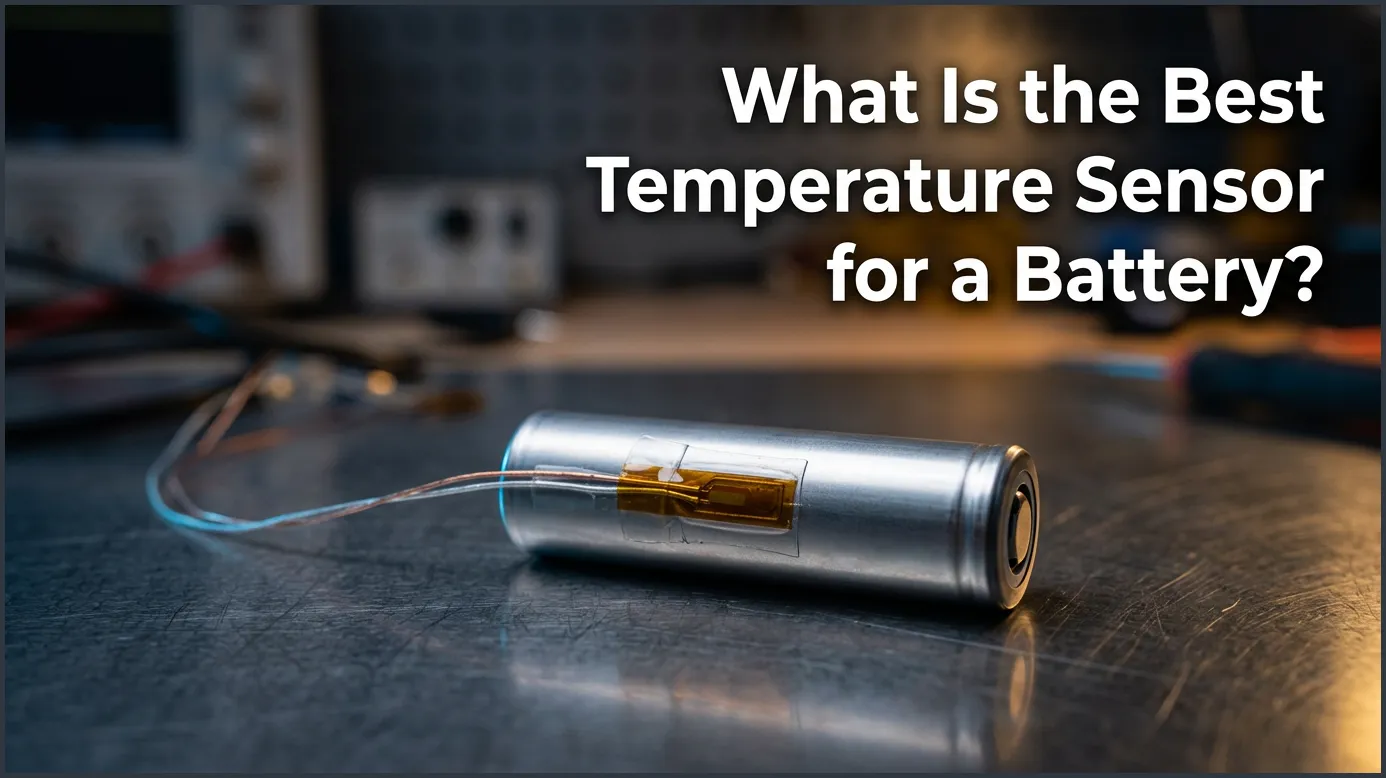
The best temperature sensor for a battery depends on your specific application, but NTC thermistors are the industry standard due to their low cost, small size, and high sensitivity. For high-precision setups like electric vehicles, resistance temperature detectors (RTDs) or digital IC sensors are preferred for their superior accuracy and linear stability. Ultimately, selecting the right sensor is crucial for preventing dangerous thermal runaway and maximizing battery life.
Imagine your smartphone getting hot in your hand while charging. Or think about an electric car driving through a scorching summer desert. Batteries are the beating hearts of our modern gadgets and vehicles. But just like humans, batteries perform their best when they do not get too hot or too cold. When batteries overheat, they can degrade quickly, lose power, or even catch fire. This is why thermal management is so important.
If you are building a custom battery pack, designing a battery management system (BMS), or working on a DIY solar project, you probably have a big question on your mind: What Is the Best Temperature Sensor for a Battery? The answer is not a one-size-fits-all solution. Different batteries and projects require different tools. In this guide, we will break down the top sensor options, compare their pros and cons, and help you choose the perfect fit for your needs.
We will look closely at thermistors, resistance temperature detectors (RTDs), and semiconductor-based integrated circuits (ICs). By the end of this article, you will know exactly how to choose the right sensor, where to place it, and how to keep your batteries running safely and efficiently for years to come.
Key Takeaways
- NTC Thermistors are the Standard: They offer the best balance of low cost, small size, and high sensitivity for everyday consumer electronics and typical battery packs.
- RTDs Offer Premium Precision: Platinum RTDs provide unmatched accuracy and stability, making them the top choice for heavy-duty industrial systems and electric vehicle battery packs.
- Digital ICs Simplify Design: Integrated circuit sensors provide direct digital outputs, removing the need for complex analog-to-digital converters in your circuit.
- Safety and Longevity: Proper thermal monitoring prevents dangerous thermal runaway, preserves battery capacity, and ensures safe, fast charging.
- Strategic Placement is Key: For the most accurate readings, place your sensors on the battery terminals or tucked securely between cells where heat builds up first.
📑 Table of Contents
Why Battery Temperature Monitoring Matters
Before we dive into the specific sensors, let us talk about why we need them in the first place. Lithium-ion batteries are highly sensitive to temperature. If they operate outside their comfort zone—usually between 15°C and 35°C—bad things start to happen. If a battery gets too cold, its internal resistance goes up, making it charge slowly and lose capacity. If it gets too hot, the chemicals inside degrade quickly, shortening its overall life.
Even worse, extreme heat can lead to a dangerous phenomenon called thermal runaway. This is a chain reaction where a rise in temperature releases energy, which further increases the temperature. It can lead to smoke, fire, and explosions. By implementing the basics of battery temperature monitoring, you create a vital safety net. The sensor talks to the BMS, which can throttle the charging current or shut down the system before things get dangerous.
The Three Best Temperature Sensors for Batteries
When it comes to selecting a sensor, three main technologies dominate the industry. Each has its own strengths and weaknesses. Let us look at them side by side.
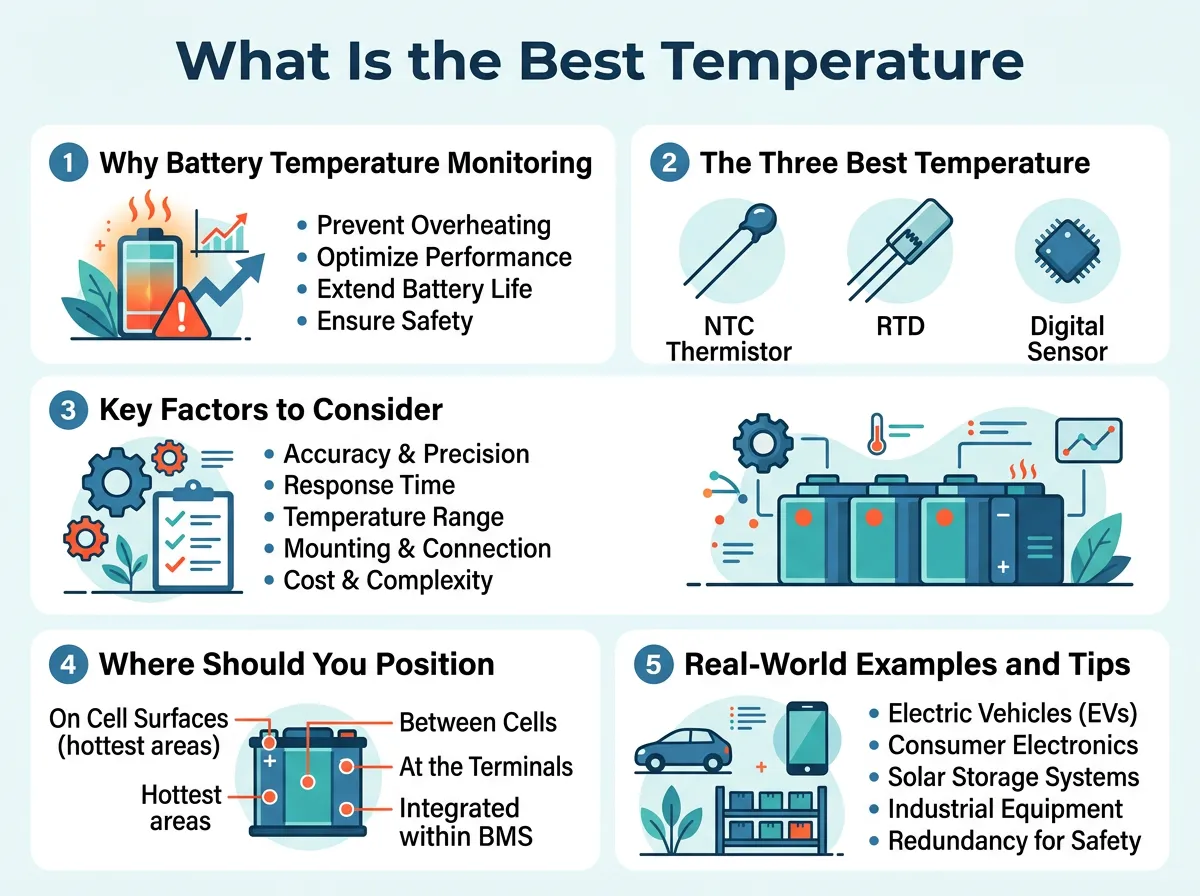
What Is the Best Temperature Sensor for a Battery? — key points at a glance
1. NTC Thermistors (The Budget Champion)
Negative Temperature Coefficient (NTC) thermistors are the most common sensors used in battery packs today. These are simple, two-wire resistors that change their electrical resistance as the temperature changes. The word “negative” means that as the temperature goes up, the resistance goes down.
Why are they so popular? First, they are incredibly cheap. You can buy them for pennies. Second, they are very sensitive to small temperature changes in the normal battery operating range. They are also tiny, meaning you can easily tape them directly to a battery cell or tuck them into tight spaces. However, they are non-linear, which means their resistance change is not a straight line on a graph. Your microchip or BMS will need to do a little bit of math to translate the resistance reading into a temperature value.
2. RTDs (The Precision Master)
Resistance Temperature Detectors (RTDs) work on a similar principle to thermistors, but they are made from pure metals like platinum. The most famous type is the Pt100 or Pt1000 sensor. As the temperature rises, the electrical resistance of the metal increases in a highly predictable, linear line.
If you want to know how the top industries monitor their packs, you will find that advanced battery temperature sensor technology often relies on RTDs. They offer unmatched accuracy, incredible stability over long periods, and can handle a wide range of extreme temperatures. The downside? They are much more expensive than thermistors and require more complex wiring and amplification circuits to read their signals. They are usually reserved for high-end electric vehicles and industrial energy storage systems.
3. Analog and Digital IC Sensors (The Smart Option)
Integrated Circuit (IC) sensors are active silicon chips. They measure temperature and output either an analog voltage or a direct digital signal (using protocols like I2C or SPI). A very popular example is the DS18B20 digital sensor.
The beauty of digital IC sensors is their simplicity of integration. Since they output digital data, you do not need to worry about analog-to-digital conversion, noise interference over long wires, or complex calibration math. Your microcontroller can read the exact temperature directly. However, they are generally larger than thermistors, have a slower response time, and are more expensive.
Key Factors to Consider When Choosing Your Sensor
To decide what is the best temperature sensor for a battery in your specific case, you should weigh several key design factors. Let us break down what you should look for.
- Accuracy: Do you need to know the temperature within 0.1°C, or is 1°C close enough? For most consumer devices, 1°C accuracy is plenty, making NTC thermistors perfect. For electric cars, tighter tolerances are needed.
- Response Time: How quickly can the sensor detect a sudden spike in heat? Small, low-mass NTC thermistors react very quickly. Larger, encased metal probes react much more slowly.
- Size and Form Factor: In a packed battery module, space is at a premium. Thin-film thermistors or ring-terminal sensors can fit into microscopic gaps.
- Cost: If you are manufacturing thousands of battery packs, saving fifty cents per sensor makes a massive difference. NTC thermistors easily win the budget battle.
When engineering a modern battery pack, you must look at all cell temperature sensing options to find the sweet spot between safety, performance, and budget constraints.
Where Should You Position the Sensor?
Having the best sensor in the world will not save your battery if you put it in the wrong place. Heat is not distributed evenly across a battery pack. If you only measure the coolest part, your battery could be failing on the other side without you knowing.
For the best results, place sensors directly on the battery terminals. The metal terminals conduct heat directly from the inside of the cell, making them excellent spots for fast and accurate readings. Alternatively, tuck the sensor into the physical center of the battery pack. The cells in the middle of a pack are surrounded by other warm cells, meaning they have the hardest time cooling down and will get the hottest. Never place your sensor on the outer plastic casing of a pack where cool ambient air can throw off your readings.
Real-World Examples and Tips
Let us look at some practical scenarios to help make your decision easier.
The DIY Solar Power Bank
If you are building a backup power system using 18650 lithium cells for your home or RV, go with NTC thermistors. They are incredibly easy to tape onto the side of the cells. You can connect them directly to cheap, off-the-shelf BMS boards. This keeps your project affordable while keeping you perfectly safe.
Electric Ride-on Toys or E-Bikes
For mid-sized mobility devices, digital IC sensors like the DS18B20 are highly convenient. Because they communicate digitally, you can string several of them along a single bus line to monitor multiple zones of the battery pack without cluttering your wiring harness.
High-Performance Electric Vehicles
If you are working on a high-voltage racing kart or a professional EV project, use platinum RTD sensors. The extreme vibration, electrical noise, and high current demands of these systems require the rugged stability and extreme accuracy that only platinum sensors can provide.
Conclusion
In the end, answering What Is the Best Temperature Sensor for a Battery? comes down to your specific project goals. For 90% of everyday projects and consumer electronics, the simple, affordable, and highly sensitive NTC thermistor is the undisputed king. It gets the job done without breaking the bank.
However, if your project demands extreme precision, robust noise resistance, and long-term stability, investing in platinum RTDs or digital IC sensors is well worth the extra cost. By choosing the right sensor and placing it in the hottest zones of your battery pack, you will ensure your system runs cool, stays safe, and lasts for years to come.
Frequently Asked Questions
Why do batteries need temperature sensors?
Batteries need temperature sensors to monitor heat levels during charging and discharging. This data allows the battery management system to slow down or stop operations if the battery gets too hot or cold, preventing damage and thermal runaway.
What is the difference between NTC and PTC thermistors?
An NTC (Negative Temperature Coefficient) thermistor decreases its electrical resistance as the temperature rises. A PTC (Positive Temperature Coefficient) thermistor increases its resistance as temperature rises, and is more commonly used as a self-resetting fuse rather than a precise measuring sensor.
Where is the best place to put a temperature sensor on a battery?
The best place to mount a sensor is directly on the metal battery terminals, as they conduct heat quickly from the cell’s interior. Placing the sensor in the physical center of a multi-cell battery pack is also highly effective, as the middle cells get the hottest.
Can a faulty temperature sensor prevent a battery from charging?
Yes, a broken or disconnected temperature sensor will often trigger a safety fault in the battery management system. To prevent potential damage, the system will completely block charging or discharging until the sensor is repaired.
Which sensor is better for a DIY battery build, NTC or RTD?
An NTC thermistor is almost always better for DIY battery projects due to its low cost, small size, and ease of use. RTD sensors are much more expensive and require specialized electronics that are usually unnecessary for hobbyist setups.
How does temperature affect lithium-ion battery life?
Extreme cold reduces a lithium-ion battery’s capacity and slows down charging, while extreme heat accelerates the degradation of internal chemicals. Operating a battery outside its ideal thermal window significantly shortens its overall life span.
