


Major IoT World Alliance members like Deutsche Telekom, Orange, Telefonica, and Singtel actively support NB-IoT and LTE-M roaming across Europe and Asia. By leveraging collaborative carrier agreements, these operators allow enterprises to deploy low-power wide-area (LPWA) devices that cross borders without losing connectivity. This joint ecosystem simplifies global logistics, asset tracking, and smart utility deployments.
Imagine you are shipping a smart cargo container from Munich to Tokyo. Inside, a tiny sensor tracks temperature, humidity, and location. It needs to last for years on a single battery. If the container crosses a border, does the sensor stop working? Or does it smoothly switch to a local network?
This is where low-power wide-area networks (LPWAN) come into play. Technologies like NB-IoT and LTE-M keep devices connected using very little power. However, making them work across different countries has historically been a major challenge. Fortunately, global telecom groups are working hard to solve this issue.
In this guide, we will explore how global telecom giants make this seamless. Specifically, we will answer a major industry question: Which IoT World Alliance Members Support NB-IoT and LTE-M Roaming in Europe and Asia? Let us dive into the networks, the players, and how they keep your devices talking.
Key Takeaways
- Alliance Cooperation: Major telecom operators work together to offer seamless cross-border connectivity for low-power devices.
- European Leaders: Deutsche Telekom, Orange, and Telefonica provide extensive NB-IoT and LTE-M coverage throughout Europe.
- Asia-Pacific Experts: Singtel, KDDI, and Telstra ensure robust networks for devices moving through major Asian trade hubs.
- Technology Strengths: NB-IoT works best for stationary indoor sensors, while LTE-M excels in mobile and tracking applications.
- Battery Preservation: Optimized network handshakes are critical to prevent roaming from draining device batteries.
- eSIM Benefits: Using eSIM technology allows businesses to switch networks remotely as roaming agreements evolve.
📑 Table of Contents
What is the IoT World Alliance?
The IoT World Alliance is a massive cooperative of global mobile operators. They work together to solve a major headache: global IoT deployment. Instead of signing fifty contracts with fifty different carriers, businesses can work with one member to get worldwide coverage.
This alliance represents some of the biggest names in telecom. By sharing infrastructure and roaming agreements, they help companies scale. They make sure a smart meter in Spain can connect as easily as one in South Korea. This global network is crucial for modern supply chains and logistics.
A Shared Global Footprint
The primary goal of the alliance is to offer a single, unified connectivity platform. This platform uses a single SIM card or eSIM. The SIM can adapt to different local networks as it moves. For standard 2G, 3G, and 4G networks, this is already easy. But for newer, low-power technologies like NB-IoT and LTE-M, setting up these agreements takes extra work.
The Battle of LPWAN: NB-IoT vs. LTE-M
Before we look at the specific members, let us look at the technology itself. Why do we need both NB-IoT and LTE-M? Understanding the difference helps you choose the right partner.
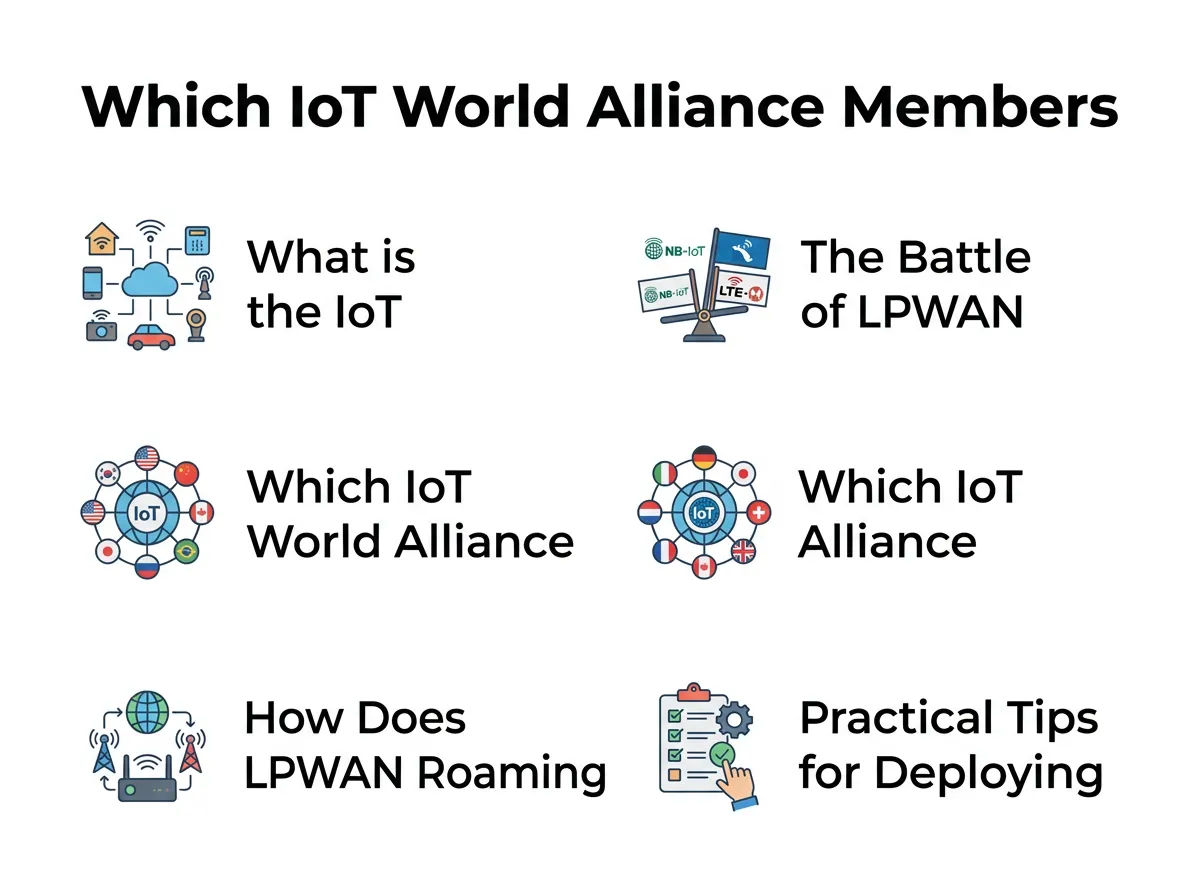
Which IoT World Alliance Members Support NB-IoT and LTE-M Roaming in Europe and Asia? — key points at a glance
Choosing the Right Standard for Your Devices
Narrowband IoT (NB-IoT) is perfect for simple, stationary devices. Think of smart soil sensors in a field or water meters in a basement. It uses very little bandwidth. It can penetrate deep underground and through thick concrete. However, it does not handle moving objects very well.
On the other hand, LTE-M (Long Term Evolution for Machines) is great for mobile devices. It offers higher data speeds. It supports voice features. If you are tracking a moving vehicle, LTE-M is your best bet. Because these technologies serve different needs, businesses often require access to both. When you deploy globally, you must understand the NB-IoT and LTE-M roaming possibilities offered by your provider.
Which IoT World Alliance Members Support NB-IoT and LTE-M Roaming in Europe and Asia?
Let us get straight to the members driving this change. The alliance includes key players who have built extensive roaming corridors across Europe and Asia. These operators make global tracking a reality.
European Leaders in LPWAN
In Europe, three major alliance members dominate the LPWAN space:
- Deutsche Telekom: They are a pioneer in NB-IoT roaming. They have established agreements across dozens of European countries. Their network offers stable connections for millions of devices.
- Orange: Operating heavily in France, Spain, Belgium, and Eastern Europe, Orange supports both standards. They focus heavily on LTE-M for fleet management and logistics. This makes them a key partner for companies with moving assets.
- Telefonica: With deep roots in Spain, Germany, and the UK, Telefonica offers robust LPWAN services. They have worked hard to build cross-border paths, helping businesses look for global LTE-M coverage options.
Asian and Pacific Giants
As we move east, the alliance relies on powerful regional operators to keep the connection alive:
- Singtel: Based in Singapore, Singtel is a major hub for Southeast Asian connectivity. They support both NB-IoT and LTE-M, ensuring major trade hubs are fully connected.
- KDDI: This Japanese giant offers highly advanced IoT services. They have partnered with other alliance members to allow seamless roaming for devices entering or leaving Japan.
- Telstra: In Australia, Telstra covers massive geographic areas. Their LTE-M network is incredibly strong, perfect for tracking cargo ships and planes as they enter the Asia-Pacific region.
How Does LPWAN Roaming Actually Work?
Roaming sounds simple on paper. You turn on your phone in a new country, and it just works. But for low-power IoT, the process is much more complex.
Technical and Commercial Hurdles
When a device roams, it has to tell the new network who it is. This is called a network handshake. On normal cell networks, this handshake happens quickly but uses a lot of power. For a battery-powered sensor, a long handshake can drain the battery in weeks instead of years.
To fix this, members of the IoT World Alliance use optimized network protocols. They also rely on advanced BICS IoT connectivity solutions to bridge the gaps between various national carriers. This reduces power usage. It ensures the device stays in sleep mode as much as possible, which protects battery life.
Practical Tips for Deploying Your IoT Devices
Are you planning a global rollout? Here are a few practical tips to keep in mind before you ship your first batch of devices.
Test Your Hardware Early
Not all NB-IoT chips are the same. Some chips support only specific frequency bands. Before you buy thousands of sensors, test them in your target countries. Ensure they can handle the specific bands used by partners like Deutsche Telekom or Singtel. A physical test in the local market is worth a thousand spec sheets.
Choose the Right SIM Technology
Use eSIM (eUICC) technology if possible. An eSIM allows you to change network profiles over the air. If an alliance member changes their roaming agreements, you can update your devices without physically replacing the SIM cards. This saves time, money, and logistic headaches.
The Future of Global IoT Connectivity
The landscape of IoT is shifting fast. By 2025 and beyond, we will see even more cooperation. The question of Which IoT World Alliance Members Support NB-IoT and LTE-M Roaming in Europe and Asia? will become simpler as networks mature. We expect virtually all alliance members to offer full, mutual roaming for both standards. This will make global tracking as easy as sending a text message.
Building a global IoT network can feel like putting together a giant puzzle. But with the right partners, it becomes simple. The IoT World Alliance provides the framework. Members like Deutsche Telekom, Orange, Singtel, and KDDI provide the actual boots on the ground. By using their combined networks, you can deploy your devices with confidence, knowing they will stay connected from Europe to Asia.
Frequently Asked Questions
What is the main difference between NB-IoT and LTE-M roaming?
NB-IoT roaming is optimized for low-bandwidth, stationary devices that need deep indoor penetration. LTE-M roaming supports higher data rates and seamless handovers between cell towers, making it ideal for mobile assets and tracking.
Do all IoT World Alliance members support NB-IoT?
Most major members in Europe and Asia support NB-IoT, but availability varies by country. It is always best to check the specific coverage maps of partners like Deutsche Telekom and Singtel before deploying.
Can I use a single SIM card for roaming in Europe and Asia?
Yes, by using an alliance member’s global SIM or an eSIM, you can access multiple networks across both continents. This eliminates the need to swap physical SIM cards when crossing borders.
What is the role of eSIM in LPWAN roaming?
eSIM technology allows you to download new network profiles over the air. This ensures your devices can switch to active local partners if roaming agreements change in the future.
Does roaming drain an IoT device’s battery faster?
It can if the device struggles to find a network or performs long handshakes. Working with alliance members who optimize low-power roaming protocols helps minimize this battery drain.
Which European carriers are best for cross-border NB-IoT tracking?
Deutsche Telekom, Orange, and Telefonica are the strongest European choices. They have the most mature NB-IoT networks and extensive cross-border roaming agreements in place.
