


Choosing the right partner to oversee your connected fleet is critical for scaling successfully. The leading IoT device management providers include global cloud giants like AWS and Microsoft Azure, alongside specialized industry experts like Particle, Telit, and Pelion. These companies offer robust platforms that streamline device provisioning, security updates, and real-time monitoring to keep your network running smoothly.
Imagine you have one smart light bulb in your living room. It is very easy to use. You download a simple app on your phone. You tap a button, and the light turns on. But what if you run a business with ten thousand smart devices? What if these devices are scattered across ten different cities? Managing them one by one is impossible.
This is where smart business tools come in. Businesses need a way to track, update, and secure all their connected hardware from one single screen. Today, we will look at the best ways to do this. We will answer the big question: What Are the Top IoT Device Management Companies? Let us dive in and see which providers can help you scale your business.
We will cover the top players in the market. We will look at giant cloud providers and smaller, specialized helpers. By the end of this guide, you will know exactly which partner fits your business needs.
Key Takeaways
- Cloud Giants Lead: AWS IoT Core and Microsoft Azure IoT Hub remain the most scalable options for massive, global deployments.
- Security is Paramount: Top providers prioritize end-to-end encryption, secure boot, and automatic over-the-air (OTA) updates.
- Specialized Platforms Exist: Niche providers like Particle and Telit offer excellent end-to-end hardware and software integration.
- Lifecycle Management is Key: Good device management covers everything from initial factory onboarding to final decommissioning.
- Cost vs. Complexity: Businesses must weigh the low entry cost of major cloud suites against the ease of use of specialized platforms.
📑 Table of Contents
Why You Need IoT Device Management Companies
Before we look at the names, let us talk about why these services matter. A connected device is like a tiny computer. It needs updates. It needs security. It needs to send data back to you. If a device stops working, you need to know right away.
The best IoT device management companies take away the stress of managing these fleets. They offer platforms that act as a central brain for your hardware. Without them, your team would spend all their time fixing broken connections. In the tech world, these firms are known as IoT device management companies.
The Core Jobs of Device Management
Good software does a few key jobs. First, it helps you set up new devices fast. This is called onboarding. Second, it lets you change settings from far away. Third, it monitors device health. It tells you if a battery is low or if a device goes offline. Finally, it sends out security patches to keep hackers away. You can learn more about this by reading about highly rated IoT device management software currently on the market.
The Giant Cloud Providers
When people search for IoT device management companies, they often find the biggest tech brands in the world. These companies have massive cloud networks. They can handle millions of devices at the same time.
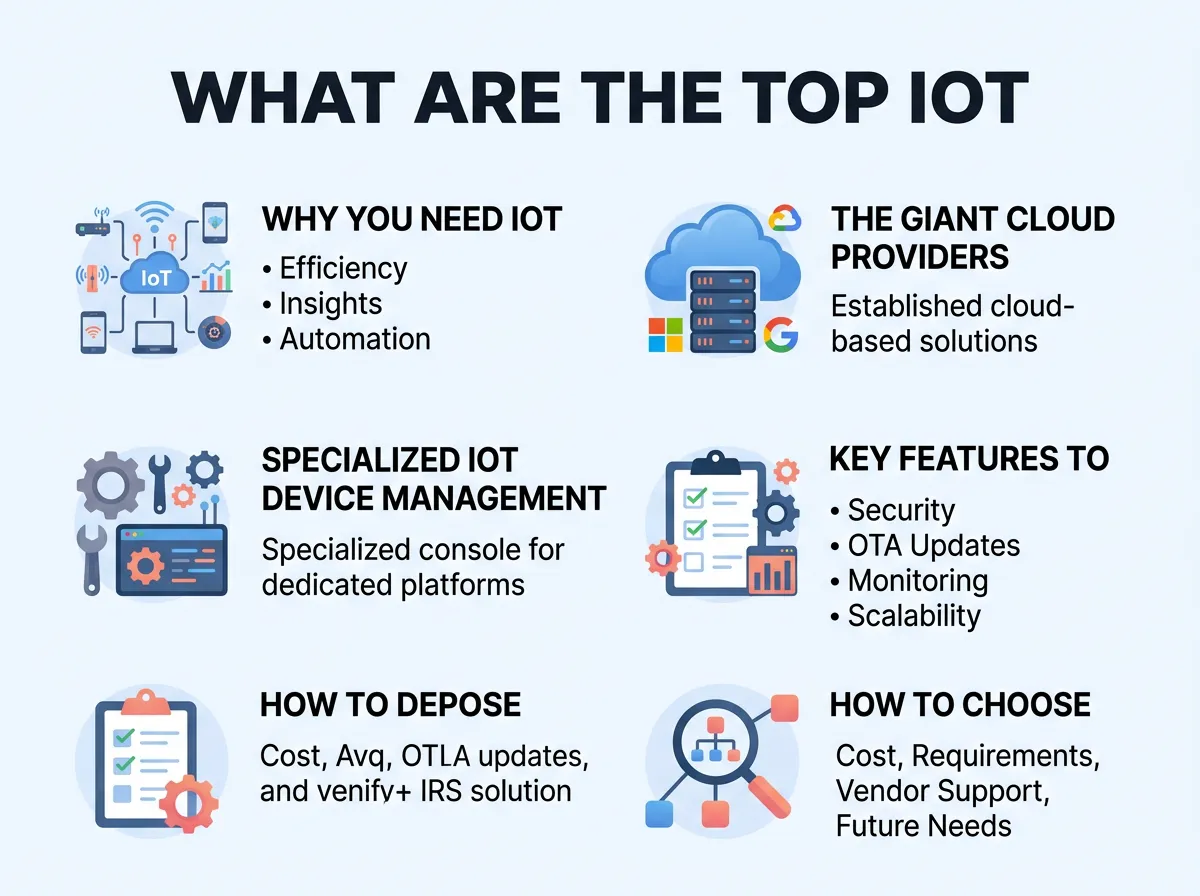
What Are the Top IoT Device Management Companies? — key points at a glance
Amazon Web Services (AWS) IoT Core
Amazon is a giant in the cloud world. Their tool is called AWS IoT Core. It is incredibly powerful. AWS lets you connect devices to the cloud easily. It can process billions of messages every day. It also routes those messages to other AWS tools safely.
AWS is great for large businesses. It offers amazing security. However, it can be hard to learn at first. You may need a trained engineer to set it up. But once it runs, it can scale to any size. This makes Amazon one of the absolute top IoT device management companies today.
Microsoft Azure IoT Hub
Microsoft is another giant in this space. Azure IoT Hub is their main tool. It offers secure communication between your IoT devices and the cloud. It works well with other Microsoft software. If your business already uses Microsoft tools, this is a very natural choice.
Azure makes it easy to update your devices. They have a tool called Device Update for IoT Hub. This tool sends updates to your devices without any hassle. It helps keep your devices safe from new online threats.
Specialized IoT Device Management Companies
Sometimes, giant cloud platforms are too complex. You might want a simpler solution. Some IoT device management companies focus only on connected devices. They offer end-to-end services that include both hardware and software. You can compare how these specialized players stack up in a detailed comparison of top IoT platforms.
Particle: Easy Edge-to-Cloud
Particle is a very popular choice for growing businesses. They do things a bit differently. They provide the cellular hardware, the cloud connection, and the management software all in one package. This makes it very easy to get started. Unlike some other IoT device management companies, they keep things simple.
With Particle, you do not have to worry about buying chips from one place and software from another. Everything works together out of the box. Their portal is very clean and easy to use. It is great for teams that want to move fast without deep cloud expertise.
Telit: Industrial Strength IoT
Telit is a leader in industrial settings. They have been in the wireless business for a long time. Their platform helps companies manage complex industrial machines. Telit is great at handling different types of network connections, like 5G and LTE.
If your devices are in remote areas, Telit is a strong option. They focus heavily on connection reliability. They make sure your data gets through, even in places with bad cell service.
Pelion: Deep Security and Lifespan Care
Pelion is another excellent name among specialized IoT device management companies. It started as part of ARM, the famous chip design company. Pelion is built with deep security in mind. It works well with many different types of chips and devices.
Pelion makes it easy to manage devices over their entire lifespan. They help you secure devices from the factory floor all the way to their final retirement. This makes them a trusted partner for enterprise clients.
Key Features to Look For
Every business has different needs. But there are some features you should always look for. When you compare IoT device management companies, keep these key elements in mind.
Over-the-Air (OTA) Updates
Your devices will need new software over time. You cannot go to each device with a cable to update it. You need a platform that can send updates through the air. This is called an OTA update. The best IoT device management companies make OTA updates safe and simple. If an update fails, the device should go back to its old settings automatically so it does not break.
Real-Time Alerts and Monitoring
You need to know the moment a device goes offline. Look for companies that offer clear dashboards. You should be able to see all your devices on a map. The system should send you an email or a text message if something goes wrong. This helps you fix problems before your customers even notice them.
Strong Security Protocols
Security is the biggest challenge in IoT. Hackers love to target smart devices because they are often weak. The best IoT device management companies use strong encryption. They make sure each device has its own unique password or certificate. This prevents a single hacked device from putting your entire network at risk. You can read more about how security fits into the bigger picture in detailed reports on IoT platforms.
How to Choose the Best Partner
Now you know the top players. How do you choose the right one for your business? Here are a few simple tips to guide your choice.
Look at Your Team’s Skills
Do you have a big team of software developers? If yes, a giant like AWS or Azure is a great choice. They give you total control. But what if you have a small team? In that case, look for specialized IoT device management companies like Particle. They do more of the heavy lifting for you.
Think About Your Budget
Cloud giants often charge you based on how much data you use. This can be very cheap at first. But it can get expensive if your devices send a lot of messages. Specialized companies often have simpler, predictable monthly pricing. Make sure to estimate your costs before you sign up.
Hardware Compatibility
Not all IoT device management companies support every type of hardware. Some work best with their own chips. Others work with almost any device. Make sure the company you choose supports the specific sensors and microchips you plan to use in your products.
Test Before You Commit
Many IoT device management companies offer free trials. You can connect a few devices and see how the software feels. Is it easy to use? Does the support team help you when you get stuck? Testing first will save you a lot of headache later.
Conclusion
Managing a fleet of connected devices does not have to be a nightmare. By partnering with one of the top IoT device management companies, you can focus on growing your business. Whether you choose a giant like AWS or Microsoft, or a dedicated specialist like Particle, the right tool is out of the box and waiting for you. Take your time, test a few options, and watch your smart business grow!
Frequently Asked Questions
What is IoT device management?
IoT device management is the process of setting up, monitoring, updating, and securing connected smart devices. It allows businesses to manage thousands of devices remotely from a single digital dashboard. This keeps the network secure and running smoothly without manual, on-site fixes.
Why is security so important for IoT devices?
Smart devices are often targets for hackers because they have limited computing power and weak built-in security. A single hacked device can expose your entire network to data theft or malware. Using a proper management platform helps you push instant security updates to protect your devices.
Can I manage different types of hardware on one platform?
Yes, many top platforms are designed to be hardware-agnostic, meaning they support various chips and sensors. However, some specialized platforms work best when you use their specific hardware. Always check compatibility before choosing a provider.
What does an OTA update mean in IoT?
An OTA update stands for “Over-the-Air” update, which means sending new software to your devices wirelessly over the internet. This is crucial for fixing bugs and adding features to devices that are already deployed in the field. It saves businesses from having to physically retrieve or plug in devices to update them.
Are cloud giants better than specialized IoT companies?
Cloud giants like AWS and Azure offer massive scale and custom options, but they require deep technical skills to set up. Specialized companies like Particle are easier to use because they bundle hardware, connectivity, and software together. The best choice depends on your team’s technical skills and budget.
How much does IoT device management cost?
Pricing varies widely depending on the provider you choose and how much data your devices send. Cloud giants typically charge per message or per active device, which is cheap for small networks but can scale up. Specialized providers often use flat monthly subscription fees based on device tiers.
