


An NB-IoT SIM card is a specialized cellular card designed to connect low-power Internet of Things (IoT) devices over long-distance networks. It enables devices like smart meters and environmental sensors to transmit small packets of data reliably while using minimal energy, allowing batteries to last for over ten years. Unlike standard mobile SIMs, these cards are built for deep signal penetration, ensuring coverage even in underground or remote areas.
Imagine a water meter buried deep in a concrete basement. It needs to send its readings to the utility company once a day. It has no access to power outlets, and a Wi-Fi signal cannot penetrate the thick concrete walls. How does this little device communicate without draining its battery in a week? This is where the magic of modern internet of things (IoT) technology comes into play.
When we think of SIM cards, we usually think of the tiny plastic chips inside our smartphones. We use them to stream videos, browse social media, and make calls. However, smart machines do not need high-speed internet to do their jobs. Instead, they need a different kind of connection—one that is highly reliable, incredibly power-efficient, and capable of reaching deep underground.
In this guide, we will dive deep into the technology that makes this possible. We will explore how these unique cellular cards work, why they are essential for modern industries, and how they compare to traditional mobile connections. By the end of this article, you will understand exactly why this technology is shaping the future of smart connectivity.
Key Takeaways
- Low Power Consumption: NB-IoT SIMs are optimized for devices that sleep most of the time, extending battery life up to a decade.
- Deep Coverage: They excel at sending signals through thick walls and underground structures, unlike standard SIMs.
- Cost-Effective Connectivity: These cards operate on low-cost data plans, perfect for sending small, infrequent packets of data.
- Scalability: Network providers can support tens of thousands of NB-IoT devices within a single cell site.
- Global Standards: Built on cellular 3GPP standards, they offer secure, reliable, and standardized connectivity worldwide.
📑 Table of Contents
What Makes an NB-IoT SIM Card Different?
To truly understand this technology, we must look at how it differs from the SIM card in your phone. A standard SIM is built for speed. It allows you to download files and watch high-definition videos over 4G or 5G networks. But this speed requires a massive amount of power.
An NB-IoT SIM card, on the other hand, is built for efficiency. NB-IoT stands for Narrowband Internet of Things. It is a specialized cellular standard created by the 3GPP telecom organization. It uses very narrow frequency bands to transmit small amounts of data.
Form Factors and Durability
These specialized NB-IoT SIM cards come in different physical shapes. You can get them as standard plastic triple-cut SIMs (micro, nano, and mini). However, they often come as embedded SIMs (MFF2), which are soldered directly onto the device’s circuit board during manufacturing. This makes them highly resistant to extreme temperatures, dust, vibration, and moisture. If you want to explore the physical variations, you can read more about different types of IoT SIM cards and how they protect hardware in harsh environments.
Data Consumption Patterns
Standard SIMs expect continuous, heavy data usage. An NB-IoT SIM card expects the exact opposite. It is designed for devices that sleep most of the time and wake up occasionally to send a tiny packet of data. This might be a temperature reading, a GPS coordinate, or a simple status report. Because the data packets are so small, the data plans for these SIMs are incredibly inexpensive.
How Does NB-IoT Technology Work?
The technology behind these NB-IoT SIM cards is fascinating. According to the technical details found on Wikipedia’s Narrowband IoT page, it operates on a bandwidth of just 180 kHz. To put that in perspective, a standard 4G channel can be up to 20 MHz wide. That is like comparing a narrow bike path to a twenty-lane highway.
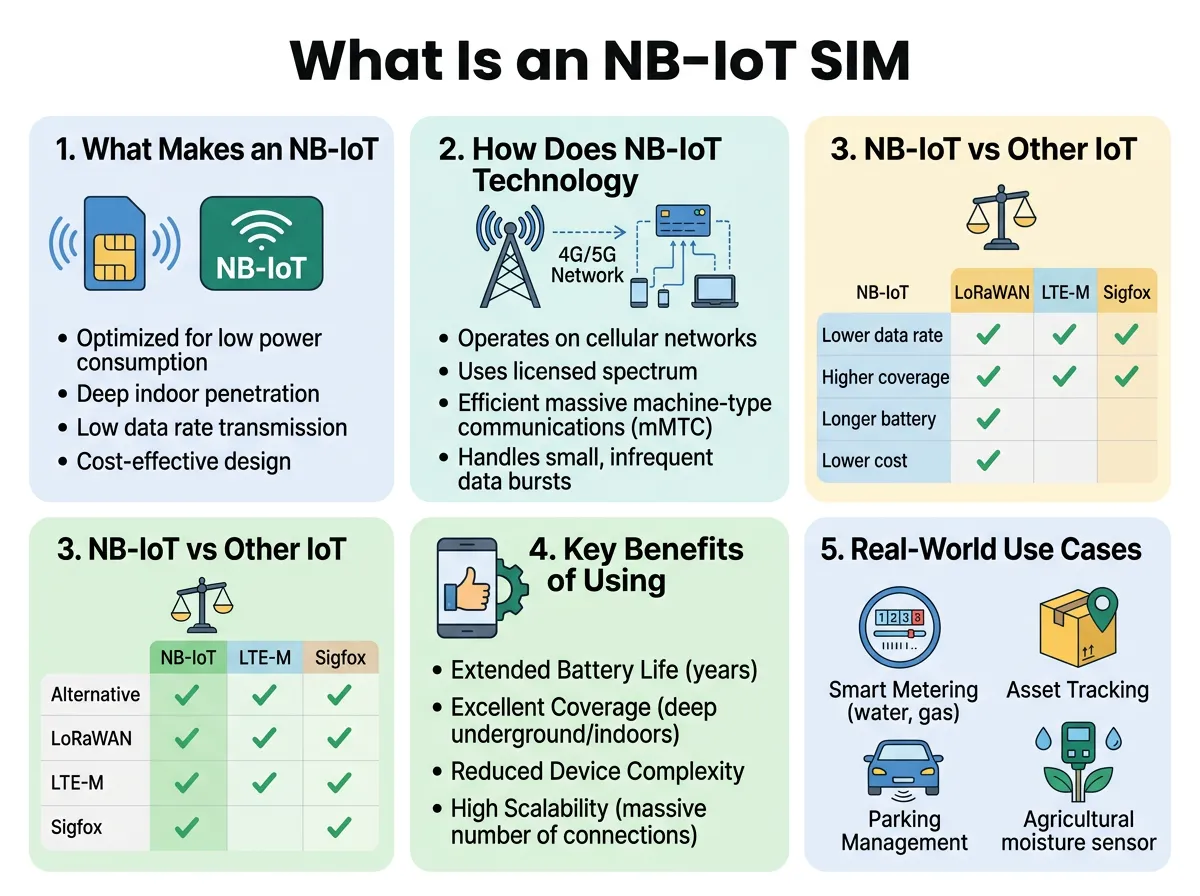
What Is an NB-IoT SIM Card? — key points at a glance
Narrow Bandwidth, Big Reach
Because the bandwidth is so narrow, the signal is highly concentrated. This concentration allows the signal to travel much further than standard cellular waves. It also allows the signal to pass through obstacles like thick brick, concrete, and soil. This makes it the perfect solution for devices placed inside metal enclosures or deep in basements.
Power Saving Modes (PSM and eDRX)
One of the biggest advantages of this technology is how it manages power. Two features make this possible: Power Saving Mode (PSM) and Extended Discontinuous Reception (eDRX).
PSM allows the device to go into a deep sleep mode where it is unregistered from the network but remains attached. This means it does not waste energy searching for a signal when it wakes up. eDRX allows the device to check for incoming messages at much longer intervals than normal mobile phones, saving precious battery life.
NB-IoT vs. Other IoT Connectivity Options
When building an IoT project, you have several cellular options. Understanding the differences will help you make the right choice for your deployment.
NB-IoT vs. Standard SIM Cards
Traditional consumer SIM cards are designed for high-bandwidth activities. If you put a standard SIM into a remote sensor, the device would run out of battery within days. A standard SIM constantly searches for the strongest cell tower, which drains power. You can learn more about how industrial connectivity differs from consumer mobile plans by reading about what is an IoT SIM card and how it serves business needs.
NB-IoT vs. LTE-M
Another common option is LTE-M (Long Term Evolution for Machines). While both are designed for IoT, they serve different purposes. LTE-M offers higher data rates, supports voice transmission, and handles handovers between cell towers seamlessly. This makes LTE-M ideal for moving objects like vehicles.
Conversely, NB-IoT is designed for static devices that do not move often and only send small data packets. It offers better signal penetration and lower power consumption than LTE-M. For a deeper dive into these technical differences, check out this guide on NB-IoT vs LTE-M.
Key Benefits of Using an NB-IoT SIM Card
If you are planning to deploy smart devices, using a dedicated NB-IoT SIM card offers several distinct advantages.
Exceptional Battery Longevity
Because the network and the SIM are optimized for low-power states, devices can run on a single battery for up to ten years. This reduces maintenance costs dramatically, as you do not need to send technicians to change batteries constantly.
Superior Signal Penetration
With an extra 20dB of signal gain compared to standard GSM, these SIMs can connect in places where other devices fail. Whether it is a water meter in a deep cellar or a sensor in a dense forest, the signal gets through.
Reduced Operational Costs
The hardware components for NB-IoT are simpler and cheaper to manufacture. Additionally, because the data usage is minimal, the recurring network subscription fees are very low.
Real-World Use Cases for NB-IoT SIMs
This technology is not just theoretical; it is actively changing how industries operate.
Smart Agriculture
Farmers place soil moisture sensors across hundreds of acres of farmland. These sensors do not need high-speed internet. They only need to send a simple moisture reading once every few hours. An NB-IoT SIM card keeps these sensors online for years without a battery change.
Utility Metering and Smart Cities
Gas, water, and electricity companies use these SIMs to automate meter readings. Instead of sending workers to manually read meters, the meters transmit usage data directly to the utility company. This reduces errors and cuts operational costs.
Asset Tracking in Remote Areas
While LTE-M is often preferred for rapid movement, NB-IoT is perfect for stationary assets or slow-moving items in remote locations. Cargo containers, waste bins, and environmental monitoring stations all benefit from this technology.
Tips for Choosing the Right NB-IoT SIM Card Provider
When selecting a provider for your project, keep these practical tips in mind:
- Check Local Coverage: Ensure the carrier has active NB-IoT bands in your deployment area, as coverage can vary by country and region.
- Look for Global Roaming: If your devices will be shipped across borders, choose a provider that offers multi-network roaming agreements.
- Evaluate Management Platforms: A good provider should offer a user-friendly connectivity management platform (CMP) to monitor data usage, manage SIM states, and set alerts.
- Consider the Form Factor: Determine if your hardware requires standard plastic SIM cards or rugged, soldered eSIMs (MFF2).
Conclusion
The Internet of Things is growing at an incredible pace, and it requires efficient, reliable communication channels to thrive. The NB-IoT SIM card is the perfect answer for devices that need to send small amounts of data over long distances without consuming much power. By offering superior signal penetration, decade-long battery life, and low operational costs, this technology is unlocking new possibilities for smart cities, modern agriculture, and industrial automation. Whether you are building a fleet of smart meters or deploying agricultural sensors, choosing the right connectivity solution is the first step toward long-term success.
Frequently Asked Questions
Can I use an NB-IoT SIM card in my smartphone?
No, you cannot use an NB-IoT SIM card in a standard smartphone. Smartphones require high-bandwidth connections for web browsing and media streaming, which NB-IoT networks do not support. Additionally, standard smartphones do not have the specific modems required to communicate with NB-IoT bands.
How long does an NB-IoT SIM card battery last?
Devices using NB-IoT SIM cards can have a battery life of up to ten years or more. This exceptional longevity is made possible because the devices remain in a deep sleep state for most of the day, waking up only briefly to transmit small packets of data.
What is the main difference between NB-IoT and LTE-M?
The main difference lies in bandwidth, mobility, and data speed. LTE-M supports higher data speeds, voice transmission, and seamless cell tower handovers for moving objects. NB-IoT offers lower data speeds but provides much better signal penetration and energy efficiency for stationary devices.
Does NB-IoT require 5G networks to work?
No, NB-IoT does not strictly require 5G networks to function, as it was originally built on 4G LTE infrastructure. However, it is fully compatible with 5G networks and has been officially accepted as part of the 5G cellular standard for massive IoT deployments.
Are NB-IoT SIM cards expensive?
No, NB-IoT SIM cards and their corresponding data plans are highly cost-effective. Because these devices consume very little data—often only a few kilobytes or megabytes per month—the monthly subscription fees are significantly lower than standard mobile plans.
Where are NB-IoT SIM cards most commonly used?
They are most commonly used in industrial and smart city applications. Popular examples include automated water and gas meters, soil moisture sensors in smart agriculture, smart waste management bins, and static asset trackers in remote environments.
