

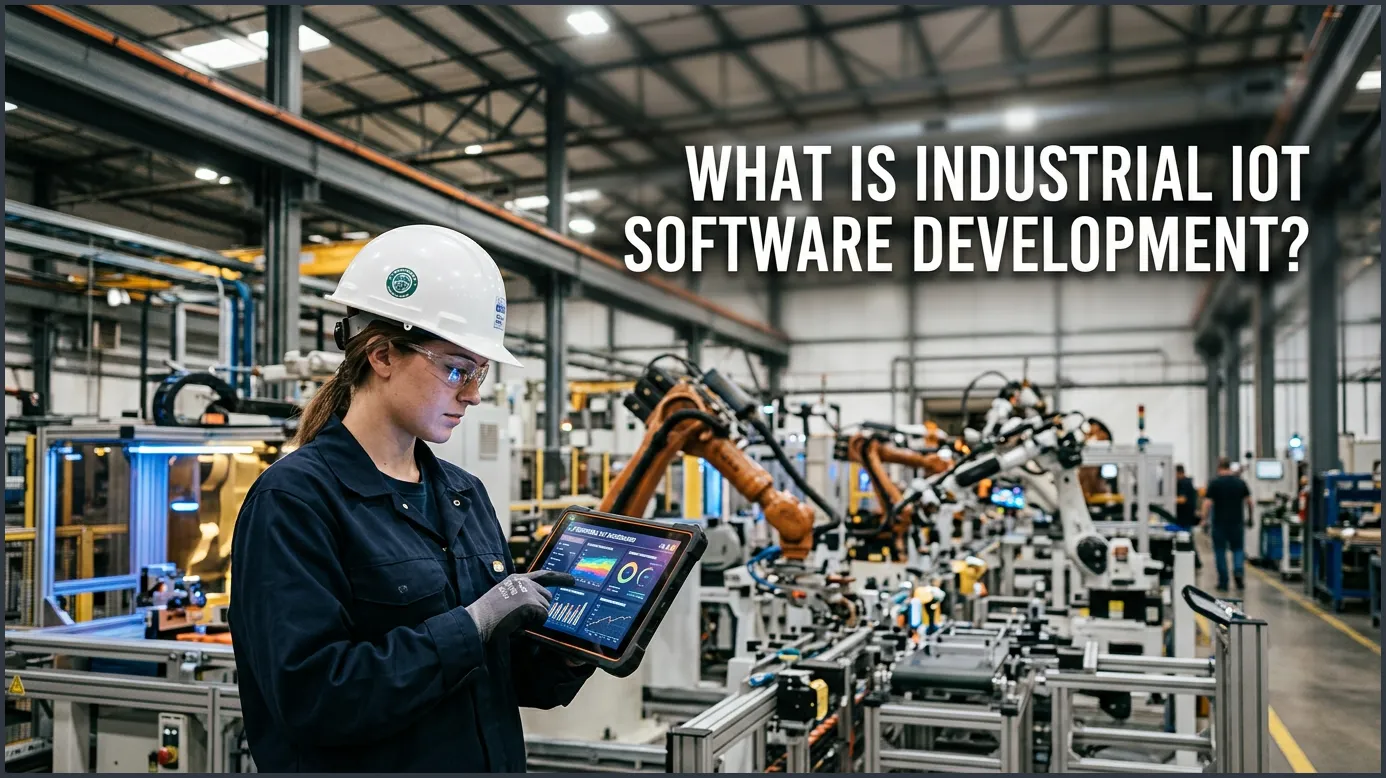
Industrial IoT software development is the process of building custom applications that connect heavy industrial machinery with digital networks. This specialized software allows factories, warehouses, and energy plants to collect, analyze, and use real-time machine data to improve daily operations. By bridging the gap between physical hardware and cloud databases, it helps industries automate complex tasks and predict machine failures before they happen.
Imagine walking onto a modern factory floor. You hear the loud hum of giant machines. Sparks fly, gears turn, and conveyor belts roll. For decades, these machines did their jobs in total silence. They worked until they broke. When a breakdown happened, everything stopped, costing the company time and money. Today, a quiet revolution is happening inside these heavy metal frames. Machines are finally talking to us.
Modern industrial machines share their temperature, speed, and health in real time. This amazing shift does not happen by magic. It happens because of clever, custom-written code. You might wonder, what is the brain behind this shift? That is exactly where our main topic comes into play.
In this guide, we will explore the world of smart machinery. We will see how code connects physical gear to digital screens. We will look at how teams build these tools, why they matter, and what you need to get started.
Key Takeaways
- Bridge to Physical Systems: This type of development connects real-world industrial machines directly to digital networks.
- Predictive Maintenance: The software analyzes data trends to predict when machines need repairs, reducing costly downtime.
- High Security Needs: Industrial software must have top-tier cybersecurity to protect critical physical plants from hackers.
- Specialized Protocols: Developers use specific communication protocols like MQTT and OPC UA to let machines talk to the cloud.
- Edge Computing: Processing data right on the factory floor helps systems make instant decisions without delay.
📑 Table of Contents
Demystifying Industrial IoT Software Development
To grasp this field, we must first look at the Industrial Internet of Things (IIoT). For a deep dive, you can learn more about what is industrial internet of things and how it shapes modern factories. In simple terms, it is a network of smart devices. Industrial IoT software development is the creation of the software that runs this entire network.
The Core Definition
This process involves writing code for devices used in industrial settings. These settings include water plants, oil rigs, warehouses, and factories. Developers write code that runs on tiny chips inside machines. They also build cloud platforms that organize and show this data to managers.
Consumer IoT vs. Industrial IoT
Consumer IoT is about convenience. Think of smart lightbulbs or home thermostats. If a smart bulb loses its connection, your room stays dark for a moment. It is annoying, but nobody gets hurt.
Industrial IoT is different. It deals with high-stakes environments. If a sensor on a pressure valve fails on an oil rig, it can lead to a major disaster. Therefore, industrial software must be highly reliable, incredibly secure, and able to run without stopping.
Key Components of an IIoT Software System
An industrial software system has many moving parts. It is not just a single application. It is a large ecosystem where hardware and software work together.
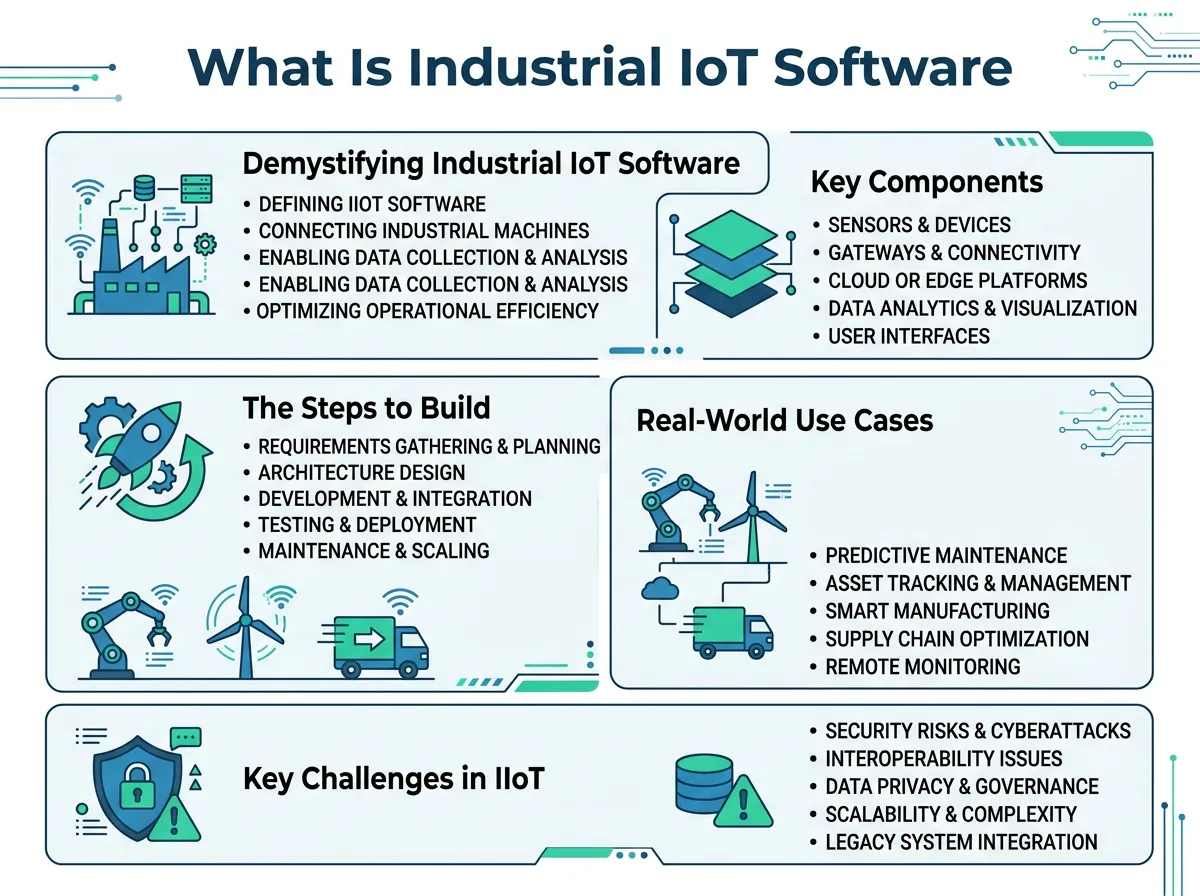
What Is Industrial IoT Software Development? — key points at a glance
Smart Edge Devices and Sensors
Sensors are the eyes and ears of the system. They measure heat, vibration, speed, and sound. Developers write lightweight code that runs directly on these devices. This code helps the sensors collect raw data and send it to the next level.
Connectivity and Protocols
Machines speak different digital languages than laptops. Developers use special protocols to bridge this gap. Common protocols include MQTT, CoAP, and OPC UA. These systems ensure that data travels safely across weak wireless networks on factory floors.
The Central Platform and Dashboard
Once the data leaves the machines, it needs a place to go. This is where a centralized platform comes in. To understand how these platforms process raw data, you can read about what is an IIoT platform and how it acts as the nervous system of an operation. It displays real-time data on user-friendly screens for plant managers.
The Steps to Build Industrial IoT Software
Creating this software requires a careful, step-by-step approach. You cannot simply write code and hope for the best. You must plan for physical and digital challenges.
Step 1: Connecting Legacy Equipment
Most factories have machines that are twenty years old. These machines do not have internet chips. Developers must find ways to add external sensors to these older systems. For practical tips, you can read this guide on connecting and managing machines in manufacturing plants. This step forms the foundation of any project.
Step 2: Data Ingestion and Processing
A single factory can generate gigabytes of data every minute. Developers must build systems that can handle this flood of information. They use edge computing to process data locally. This means the system filters out useless data before sending the important bits to the cloud.
Step 3: Security Integration
Security cannot be an afterthought. Developers must build end-to-end encryption into the code. This ensures that even if someone intercepts the data, they cannot read it or control the machines.
Real-World Use Cases and Examples
Why do companies spend money on this development? Because it saves them time, energy, and resources. Here are two practical examples of this software in action.
Predictive Maintenance
Imagine a giant cooling fan in a car factory. If the fan breaks, the whole assembly line stops. With smart software, a sensor tracks the fan’s vibration. If the fan starts to wobble, even slightly, the software flags it. The system alerts a mechanic to fix the fan during a scheduled break. No unplanned downtime occurs.
Real-Time Asset Tracking
In large warehouses, finding a specific shipping container can take hours. Smart software connects to GPS and Bluetooth tags on each container. Workers can look at a tablet and see the exact location of any item in seconds. This saves hours of manual searching every single day.
Key Challenges in IIoT Development
Building this software is not always easy. Developers face unique hurdles that do not exist in standard web development.
Dealing with Dirty Environments
Factories are hot, dusty, and loud. Wireless signals can bounce off metal walls and drop out. Developers must write code that can handle lost connections gracefully. The software must store data locally and upload it once the connection returns.
Extreme Cybersecurity Risks
If a hacker gains access to a bank app, they steal money. If a hacker gains access to a water treatment plant, they can change chemical levels. The physical danger is much higher. Developers must use strict access controls, secure firewalls, and continuous updates to keep systems safe.
Future Trends in Industrial IoT Software
The world of industrial software is moving fast. New technologies are making these systems even smarter and more efficient.
Artificial Intelligence at the Edge
In the past, the cloud did all the heavy thinking. Now, we are putting AI chips directly onto factory machines. This allows a machine to make split-second safety decisions without waiting for a cloud response.
Digital Twins
A digital twin is a virtual copy of a physical machine. Developers use live data to run tests on the digital twin first. This lets companies see how a machine will react to speed changes before they touch the real equipment.
Conclusion
Industrial IoT software development is changing how the world builds, moves, and manages physical things. By connecting heavy machinery to smart code, companies can work faster, safer, and with fewer mistakes. It is a challenging field that requires a mix of hardware knowledge, software skills, and strong security practices. As technology keeps growing, the silent factories of the past will continue to wake up, talk, and work smarter than ever before.
Frequently Asked Questions
What is the difference between IoT and IIoT software development?
IoT software development focus on consumer products like smart home devices and wearables. IIoT software development focuses on high-stakes industrial environments like factories, power plants, and oil rigs, where safety and reliability are critical.
What programming languages are used in Industrial IoT?
Developers often use C and C++ for writing code on low-power hardware and sensors because of their speed. For cloud platforms and data analysis, they typically use Python, Java, and Go.
How does predictive maintenance work in IIoT software?
Sensors collect continuous data on a machine’s temperature, vibration, and performance. The IIoT software analyzes this data to spot unusual patterns, alerting workers to fix the machine before it breaks down.
What are the biggest security risks in Industrial IoT?
The biggest risks include unauthorized access to physical machinery, data leaks, and malware attacks. Because IIoT connects physical infrastructure to the internet, a cyberattack can cause real-world damage or shut down operations.
What is edge computing in Industrial IoT?
Edge computing is the practice of processing data near the source, such as on the factory floor, rather than sending it to a distant cloud server. This reduces lag time and saves network bandwidth by filtering data locally.
Can old factory machines be used with IIoT software?
Yes, older machines can be integrated into IIoT systems. Developers use retrofitted sensors and gateway devices to collect data from legacy equipment without replacing the entire machine.
