


What Do You Need to Know About IoT Device Batteries? Success in IoT depends on picking the right battery chemistry, managing power draw, and planning for real-world environments. Selecting the wrong power source can lead to early failure and high replacement costs.
Imagine you have a smart home. You set up ten smart sensors to check for leaks. They work great at first. But a few months later, they all stop working. You have to climb ladders to change all of them. This is a big chore. It is also very costly. If you run a business with thousands of sensors, this chore becomes a disaster. You cannot afford to replace cells every few months.
This is why power is so vital. Smart tools are only as good as their power source. If the power dies, the data stops. You must know how to choose, use, and save energy. In this guide, we will look at how IoT device batteries work. We will share tips to help you choose the best option for your next project.
Key Takeaways
- Pick the Right Chemistry: Choose primary batteries for long shelf life or secondary batteries for high daily use.
- Look Beyond Datasheets: Real-world battery life is often much shorter than the numbers on paper.
- Manage Temperature: Extreme heat and cold can drain your battery power in a matter of weeks.
- Control Power Pulses: High power peaks can damage some cells, causing a fast drop in voltage.
- Optimize Software: Use deep sleep modes and clean code to save energy and extend overall battery life.
📑 Table of Contents
What Are the Common Types of IoT Device Batteries?
Not all power cells are the same. Some are built to last for ten years. Others are built to be charged every day. You must match the cell to the job. Let us look at the two main groups of types of IoT device batteries you can use.
Primary (Non-Rechargeable) Batteries
Primary cells are for single use. You use them until they die, then throw them away. They are great for tools in hard-to-reach places. These cells lose very little power when they sit idle. They can sit on a shelf or in a device for years without losing charge.
Lithium-based primary cells are very common. They are light and hold a lot of power. They also work well in cold weather. Many water meters and gas sensors use these cells because they can last for a decade without a swap.
Secondary (Rechargeable) Batteries
Secondary cells can be charged again and again. These are the same types you find in your smartphone. They are great for tools that consume a lot of power. If your tool sends data every minute, you need a rechargeable cell.
Lithium-ion and lithium-polymer are the most popular choices here. They store a lot of energy in a small size. However, they lose charge faster when they sit idle. They also do not like extreme heat or cold. You will need a way to recharge them, like a solar panel or a wall plug.
Why Datasheets Do Not Tell the Whole Story
When you buy cells, you get a sheet of paper with specs. This is called a datasheet. It tells you how much power the cell holds. But do not rely solely on these numbers. They can be very misleading in the real world.
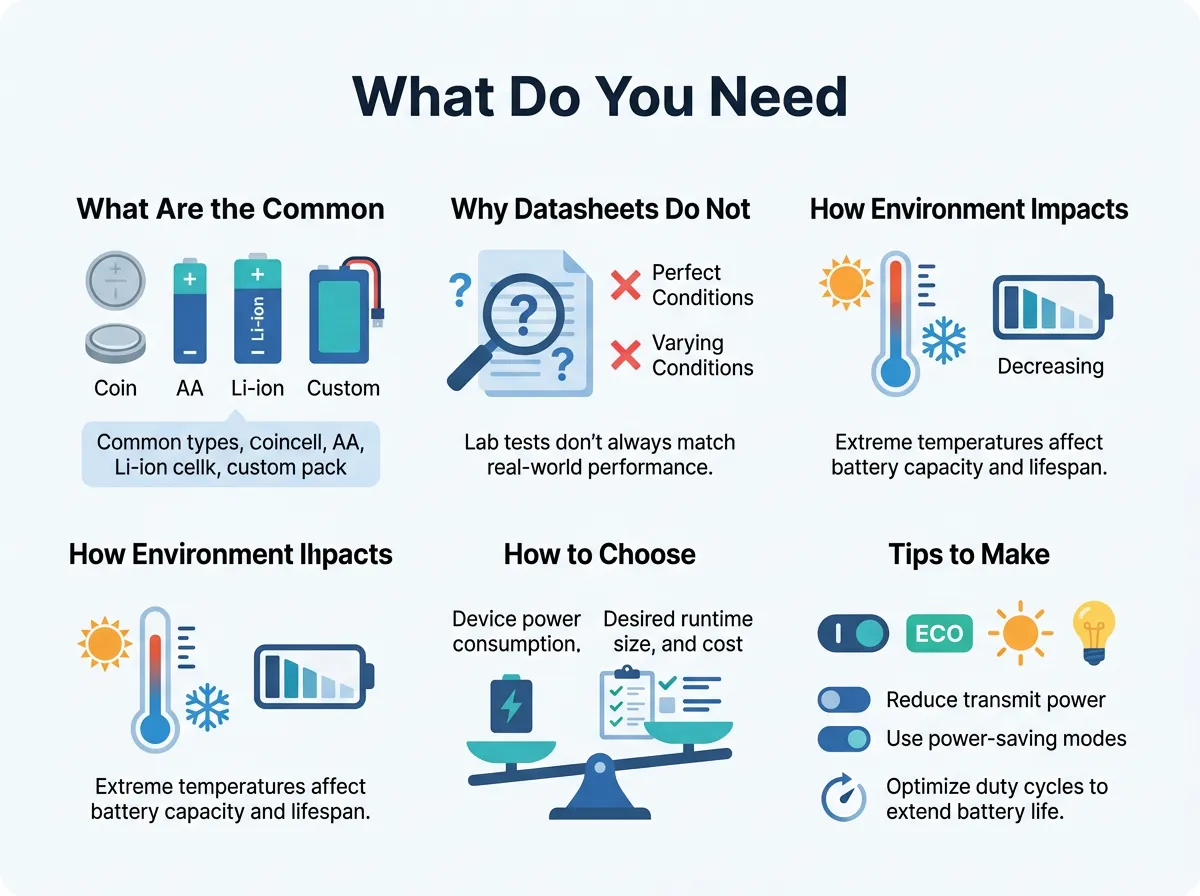
What Do You Need to Know About IoT Device Batteries? — key points at a glance
The Self-Discharge Trap
All IoT device batteries lose energy over time, even when the device is off. This is called self-discharge. A datasheet might say a cell lasts for ten years. But that assumes the cell sits in a perfect room. In real life, self-discharge can cut that time in half. You must choose cells with low self-discharge rates if your tool needs to last for years.
Pulse Currents and Voltage Drops
Most smart tools do not use power at a steady rate. Instead, they sleep most of the time. Then, they wake up to send a radio signal. This requires a big pulse of current. Some cells cannot handle these quick, heavy demands. When they try, their voltage drops too low. The tool might think the cell is dead, even if it has plenty of energy left. You can learn more about how this affects battery life in real-world situations to avoid common mistakes.
How Environment Impacts Your IoT Device Batteries
Where do you plan to put your smart tools? Is it in a warm office or on a freezing farm? Weather plays a huge role in how long your power source will last.
Extreme Heat and Cold
Cold weather slows down chemical reactions. This makes IoT device batteries drain fast. They cannot give off as much power as they do in warm rooms. On the flip side, extreme heat is also bad. Heat can damage the inside of the cell. It makes the cell lose charge much faster. It can even lead to leaks or swelling.
Moisture and Corrosion
Wet places can cause big problems too. Water can rust the metal tabs on your cells. Rust blocks the flow of power. It can also cause short circuits. If you put tools outside, you must seal them tight. A good case keeps water out and keeps the cell safe.
How to Choose the Right Battery for Your Project
With so many choices, how do you pick? It helps to follow a simple plan. You need to look at how your tool uses power and where it will live.
Know Your Device’s Power Profile
How often does your tool wake up? How much power does it use when it sends data? These questions form your power profile. If your tool uses high pulses of power, you need a cell that can handle high current. If your tool uses a tiny drip of power, a simple primary cell is best. Getting this right is key to powering IoT devices without constant maintenance.
Size and Weight Limits
Some tools must be small. A smart ring or a fitness tracker cannot hold a heavy cell. You must balance size and power. Lithium polymer cells are great for odd shapes. They are thin and light. For bigger tools, you can use standard round cells, which cost less and are easy to buy.
Tips to Make Your IoT Device Batteries Last Longer
You do not always need a bigger power source to get more life. You can often make small changes to your tool to save a lot of energy. Here are some simple tips to try.
Optimize Your Code
Bad code can waste power. If your tool takes too long to run a task, it stays awake longer. Keep your code fast and clean. Let the tool do its job and then get back to sleep as fast as possible.
Use Sleep Modes Wisely
Most smart tools should sleep 99% of the time. In deep sleep, the tool uses almost no power. This keeps your IoT device batteries fresh for a long time. Only wake the tool when you really need to send data or read a sensor.
Conclusion
Now you know the basics of IoT device batteries. There is no single best cell for every job. You must look at how your tool works, the weather, and your budget. By choosing the right chemistry and writing smart code, you can keep your devices running for years. Investing in the right IoT device batteries pays off. It saves you time, money, and lots of hard work in the long run.
Frequently Asked Questions
What is the difference between primary and secondary IoT batteries?
Primary batteries are for single use and cannot be recharged, making them great for long-term, low-power tasks. Secondary batteries can be recharged many times, which is ideal for devices that use a lot of power daily.
Why do IoT batteries drain faster in cold weather?
Cold temperatures slow down the chemical reactions inside the battery. This reduces its capacity and makes it harder for the battery to deliver the power your device needs.
What is self-discharge in IoT batteries?
Self-discharge is the natural loss of charge that occurs when a battery sits idle. Even if the device is turned off, the battery will slowly lose its power over time due to internal chemical reactions.
How can I make my IoT device battery last for ten years?
To hit a ten-year lifespan, choose a high-quality primary battery with a low self-discharge rate. You must also design your device to stay in deep sleep mode most of the time and minimize power spikes.
Are lithium batteries safe for all IoT devices?
Lithium batteries are generally safe, but they must be handled with care. They can overheat or swell if they are exposed to extreme heat, short circuits, or physical damage.
Should I rely on the battery lifespan listed on the datasheet?
No, you should not rely solely on the datasheet. Real-world conditions like temperature changes, self-discharge, and high power pulses usually make the battery life much shorter than what is written on paper.
