



A wireless vibration monitoring sensor is a smart, battery-powered device that attaches to industrial machinery to measure shake and movement. By sending real-time data to the cloud, it helps maintenance teams spot tiny faults before they turn into major equipment failures. This easy-to-install tool eliminates the need for manual checks, keeping your plant running smoothly and safely.
Imagine driving your car on a long highway. Suddenly, you feel a tiny, strange wiggle in the steering wheel. It is very soft at first, but over the next few weeks, that wiggle turns into a loud shake. If you ignore it, you know your car will eventually break down. You will end up stranded on the side of the road with a huge repair bill.
Now, imagine running a giant factory with hundreds of fast-spinning machines. A single broken motor can stop your whole production line. This costs your business thousands of dollars every single hour. How do you stop these breakdowns before they start? This is where modern technology comes to the rescue. In this guide, we will explore the ins and outs of industrial maintenance technology to answer a vital question: what is a wireless vibration monitoring sensor, and why is it a game-changer for modern plants?
Key Takeaways
- Early Warning System: These sensors detect tiny, unseen changes in machine movement long before a breakdown happens.
- No Cables Needed: Since they are completely wireless, they are cheap to install and can fit into tight, dangerous, or hard-to-reach areas.
- Continuous Monitoring: They track your equipment 24/7, replacing slow and risky manual inspections.
- Smart Cloud Data: The sensors send data directly to software that alerts you on your phone or computer when a machine needs attention.
- Boosts Safety: Maintenance teams do not have to walk near fast-moving, hot, or dangerous machines to take manual readings.
📑 Table of Contents
What Is a Wireless Vibration Monitoring Sensor?
At its core, a wireless vibration monitoring sensor is a small, rugged device that acts like a digital stethoscope for industrial machines. You stick it directly onto equipment like motors, pumps, fans, and gearboxes. Once in place, it constantly measures how much the machine shakes and wobbles during operation.
Every piece of running machinery makes some natural movement and noise. However, when internal parts begin to wear out, the way the machine shakes changes. A bearing might get loose, or a shaft might bend ever so slightly. A wireless vibration monitoring sensor detects these microscopic changes. It then packages this data and sends it through the air to your computer or smartphone. This gives you a clear, real-time look at your equipment health without using a single wire.
How Do These Smart Sensors Work?
You might wonder how such a tiny device can track the health of a giant steel machine. The process is actually very simple. It relies on a few key steps that happen in the blink of an eye.
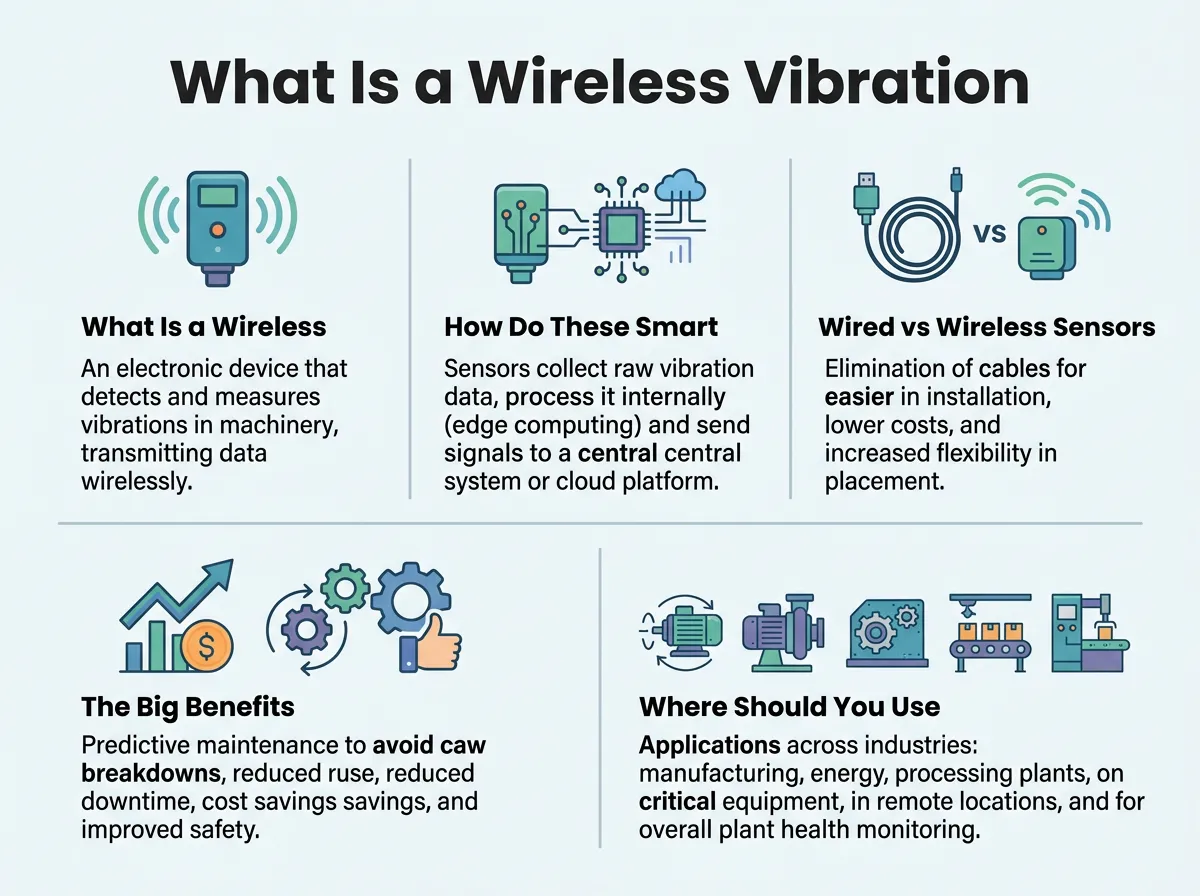
What Is a Wireless Vibration Monitoring Sensor? — key points at a glance
1. Sensing the Motion
Inside the sensor sits a tiny microchip called an accelerometer. Many modern sensors use Micro-Electro-Mechanical Systems (MEMS) technology. This chip acts like a tiny weight on a spring. As the machine shakes, the weight moves. The sensor turns this physical movement into an electrical signal. Many advanced devices are triaxial wireless vibration sensors, which means they can measure shaking in three different directions at the same time: up and down, side to side, and back and forth.
2. Processing the Data
Once the sensor has the electrical signal, it translates the raw movement into numbers. It measures things like acceleration (how fast the shake changes speed) and velocity (how fast the machine is moving back and forth). The sensor can even look at high-frequency stress waves that point to very early bearing wear.
3. Sending the Signal
This is where the “wireless” part comes in. Instead of sending data through a heavy copper cable, the sensor uses radio waves. It can send data using common technologies like Bluetooth, Wi-Fi, cellular networks, or specialized long-range protocols like LoRaWAN. The data travels safely through the air to a nearby gateway, which pushes the information up to the cloud.
Wired vs. Wireless Sensors: Which Is Best?
For many years, factories used wired sensors to track machine health. While wired options are highly reliable, they come with major drawbacks. When deciding between the two, it helps to understand why so many businesses are making the switch to wireless systems.
Installing wired sensors is a massive project. You have to run hundreds of feet of heavy, expensive cables through metal conduits. If a machine is in a hard-to-reach spot, running a wire might be impossible. Furthermore, cables can easily get snagged, cut, or burnt in hot industrial environments. If you want to dive deeper into this choice, you can read this detailed wired vs. wireless vibration sensors guide to see how they stack up side-by-side.
A wireless vibration monitoring sensor, on the other hand, installs in minutes. You can mount it using a strong magnet, special epoxy, or a threaded stud. There are no cables to run, protect, or replace. If you need to move the sensor to a different machine, you simply unclip it and move it. This flexibility makes wireless setups far cheaper and easier to scale across a large factory floor.
The Big Benefits of Going Wireless
Investing in new technology can feel daunting. However, adding wireless sensors to your maintenance routine offers clear, immediate benefits that save time, money, and stress.
- Prevents Unplanned Downtime: This is the biggest benefit. By spotting early signs of wear, you can schedule repairs during normal break times rather than dealing with a sudden, chaotic breakdown in the middle of a busy shift.
- Saves Money on Repairs: Fixing a small, worn-out bearing costs very little. If you let that bearing fail, it can destroy the entire motor, costing you thousands of dollars in replacement parts and lost production time.
- Keeps Workers Safe: Some machines are located in high, hot, or highly toxic areas. Using a wireless vibration monitoring sensor means your maintenance team does not have to climb into dangerous spots just to take a manual reading. They can view the data safely from an office desk.
- 24/7 Peace of Mind: Instead of checking a machine once a month with a handheld tool, these sensors check your gear dozens of times a day. You get instant alerts if something goes wrong unexpectedly.
If you want to explore some of the best tool options available today, you can check out Fluke’s vibration monitoring solutions to see how these devices fit into a modern industrial workspace.
Where Should You Use These Sensors?
While you can use a wireless vibration monitoring sensor on almost any machine, they are especially helpful on critical equipment. Here are the most common places you will find them in action:
Electric Motors
Motors are the muscles of the industrial world. They run pumps, belts, and fans. When a motor shaft goes out of alignment, it shakes. The sensor catches this wobble instantly, saving the motor from burning out.
Water and Chemical Pumps
Pumps often suffer from a problem called cavitation, where bubbles pop inside the fluid and erode the metal. This creates a very specific high-frequency vibration. A smart sensor can hear this hidden damage before the pump leaks.
Cooling Tower Fans
Cooling towers are often located high up on roofs. They are hard to get to and dangerous to inspect while running. Mounting a weatherproof, wireless sensor on these fans keeps your team safe on the ground while still tracking fan health.
Gearboxes
Gearboxes contain complex, interlocking metal teeth. If a single tooth chips or wears down, it changes the vibration pattern of the entire box. Early detection prevents a complete, noisy gear lockup.
Tips for Choosing the Right Sensor
Not all sensors are created equal. To get the best results, you need to match the sensor to your specific plant environment and machinery. Here are a few practical tips to keep in mind:
First, check the frequency range. Slow-moving machines need sensors that can read low frequencies. Fast-spinning turbines require sensors that can capture very high-frequency shakes. Second, look at the battery life. Changing batteries on a hundred sensors every six months is a headache. Look for quality devices with batteries that last three to five years.
Third, consider the durability rating. If your plant is dusty, wet, or uses harsh washdown chemicals, you need a sensor with a high IP rating, such as IP67 or IP69K. This ensures the delicate electronics inside remain dry and functional. You can learn more about picking the right hardware by exploring these high-quality wireless vibration sensors designed for tough industrial environments.
Conclusion
In the past, factory maintenance was mostly reactive. Teams waited for a machine to break down, and then they rushed to fix it. Today, a wireless vibration monitoring sensor gives you the power to see the future. By listening to the quiet hums and tiny shakes of your machinery, these smart tools tell you exactly when, where, and how a machine needs help.
Installing these sensors is quick, affordable, and incredibly safe. They take the guesswork out of maintenance, protect your hard-working team, and keep your business running smoothly. If you want to eliminate unexpected downtime and run a smarter, safer plant, making the jump to wireless monitoring is one of the best moves you can make.
Frequently Asked Questions
What does a wireless vibration monitoring sensor measure?
It measures physical machine movement, focusing on acceleration, velocity, and displacement. These metrics show how fast, how far, and how often a machine shakes during operation, pointing to potential internal damage.
How do you mount a wireless vibration sensor to a machine?
You can easily mount them using super-strong magnets, industrial adhesive epoxy, or threaded studs. The key is to make sure the sensor has tight, direct metal-to-metal contact with the machine housing for the most accurate readings.
How long do the batteries last in these sensors?
Most industrial wireless sensors have an impressive battery life of 3 to 5 years. They save power by sleeping most of the time and only waking up at set intervals, like once an hour, to take and send readings.
What wireless technologies do these sensors use?
They commonly use Bluetooth, Wi-Fi, cellular data, or LoRaWAN to send their readings. The right choice depends on how far apart your machines are and how much metal interference is in your factory.
Can these sensors handle hot and wet factory conditions?
Yes, most high-quality sensors are built specifically for harsh environments. They feature sealed, rugged outer shells with IP67 or IP69K ratings, meaning they can survive dust, heavy rain, and hot water washdowns.
Why is vibration a good indicator of machine failure?
When mechanical parts like bearings, gears, or shafts wear out, they lose their perfect balance. This imbalance causes the machine to shake abnormally, which is always the very first physical sign of a looming breakdown.
