

The best global IoT SIM card depends on your device’s specific needs, but top choices like Hologram, EMnify, and BNESIM stand out for their multi-carrier roaming capabilities, flexible pricing, and robust management platforms. For most businesses, the ideal solution is an eUICC-enabled SIM that automatically switches networks to maintain the strongest possible connection anywhere in the world.
Imagine launching a fleet of smart cargo trackers that need to travel from a factory in Shenzhen, across the ocean, and into the hands of customers in Chicago. Along the journey, these devices must send constant location updates. If they lose their signal for even an hour, your supply chain goes blind. This exact challenge is why businesses of all sizes find themselves asking: What Is the Best Global IoT SIM Card?
The search for the perfect connectivity solution can feel overwhelming. Traditional consumer SIM cards will not work for these setups. They lack the durability, security, and flexible pricing that machine-to-machine (M2M) deployments require. Instead, you need a dedicated global IoT SIM card that can hop from one cellular network to another without any human intervention.
In this guide, we will break down the features that make an IoT SIM truly great. We will compare the top players in the market, explore how different industries use these cards, and give you practical tips to choose the best option for your unique business goals.
Key Takeaways
- eUICC is Essential: Look for cards with eUICC technology so you can update network profiles over the air without swapping physical SIMs.
- Multi-Network Roaming: The top providers offer access to multiple local carriers in each country, preventing costly connection drops.
- Centralized Management: A strong software platform is vital to monitor data usage, lock SIMs to specific devices, and troubleshoot remotely.
- Flexible Pricing Models: Choose vendors that offer pooled data plans to share data across your entire fleet and avoid overage fees.
- Security First: Always prioritize providers that offer private APNs, VPN support, and IMEI locking to keep your device data safe.
📑 Table of Contents
Understanding Global IoT SIM Cards
To find the best option for your business, it helps to understand what makes these small pieces of plastic (or silicon) so unique. They are much more than just smaller versions of the SIM card inside your personal smartphone.
What Makes an IoT SIM Different?
Unlike standard SIM cards, IoT SIMs are built for industrial environments. They can withstand extreme temperatures, moisture, and heavy vibrations. They also have much longer lifespans, often lasting up to ten years. More importantly, they come with specialized software that allows you to manage thousands of devices from a single web dashboard.
The Power of Multi-Network Roaming
A standard phone SIM is tied to one primary carrier. If you lose that carrier’s signal, your phone loses service. A global IoT SIM card works differently. It features multi-network roaming. This means the card can connect to hundreds of different partner networks around the world. If one network signal fades, the SIM automatically switches to the next strongest available network.
Top Contenders for the Best Global IoT SIM Card
Several major players dominate the IoT connectivity market. Each vendor has its own strengths, target audience, and pricing structure. Let us look at some of the industry leaders.
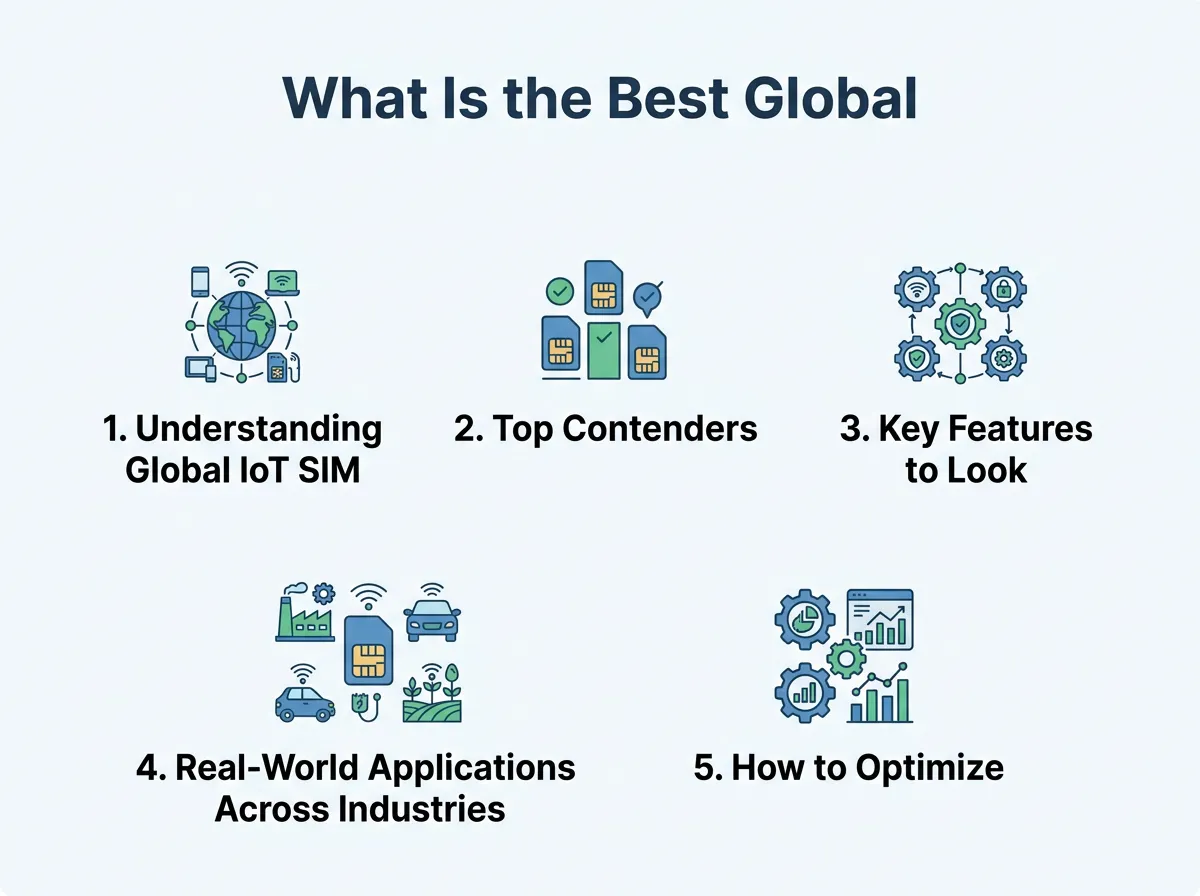
What Is the Best Global IoT SIM Card? — key points at a glance
Hologram IoT
Hologram is one of the most popular choices for businesses looking for flexible, developer-friendly connectivity. Their global SIM card offers access to more than 550 carriers across more than 200 countries. Their dashboard is highly praised for its clean user interface, making it easy to activate, pause, or monitor devices in seconds. If you want to know more about what to look for in a partner, you can read their guide on how to choose an IoT SIM card vendor to help make your decision easier.
EMnify
EMnify is a cloud-native provider that integrates deeply with major cloud services like AWS and Azure. This makes them a fantastic choice for developers who want to feed their IoT data straight into their existing cloud infrastructure. They offer superb security tools, including private network pathways that keep your device data away from the public internet.
BNESIM
For startups and businesses looking to test their products quickly, BNESIM offers highly competitive pay-as-you-go plans. They focus on minimizing the friction of global deployment. You can learn more about how they compare by looking at options for international global IoT SIM card M2M startups online. They are known for providing excellent coverage across Europe and Asia with very simple activation steps.
Key Features to Look For When Choosing
When you are comparing providers to find the best global IoT SIM card, you should look beyond just the raw price per megabyte of data. Here are the technical features that will save you time and money in the long run.
eUICC and eSIM Capabilities
In the past, if you wanted to change your network provider, you had to physically remove the SIM card from every device and insert a new one. This is a nightmare if your devices are already deployed in the field. Modern cards use eUICC (Embedded Universal Integrated Circuit) technology. This allows you to send new carrier profiles to the SIM card over the air. It future-proofs your hardware and keeps you from being locked into a single vendor forever.
Management Console and API Access
You cannot manually manage a fleet of five hundred devices. You need a centralized platform that lets you see everything at a glance. The best providers offer robust APIs. This allows your software developers to write code that automatically activates SIMs, monitors data limits, and flags any unusual device behavior.
Advanced Security Features
IoT devices are frequent targets for hackers. To protect your network, look for a provider that offers private APNs (Access Point Names) and static IPs. You should also ensure the platform supports IMEI locking. This feature ensures that if a physical SIM card is stolen out of your device, it cannot be used in a phone or laptop to steal your data.
Real-World Applications Across Industries
Different industries have wildly different data needs. The ideal SIM for a smart water meter will not be the same as the one used in a self-driving delivery robot. Understanding which sectors are the IoT SIM cards used in can help you identify where your own business fits.
Logistics and Asset Tracking
In logistics, devices are constantly moving across national borders. Here, seamless global roaming is the number one priority. The best SIM cards for tracking must support rapid network switching to avoid gaps in location data as trucks move between cellular towers.
Smart Agriculture
Agricultural sensors are often placed in highly remote areas where cellular coverage is weak. These devices need low-power networks like LTE-M or NB-IoT. These technologies allow the devices to send small bursts of data over long distances while preserving battery life for years.
Retail and Point of Sale (POS)
Modern cash registers and vending machines rely on steady internet access to process credit card payments. For these stationary devices, the best global IoT SIM serves as a backup connection. If the store’s main Wi-Fi goes down, the cellular SIM instantly kicks in, preventing lost sales.
How to Optimize Your IoT Costs
Data costs can quickly spiral out of control if you do not plan ahead. Fortunately, the best IoT providers offer flexible pricing models designed to save you money.
Understanding Pooled Data Plans
In a standard consumer plan, if one device goes over its limit, you pay a heavy fine. In the IoT world, you should look for pooled data plans. If you have 100 devices that each get 10 megabytes of data, your total pool is 1,000 megabytes. If one device uses 20 megabytes while another uses only 2, the total stays within the limit, and you avoid overage fees.
Avoiding Hidden Roaming Fees
Some providers offer cheap rates but charge massive fees when your devices roam onto certain networks. Always read the fine print. Ensure that the countries your devices will visit are included in your provider’s standard zone rates.
Conclusion
There is no single “perfect” card that fits every scenario, but finding the best global IoT SIM card comes down to understanding your deployment footprint, security needs, and scaling plans. For global flexibility, look for eUICC-enabled cards from trusted providers like Hologram or EMnify. By focusing on multi-carrier coverage, a strong management platform, and pooled data pricing, you can keep your devices connected safely and affordably anywhere in the world.
Frequently Asked Questions
What is the difference between a global IoT SIM and a regular SIM?
A global IoT SIM is built for machines and can connect to multiple cellular networks in different countries automatically. It also features industrial-grade physical durability and offers a central dashboard to manage thousands of devices at once.
Can I use a regular phone SIM card for IoT devices?
While a regular SIM card might work for a quick prototype, it is not recommended for commercial deployments. Consumer SIMs lack the rugged build, long lifespans, multi-network roaming, and advanced security features that professional IoT projects require.
What is eUICC in IoT SIM cards?
eUICC is a technology that allows you to change network providers over the air without physically swapping the SIM card. This makes it easy to update your carrier profiles remotely, saving you massive logistical headaches as your business grows.
How much data do IoT devices typically use?
Data usage varies wildly depending on the device type. A smart utility meter might only use a few kilobytes of data per month, while a live video security camera can easily consume several gigabytes of data every single day.
What is a pooled data plan?
A pooled data plan combines the data allowances of all your active devices into a single shared pool. This prevents you from paying expensive overage fees if a few of your devices use more data than expected while others use less.
Do global IoT SIM cards work in remote areas?
Yes, global IoT SIMs are excellent for remote areas because they can hop between different network providers. If one carrier has no coverage in a specific rural zone, the SIM will automatically search for and connect to another partner network.
