



The best wireless vibration sensor depends on your specific industrial needs, but leading options like the Tractian Smart Trac, SKF QuickCollect, and Erbessd Phantom offer top-tier reliability. These advanced tools track machine health in real time, helping you prevent costly downtime through smart automated alerts. For overall ease of use and deep AI diagnostics, Tractian and SKF stand out as industry leaders.
Imagine walking onto a busy factory floor. The machines hum. The air is warm. Everything seems perfect. Then, without any warning, a critical motor stops working. The loud hum turns into silence. Your team rushes to fix it. This sudden stop costs your business time, peace of mind, and thousands of dollars.
Many plant managers live with this fear every single day. They want to catch machine problems before they happen. If you want to keep your factory running, you need the right tools. You might wonder, “What Is the Best Wireless Vibration Sensor?” to help you solve this issue.
This article will guide you through the process of picking the right sensor. We will look at what makes these small tools so powerful. We will also review the top choices on the market. By the end, you will know exactly how to protect your gear and keep your operations running smoothly.
Key Takeaways
- Match the sensor to your environment: Ensure your sensor has a high IP rating like IP67 to resist water, dust, and harsh conditions.
- Frequency range is critical: Choose a sensor that matches your machinery speed, using high-frequency models for gears and low-frequency ones for slow fans.
- Prioritize long battery life: Look for smart sensors with a battery life of three to five years to keep maintenance costs low.
- Consider triaxial sensing: Multi-axis sensors capture detailed vibration data in three directions for a more complete diagnostic picture.
- Leverage smart software: The best sensors offer intuitive mobile apps and cloud dashboards with automated predictive alerts.
📑 Table of Contents
Understanding Wireless Vibration Sensors
Before we find the perfect device, we should look at how they work. These small gadgets act like tiny doctors for your machines. They listen to the heartbeat of your equipment so you can fix issues early.
How Do They Work?
Every machine shakes a little bit when it runs. This shaking is called vibration. When a machine is healthy, its vibration has a steady, predictable pattern. But when a bearing wears out, the pattern changes. The sensor feels this change. It uses a small chip to measure the movement. Then, it sends this data over the air to your computer or phone.
Why Wireless Over Wired?
Wired systems are good, but they are hard to install. You must run long cables through hot, dirty, and dusty areas. This takes a lot of time. It also costs a lot of money. Wireless sensors solve this. You just stick them on your machine with a magnet or glue. They are fast to set up. They also fit into tight spots where wires cannot go. You can find out more by reading about highly accurate wireless vibration monitoring systems online.
Key Features of the Best Sensors
Not all sensors are the same. Some are simple, while others are very advanced. When you look for the best wireless vibration sensor, you must check a few important details.
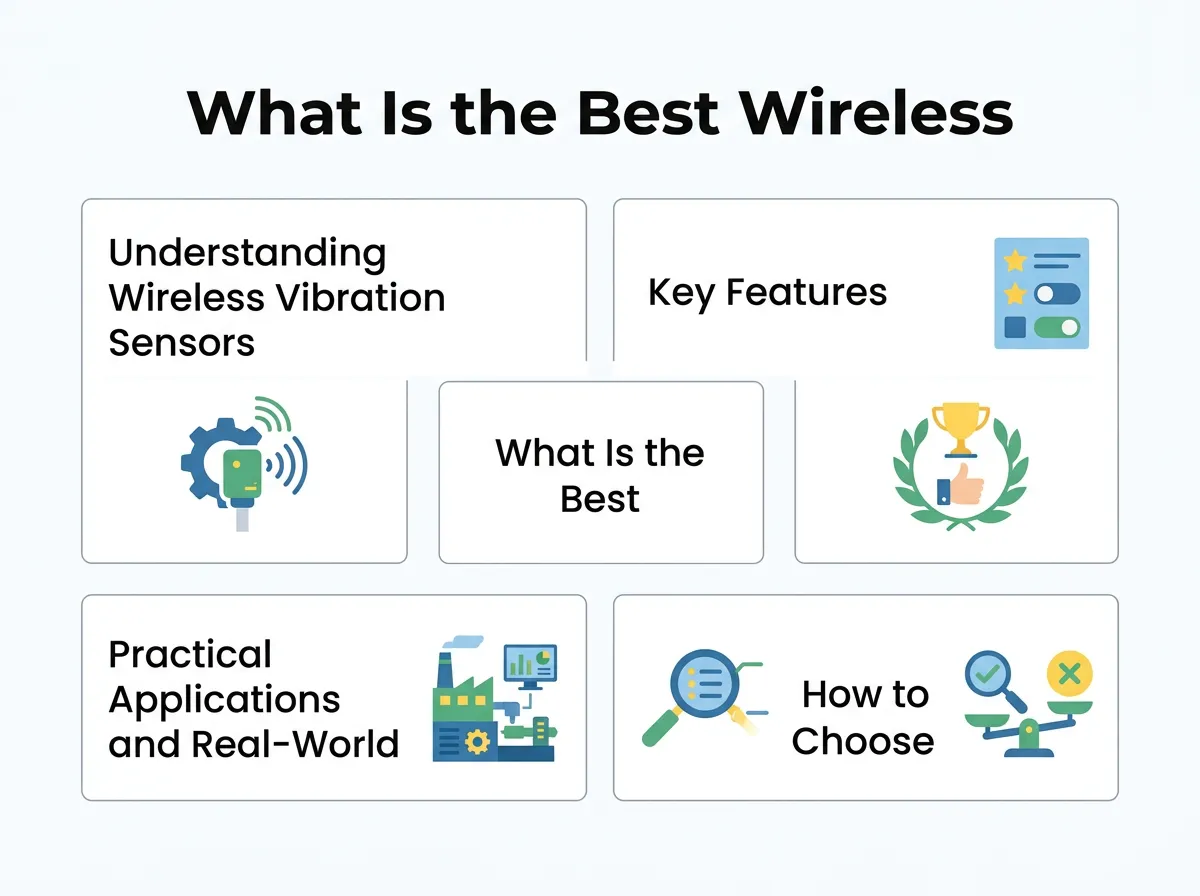
What Is the Best Wireless Vibration Sensor? — key points at a glance
Frequency Range
Frequency is how fast something shakes. Some machines run very slowly, like giant cooling fans. Other machines run very fast, like high-speed turbines. You must match your sensor to your machine speed. A good sensor can measure both high and low speeds. This ensures you do not miss any warning signs.
Battery Life
You do not want to change batteries every week. That would take too much work. The best sensors are very smart. They sleep most of the time. They wake up once an hour to take a quick reading, then go back to sleep. This smart design makes the battery last for three to five years. It keeps your maintenance costs very low.
Signal Range and Connectivity
Your sensor must send its data to your computer. It needs a strong signal to do this. Some sensors use Bluetooth. Bluetooth only works if you are close by. Others use Wi-Fi or LoRaWAN. LoRaWAN is great for big plants. It can send signals through thick concrete walls and across long distances easily.
What Is the Best Wireless Vibration Sensor? Our Top Picks
Now we can answer the main question. What Is the Best Wireless Vibration Sensor for your business? Let us look at the top three options available today.
Tractian Smart Trac
The Tractian Smart Trac is highly popular because it is so easy to use. You do not need to be an IT expert to set it up. You just stick it on your machine. The software uses smart artificial intelligence to analyze the data. It sends an alert directly to your phone when something goes wrong. It even tells you what part is failing. If you want to compare more tools, you can read about vibration sensors for machine monitoring to see how they perform in real-world settings.
SKF QuickCollect
SKF is famous for making high-quality bearings. They also make great sensors. The SKF QuickCollect is a small and tough device. It connects to your phone or tablet using Bluetooth. It is perfect for teams who walk around the plant to check machines. It gives you instant green, yellow, or red lights to show if the machine is okay. You can learn more about industry-grade SKF vibration sensors to see how they fit into a professional maintenance plan.
Erbessd Phantom
The Erbessd Phantom is another top choice. It is a triaxial sensor. This means it measures vibration in three different directions at the same time: up-and-down, side-to-side, and front-to-back. This gives you a very detailed look at your machine health. It also measures temperature at the same time. This is a great choice for complex machines that run at high speeds.
Practical Applications and Real-World Examples
How do these sensors help in real life? Let us look at two simple examples of how they save money and keep workers safe.
Saving a Factory Water Pump
A clean water plant installed wireless sensors on its main pumps. One day, the sensor on Pump B sent a warning. The vibration was slightly higher than usual. The team checked the dashboard. The system predicted a bearing failure in ten days. The team ordered a new bearing. They changed it during a quiet weekend shift. The pump never stopped running, and the town kept its clean water.
Safe Monitoring on High Roofs
Many factories have cooling towers on their roofs. These towers have big fans that vibrate over time. Sending a worker up a tall ladder to check them is dangerous. By using wireless sensors, the team can check the fan health from their desks. This keeps workers safe and prevents unexpected plant shutdowns.
How to Choose the Right Sensor for Your Facility
Are you still thinking, “What Is the Best Wireless Vibration Sensor?” If so, here are a few tips to help you decide.
Know Your Environment
Is your plant wet, dusty, or very hot? You need a tough sensor. Look for an IP67 rating. This means the sensor can handle dust and splashes of water. If you work in a chemical plant, you may need an intrinsically safe sensor. These sensors will not cause sparks in dangerous areas.
Check Your Budget
Think about the total cost. This includes the price of the sensor, any hubs you need, and the software fee. A cheap sensor might seem great at first. But if the software is hard to use, you will waste time. Sometimes, spending a little more on a smart system saves you more money over time because it finds faults faster.
Conclusion: Making Your Final Decision
Finding the right tool does not have to be hard. The best wireless vibration sensor is the one that meets your unique needs and budget. If you want smart AI alerts and fast setup, look at Tractian. If you want a small, trusted tool for walk-by checks, SKF is perfect. If you need deep data from three angles, go with Erbessd.
Do not wait for a machine to break down. Start protecting your gear today. A good wireless sensor will give you peace of mind and keep your business moving forward.
Frequently Asked Questions
How long do wireless vibration sensor batteries last?
Most high-quality wireless vibration sensors have a battery life of three to five years. They save power by staying asleep and only waking up to take scheduled readings. This ensures they do not require constant maintenance or frequent battery swaps.
Can wireless vibration sensors work in wet conditions?
Yes, many sensors are designed for harsh environments. Look for devices with an IP67 or IP69K rating, which means they are fully waterproof and dustproof. This makes them perfect for food processing or outdoor plants.
What is a triaxial vibration sensor?
A triaxial sensor measures vibration in three different directions at the same time. It tracks up-and-down, side-to-side, and front-to-back movements. This gives you a much more complete picture of machine health than a single-axis sensor.
How do wireless sensors send data?
Wireless vibration sensors use different radio signals to send data. Common options include Bluetooth for short distances, and Wi-Fi or LoRaWAN for longer distances. Some advanced sensors can even send data directly via cellular networks.
Do I need software to use these sensors?
Yes, almost all modern wireless sensors require a software platform to view and analyze the data. This software often uses artificial intelligence to predict machine failures before they happen. Many brands offer both mobile apps and desktop dashboards.
Can these sensors be used on any machine?
They can be used on almost any rotating machinery, such as motors, pumps, fans, and gearboxes. However, you must ensure the sensor’s frequency range matches the speed of the machine you want to monitor. Slow-moving machines require specialized low-frequency sensors.
