


The recommended multi-network SIM for IoT is an eUICC-enabled eSIM or a robust non-steered roaming SIM that automatically connects to the strongest available network. These advanced SIMs offer global coverage, eliminate single carrier points of failure, and simplify international device deployments. By utilizing carrier-agnostic technology, businesses can ensure their smart devices stay online across borders without the need for manual physical swaps.
Imagine you launch a fleet of smart trackers. Your devices leave the warehouse. They head across the country. Suddenly, half of them go offline. They hit a spot where your network has no signal. Your customers get angry. This is a nightmare for any smart tech project.
A reliable connection is key for smart devices. If your hardware cannot connect to the cloud, it is useless. That is why many business owners ask: What Is the Recommended Multi-Network SIM for IoT? The answer is not just one brand. It is a smart type of card that keeps your devices online anywhere.
In this guide, we will look at the best choices for your projects. We will explain how these special cards work. You will learn what features you need. By the end, you will know how to choose the right tech for your hardware. Let us dive in and look at the options.
Key Takeaways
- Uptime Redundancy: Multi-network SIMs prevent costly downtime by switching carriers automatically if one network fails.
- eUICC Technology: This standard allows you to update carrier profiles over-the-air without swapping physical cards.
- Non-Steered Performance: Non-steered SIMs do not have preferred networks, ensuring your devices always connect to the strongest signal.
- Global Logistics: Utilizing a single global SIM simplifies your manufacturing process and cuts down on inventory management.
- Centralized Control: The best SIM solutions come with an easy-to-use management platform to track data use in real time.
📑 Table of Contents
Understanding Multi-Network SIMs for Smart Devices
A standard phone SIM connects to just one network. If you use a major network, your phone stays on it. When you enter a dead zone, you lose signal. This setup does not work for smart devices. A smart meter in a basement cannot stop to find a signal. It needs to work all the time. It must connect no matter where it is.
How Multi-Carrier SIMs Work
Multi-network SIMs can connect to many different cell networks. They do not rely on just one provider. Instead, they scan the area for the strongest signal. If one network goes down, the SIM switches to another. This happens in seconds. Your device stays online, and your data keeps moving. You can learn more about how multi-carrier SIMs function to see how this works.
This auto-switch feature is vital for assets on the move. Think about delivery trucks, scooters, or wearable tech. It is also great for fixed devices. A smart security camera might be in a spot with weak coverage from one carrier. A multi-network SIM solves this by picking the strongest network in that exact spot.
What Is the Recommended Multi-Network SIM for IoT?
When searching for What Is the Recommended Multi-Network SIM for IoT?, you will find a few main types. The best choice depends on where your devices go. Let us look at the top options today.
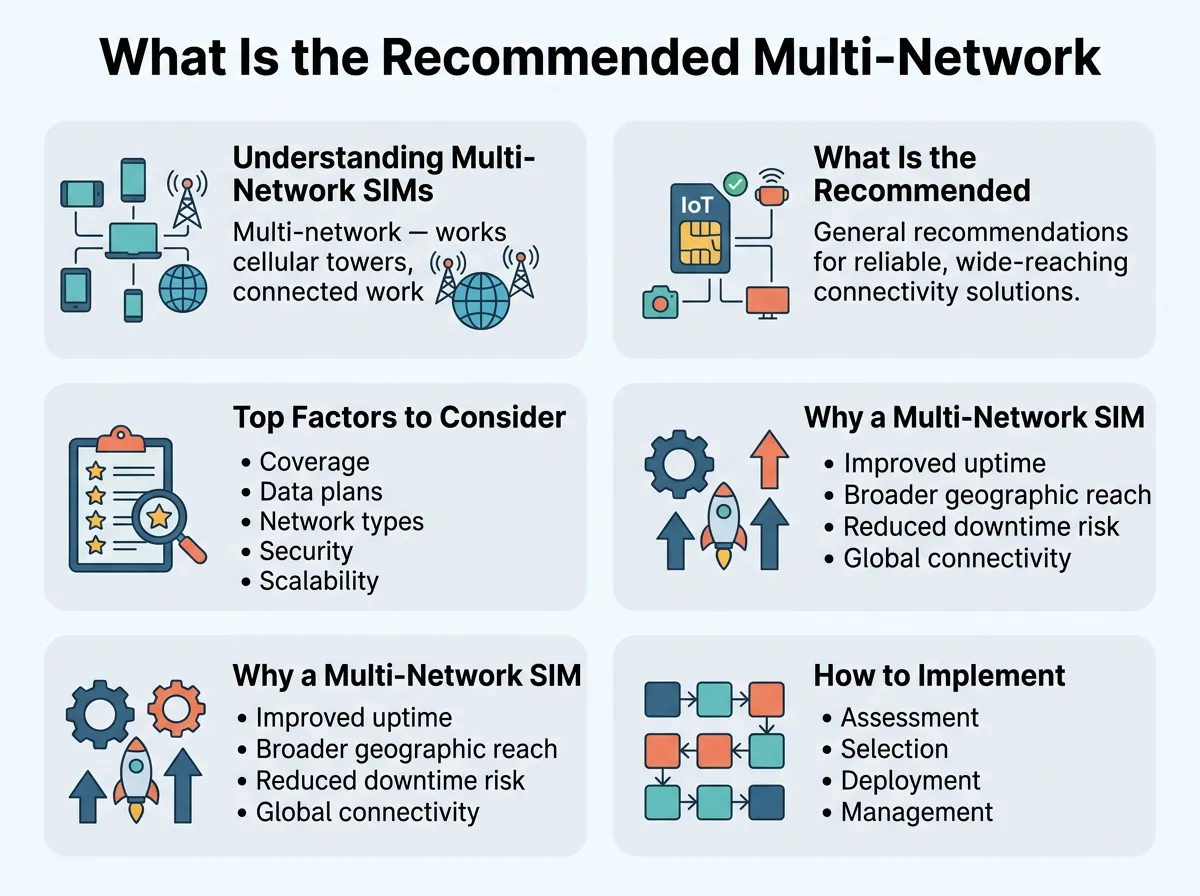
What Is the Recommended Multi-Network SIM for IoT? — key points at a glance
The Power of eUICC and eSIMs
The most recommended setup today uses eUICC technology. It stands for Embedded Universal Integrated Circuit Card. Do not worry about the complex name. It just means the SIM can hold multiple carrier profiles. You can change your network provider over the air. You do not have to swap the physical plastic card.
With standard SIMs, changing providers means you must swap cards. Imagine doing that for ten thousand smart meters. It would cost too much money. With eUICC, you push a software update, and the new profile installs. This is why many experts suggest choosing between eSIMs and traditional global SIMs based on how long your hardware will stay in the field.
Non-Steered Roaming SIMs
So, What Is the Recommended Multi-Network SIM for IoT if you need constant uptime? The answer is a non-steered roaming SIM. Some multi-network SIMs are steered. They prefer one partner network even if the signal is weak. They only switch when that network drops completely. A non-steered SIM has no favorites. It always connects to the strongest signal. For critical projects, non-steered SIMs are the best choice.
Top Factors to Consider When Choosing Your IoT SIM
Finding the right SIM requires looking at more than just the price. You must think about your specific use case. Here are the key factors you should check.
Coverage and Network Types
Not all multi-network SIMs cover the same areas. Some focus on North America. Others offer global coverage across many countries. You must match the SIM’s coverage with your market. Also, consider the network types. Does your device use 4G, 5G, or low-power networks like LTE-M and NB-IoT? Make sure your SIM provider supports these low-power options. They are vital for battery-powered devices. You can read everything to know about IoT SIMs to see how these network types affect your hardware.
Platform Management and API Integration
When you have thousands of active devices, management is a big task. The best SIM providers give you a central dashboard. This platform lets you active, pause, and monitor your SIMs in real time. You can set up alerts for high data use. This helps you avoid surprise bills. Good API support is also vital. It lets you link the SIM management platform directly with your own company software.
Why a Multi-Network SIM Outperforms Traditional SIMs
You might wonder if the extra effort is worth it. Why not just buy bulk SIMs from a local carrier? The benefits of multi-network options go far beyond simple coverage. They change how you run your business.
Avoiding Carrier Lock-In
When you sign a contract with one carrier, you are locked in. If they raise prices, you have few options. If their network goes down, your business stops. A multi-network SIM keeps you free. If you ask yourself, What Is the Recommended Multi-Network SIM for IoT to avoid carrier lock-in? The answer is a platform that lets you switch carriers easily. If a carrier’s service quality drops, you can route your traffic through other networks. This keeps your business safe.
Easy Manufacturing and Logistics
If you sell smart products globally, logistics can be hard. Without a multi-network SIM, you must install different SIM cards for different countries. This creates complex inventory rules. With a global multi-network SIM, you install the exact same card in every device at the factory. The device activates and connects to the local network when your customer turns it on. It does not matter where they are in the world.
How to Implement the Right Solution for Your Business
Ready to get started? Do not rush out and buy thousands of SIMs right away. Follow a structured approach to ensure success.
Testing with Pilot Runs
Always start with a small test batch. Before asking What Is the Recommended Multi-Network SIM for IoT for your bulk order, make sure to test first. Order five to ten test SIMs from your chosen provider. Put them in your devices and test them in real-world conditions. Take them to areas with poor coverage. Monitor how quickly they switch networks. Check if the data usage matches what the dashboard displays. This test phase helps you catch any hardware or software compatibility issues before you spend a lot of money.
Keep in mind that your device’s antenna also plays a big role in connection quality. A great SIM cannot save a device with a weak antenna. Use the pilot run to test both the hardware and the network connectivity together. Once you are sure everything works, you can launch your full fleet with confidence.
Conclusion
So, What Is the Recommended Multi-Network SIM for IoT? The best choice is a non-steered, eUICC-enabled eSIM from a provider that offers a robust management platform. This setup gives you ultimate flexibility. It keeps your devices online and saves you money in the long run. By investing in the right connectivity today, you build a strong foundation for your smart projects. Your devices will stay connected, your customers will stay happy, and your business can grow without limits.
Frequently Asked Questions
What is a multi-network SIM for IoT?
A multi-network SIM is a cellular card designed for smart devices that can connect to multiple carrier networks. Instead of locking into one network provider, it automatically switches to the strongest local signal available. This keeps your hardware online even if one carrier suffers a localized outage.
How does a multi-network SIM switch networks?
The switching process is controlled by pre-programmed rules on the SIM card itself. When the primary network signal drops below a specific threshold, the SIM scans for other partner networks in the area. It then connects to the strongest available network in just a few seconds.
What is the difference between steered and non-steered SIMs?
A steered SIM will always prefer to connect to a specific partner network, even if its signal is very weak. A non-steered SIM does not have favorites and connects to the best available network instantly. For critical smart device projects, non-steered SIMs are highly recommended.
Why is eUICC important for smart device fleets?
eUICC is a technology that allows you to change network profiles over-the-air without swapping the physical SIM card. This is essential for large deployments because it saves the immense cost of manual card replacements. It allows your fleet to stay in the field for years while keeping your carrier choices flexible.
Do global multi-network SIMs prevent permanent roaming issues?
Yes, many high-quality multi-network SIM providers offer local bootstrap profiles to bypass permanent roaming blocks. This is vital because some countries restrict foreign SIM cards from roaming on local networks for more than 90 days. The right eSIM platform can update your device with a local profile to keep you compliant.
Can I monitor data usage on these SIM cards?
Yes, recommended multi-network SIM providers offer a unified management platform to view all your devices in one place. These dashboards let you monitor data consumption, set alerts, and pause active SIM cards instantly. This direct control prevents unexpected bills and helps you manage data pools efficiently.
