


The recommended eUICC SIM for IoT is a multi-carrier, platform-agnostic solution like the Hologram Hyper or floLIVE eUICC SIM, which offer seamless global coverage and over-the-air (OTA) provisioning. These cards prevent vendor lock-in by letting you switch network profiles remotely. Choosing the right one depends on your specific coverage needs, data pricing plans, and management platform preferences.
Have you ever had to change thousands of plastic SIM cards by hand? If you run an IoT business, this is your worst nightmare. Imagine your devices are scattered all over the globe. They are in smart water meters. They are on trucks as tracking devices. They are even in medical monitors. Suddenly, your cellular carrier raises their prices. Or maybe their signal goes completely dark in one region. Swapping those physical cards would cost a fortune. It might even ruin your business.
This is why smart businesses are asking: What Is the Recommended eUICC SIM for IoT? They want a single SIM that can change its behavior without anyone touching it. In this guide, we will break down the absolute best options on the market. We will look at how this technology works. We will also help you choose the perfect fit for your specific project.
By the end of this article, you will know exactly how to choose your connectivity partner. You will understand how to keep your devices online for years to come. Let us dive in and explore how this amazing technology can save your business time and money.
Key Takeaways
- No Vendor Lock-In: An eUICC SIM lets you switch network operators remotely without physical card swaps.
- Global Flexibility: Highly recommended options like Hologram and floLIVE connect to hundreds of networks worldwide.
- Form Factors: You can get eUICC technology on standard plastic cards or soldered MFF2 chips.
- Lower Operating Costs: By managing profiles over the air, you eliminate the need for manual truck rolls.
- Future-Proofing: Keep your IoT devices online for a decade or more by updating profiles as cellular standards evolve.
📑 Table of Contents
What Is an eUICC SIM and Why Does It Matter for IoT?
Let us start with the basics. What does eUICC stand for? It stands for Embedded Universal Integrated Circuit Card. Do not let the long name scare you. It is just a smart piece of software. It can run on a physical plastic card or a chip soldered onto a board.
To truly understand how this changes the game, it helps to read a simple guide on eUICC for IoT and how it differs from older tech. Traditional SIM cards only hold one carrier profile. If you buy a SIM from Carrier A, that card only connects to Carrier A. If you want to switch to Carrier B, you must physically swap the card. That is highly impractical for thousands of deployed devices.
An eUICC SIM is different. It acts like a tiny, secure computer. It can hold multiple carrier profiles at the same time. You can swap these profiles over the air. This process gives you ultimate control over your devices. It ensures you are never stuck with a single carrier forever.
The Difference Between eSIM and eUICC
People often mix up “eSIM” and “eUICC.” They are not quite the same thing. eSIM refers to the hardware. It is the physical chip soldered onto the device board. It is very small and helps save space.
On the other hand, eUICC is the software that runs on that chip. You can actually get eUICC software on a standard plastic card. It comes in all sizes, like micro and nano. This means you do not need new hardware to use eUICC features. You can use standard SIM slots and still enjoy remote switching.
How Over-the-Air (OTA) Provisioning Works
How does this profile swap happen? It happens through Over-the-Air (OTA) updates. Your device gets a signal from a cloud platform. The platform tells the SIM to download a new profile. The SIM downloads the profile securely. It then switches to the new network. Your device never has to go offline for long. Nobody has to visit the device in person. This saves you high maintenance fees.
Key Features of the Recommended eUICC SIM for IoT
What makes one eUICC SIM better than another? Not all of them are created equal. When searching for the best eUICC SIM for IoT, you need to look for specific features. These features will ensure your devices stay connected reliably.
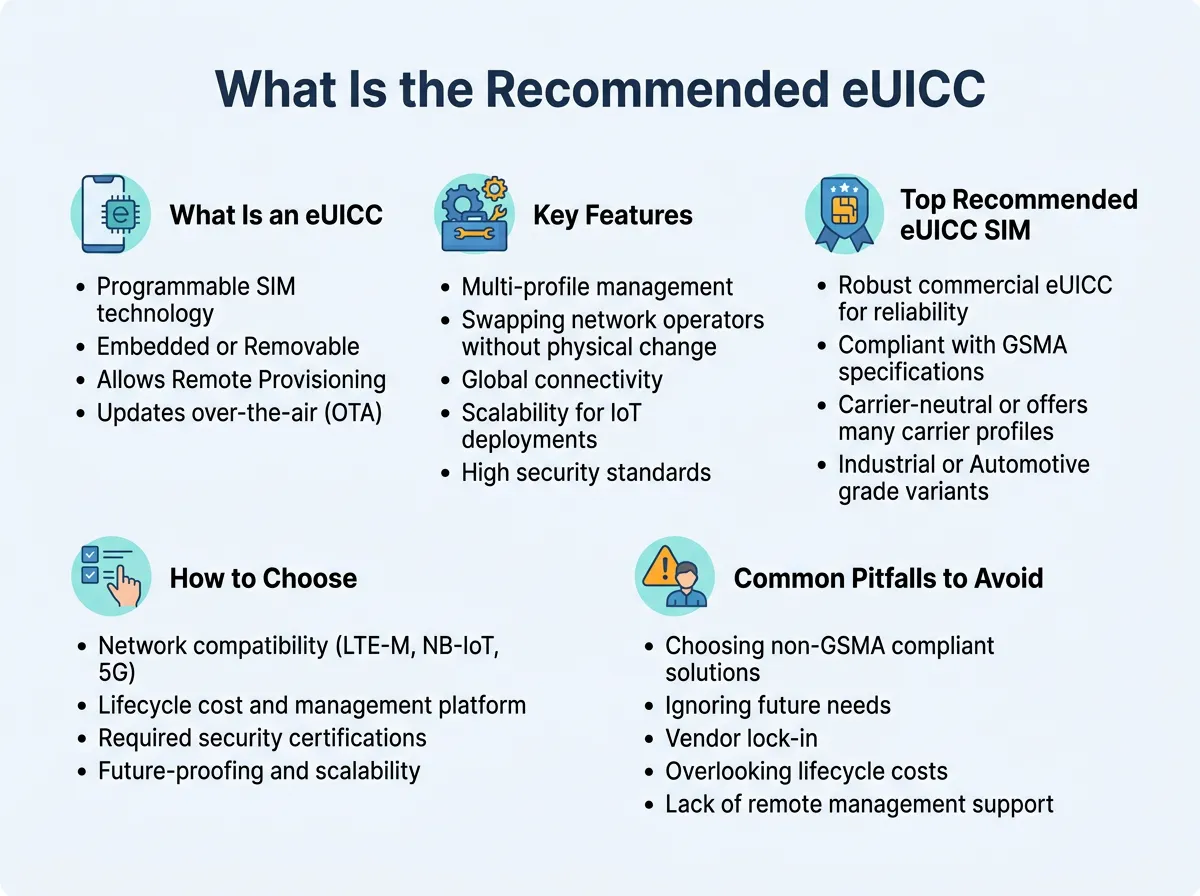
What Is the Recommended eUICC SIM for IoT? — key points at a glance
Multi-Carrier Access and Failover
The best SIMs connect to many networks out of the box. They do not just rely on one partner. If a network tower goes down, the SIM should switch to another. This is called automatic failover. It keeps your devices online 24/7. It is vital for critical applications like security systems or medical monitors.
Remote Profile Management
You need a simple portal to manage your profiles. If you have to write complex code to switch networks, it defeats the purpose. The recommended SIMs come with a clean dashboard. You can click a button to change profiles on thousands of devices at once. You can also automate these changes based on the device’s location.
Security Features
Security is vital for IoT. Hackers love to target connected devices. The recommended eUICC SIM for IoT has built-in security features. They encrypt your data as it travels. They also prevent unauthorized people from changing the SIM profiles. This keeps your data and your devices safe from bad actors.
Top Recommended eUICC SIM Providers to Consider
Now, let us look at the actual products. Which ones should you buy? Here are the top industry-leading options that experts recommend.
Hologram Hyper
Hologram is a massive name in cellular IoT. Their flagship product is the Hologram Hyper eUICC SIM card, which gives you access to hundreds of networks globally. It switches carriers smoothly when your devices cross borders. This prevents any gaps in your data tracking.
Hologram also offers a great management platform. You can monitor data usage in real-time. You can set up alerts to prevent bill shock. It is an excellent choice for fleets and logistics businesses that need to scale fast.
floLIVE Global Solutions
If you need highly reliable local coverage across the globe, look at floLIVE. They own a massive global network. You can explore their features and see why they rank highly among the best eUICC SIM options for smart devices today. They specialize in high-performance connectivity.
floLIVE excels because they offer local IMSIs. This helps you avoid strict roaming laws in countries like Brazil or Turkey. Their platform acts as a single pane of glass for all your global connections. It is highly recommended for multinational deployments.
1NCE Flat Rate
1NCE offers a unique pricing model. They charge a flat rate for ten years. This is perfect for low-data devices like smart utility meters. Their eUICC software makes it easy to deploy devices globally without worrying about monthly bills. It is simple, highly predictable, and very budget-friendly.
How to Choose the Best eUICC SIM for Your Project
So, what is the recommended eUICC SIM for IoT for your specific case? Choosing a SIM is not just about picking a famous brand. You must look at your own project needs. Here are some tips to help you decide.
Evaluate Coverage and Roaming Agreements
Where will your devices live? Make sure the provider has strong roaming agreements there. Some regions have strict laws against permanent roaming. In those areas, you need a provider that can load a local profile. This keeps you compliant with local telecommunication laws.
Analyze the Total Cost of Ownership (TCO)
Do not just look at the upfront cost of the SIM card. Look at the data rates. Ask about transition fees. Do they charge you every time you download a new profile? These small fees can add up quickly. A cheap SIM might end up costing more in the long run if profile swaps are expensive.
Look at the Management Platform API
Your team will need to connect the SIM platform to your own software. Ensure the provider has a robust and friendly API. The documentation should be clear and easy to read. A good API allows you to automate profile changes directly from your own software systems.
Common Pitfalls to Avoid with eUICC Deployments
Even the best technology has some traps. Here is what to watch out for before you make a major purchase.
Hidden Bootstrap Profile Costs
When you first turn on a device, it uses a “bootstrap” profile. This profile connects the device to the cloud so it can download its main operational profile. Some companies charge high rates for this initial bootstrap connection. Always check the fine print to avoid surprise charges on your first bill.
Hardware Compatibility Issues
Some older cellular modules do not support eUICC commands. Before you buy 5,000 SIMs, test them. Get a small developer kit. Make sure your hardware and the eUICC software talk to each other without errors. Testing early saves you from massive hardware headaches later.
Conclusion
Finding the recommended eUICC SIM for IoT is about planning for the future. It gives you the freedom to scale your business. You do not have to worry about carrier lock-in. You do not have to worry about changing physical cards. Solutions like Hologram Hyper and floLIVE offer amazing flexibility. They keep your devices connected, no matter where they travel. Start small, test your hardware, and choose a partner that matches your data needs. Your future self will thank you for making the smart switch today.
Frequently Asked Questions
Can I use a normal phone SIM for IoT devices?
No, you should not use normal phone SIM cards for IoT. Phone SIMs lack the rugged hardware needed for tough environments and do not support remote eUICC profile switching. They also have different data pricing that can become very expensive for IoT deployments.
How does an eUICC SIM save money?
It saves money by preventing vendor lock-in and avoiding manual card replacements. You can switch to a cheaper network operator remotely without physically swapping cards. It also lets you use a single product version for global shipping, which lowers manufacturing costs.
What is the difference between eSIM and eUICC?
An eSIM refers to the physical chip soldered onto the device’s circuit board. In contrast, eUICC is the software technology that allows you to store and switch multiple carrier profiles. You can run eUICC software on both soldered chips and standard plastic SIM cards.
Does eUICC work anywhere in the world?
Yes, eUICC SIMs can work globally as long as your provider has roaming agreements in those countries. If a country bans permanent roaming, you can use eUICC to download a local carrier profile to stay compliant. This makes it the perfect solution for international shipping.
What is a bootstrap profile on an eUICC SIM?
A bootstrap profile is the initial network profile pre-loaded onto the SIM card. It acts as a temporary connection that allows the device to get online for the first time. Once online, the device can use this connection to download its main operational profile.
How many profiles can an eUICC SIM hold?
Most modern eUICC SIM cards can hold between 2 to 5 different carrier profiles at the same time. However, only one profile can be active and transmitting data at any given moment. You can swap between these stored profiles in just a few seconds.
